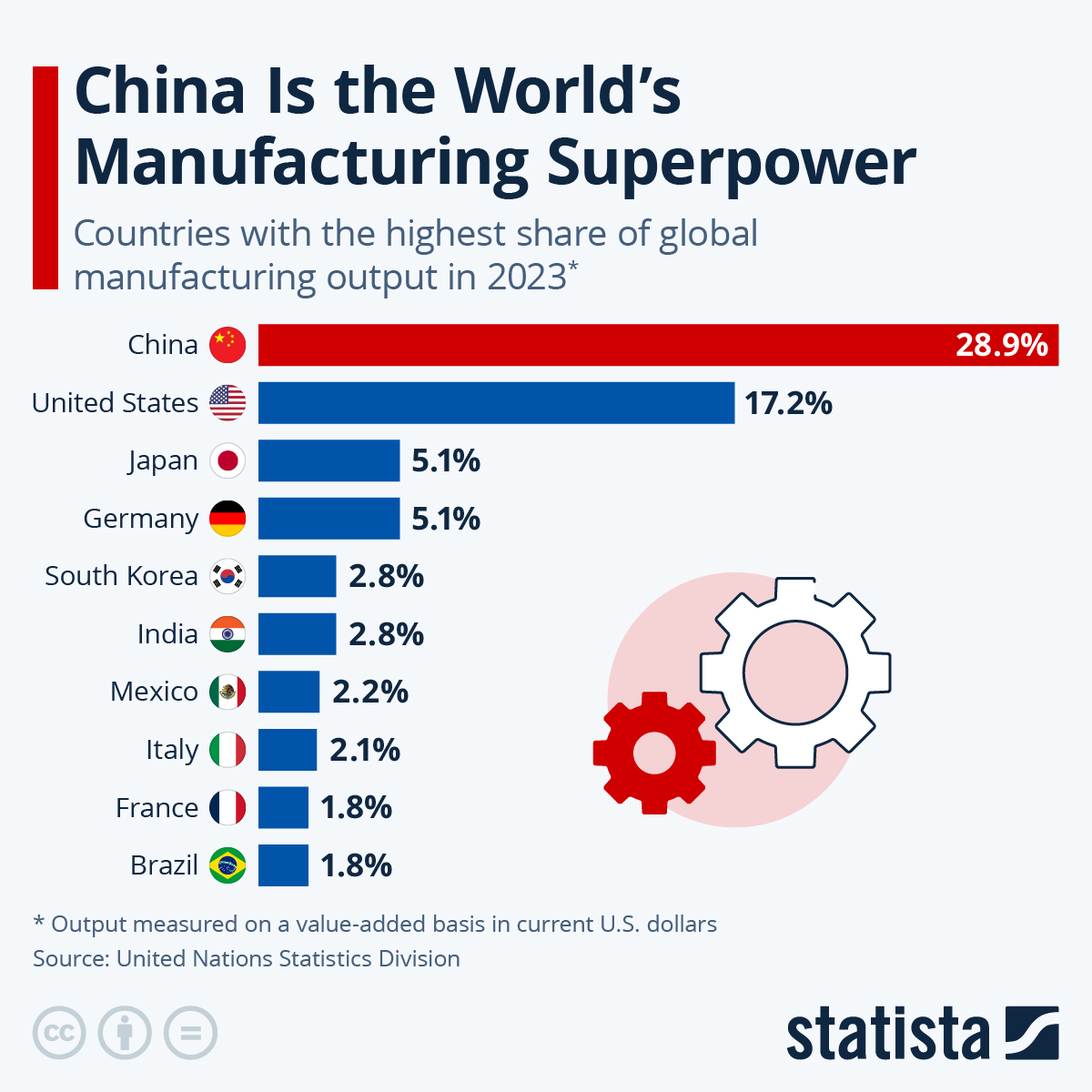
According to the United Nations Statistics Division, China accounted for 28.7 percent of global manufacturing output in 2019⁴. That puts the country more than 10 percentage points ahead of the United States, which used to have the world’s largest manufacturing sector until China overtook it in 2010⁴.
However, China’s manufacturing sector has faced some challenges in recent years, such as trade tensions, environmental regulations, rising labor costs, and the COVID-19 pandemic. These factors have affected the demand and supply of Chinese goods, as well as the competitiveness and profitability of Chinese manufacturers.
One indicator of the health of the manufacturing sector is the purchasing managers’ index (PMI), which measures the activity level of purchasing managers in the sector. A PMI above 50 indicates expansion, while a PMI below 50 indicates contraction.
According to official data from China’s National Bureau of Statistics, China’s manufacturing PMI unexpectedly shrank to 49.2 in October 2023, down from 50.6 in September 2023¹. This was the first time since July 2020 that the index fell below the 50-mark, signaling a slowdown in the recovery momentum of the sector¹.
The main reasons for the decline were weaker domestic and foreign demand, rising raw material prices, supply chain disruptions, and power shortages¹. Some analysts also attributed the drop to the impact of China’s crackdown on property developers and other high-risk sectors, which dampened business confidence and investment¹.
On the other hand, China’s non-manufacturing PMI also fell to 50.6 in October 2023 from 51.7 in September 2023¹, indicating a slowdown in activity in the vast service sector and construction industry¹. However, the index remained above 50 for the 22nd consecutive month, showing that these sectors still maintained expansion despite some headwinds³.
The non-manufacturing PMI covers services such as retail, aviation, software, real estate, logistics, and leisure, as well as construction activities such as infrastructure and housing. These sectors account for more than half of China’s GDP and employment, and are seen as key drivers of China’s economic transformation and consumption upgrade.
Therefore, while China’s manufacturing sector may face some challenges in the near term, its non-manufacturing sector may provide some support for its overall economic growth and stability.
Source:
(1) Explainer China manufacturing: everything you need to know. https://www.scmp.com/economy/china-economy/article/3114176/china-manufacturing-everything-you-need-know.
(2) China factory activity unexpectedly shrinks in Oct, dents recovery momentum. https://www.business-standard.com/world-news/china-factory-activity-unexpectedly-shrinks-in-oct-dents-recovery-momentum-123103101555_1.html.
(3) China’s non-manufacturing sector maintains expansion in October. https://www.ccfgroup.com/newscenter/newsview.php?Class_ID=800000&Info_ID=2023110130025.
(4) Explainer China manufacturing: everything you need to know. https://www.scmp.com/economy/china-economy/article/3114176/china-manufacturing-everything-you-need-know.
(5) Chart: China Is the World’s Manufacturing Superpower | Statista. https://www.statista.com/chart/20858/top-10-countries-by-share-of-global-manufacturing-output/.
(6) The 3 Industries Driving China’s Economy – Investopedia. https://www.investopedia.com/articles/investing/091515/3-industries-driving-chinas-economy.asp.
(7) There is no dependency on China in UAVs manufacturing, Optiemus Chairman says. https://www.thehindu.com/sci-tech/technology/there-is-no-dependency-on-china-in-uavs-manufacturing-optiemus-chairman-says/article67479516.ece.
(8) undefined. https://cdn.statcdn.com/Infographic/images/normal/20858.jpeg.
(9) undefined. https://www.statista.com/chartoftheday/.
 "Connecting communities, empowering nations: Unifying the Regional and Global Economy ."
Leave a comment