From Colonial Extraction to Neo-Geoeconomic Contestation
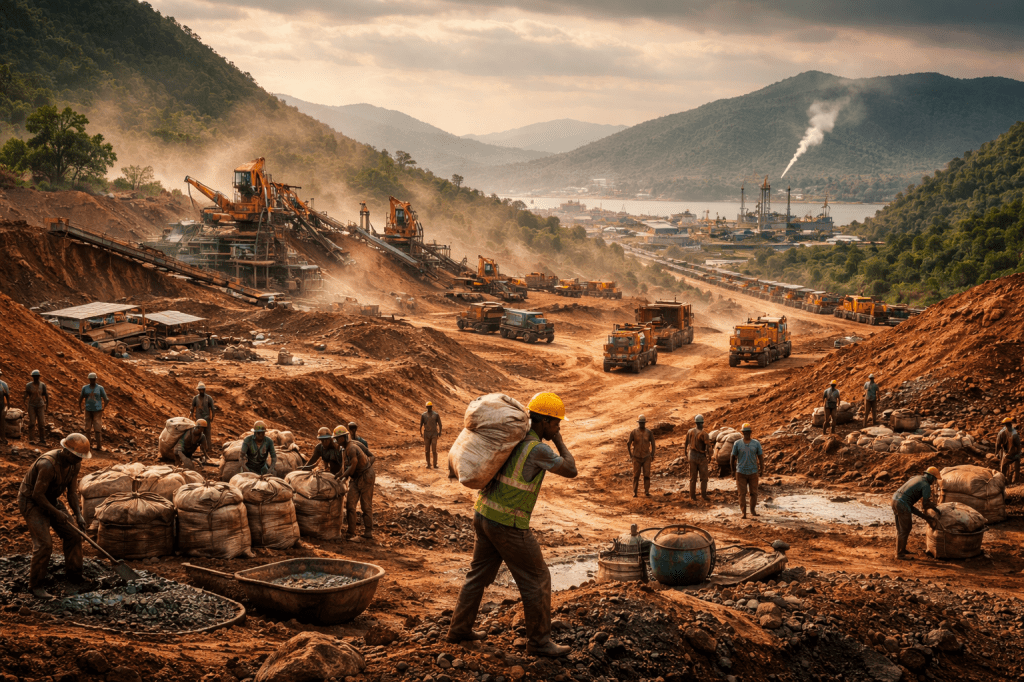
Africa’s resource story has historically oscillated between promise and paradox. From the colonial era’s extractive enclaves to post-independence attempts at resource nationalism, the continent has struggled to convert mineral wealth into broad-based industrialization. Today, this paradox is being reshaped—not resolved—by a new wave of global demand driven by energy transition minerals, rare earths, and strategic metals. Yet, beneath the surface of rising global interest lies a structural fragility: infrastructure deficits, environmental compromises, and political instability continue to constrain scalability. The stalled operations at Burundi’s Gakara rare earth mine are emblematic—not of failure alone, but of systemic constraints that persist across the continent.
Infrastructure Deficits as the Silent Constraint
The economics of mining in Africa is not merely about resource availability but about the cost of moving, processing, and exporting those resources. Weak transport corridors, unreliable power supply, and underdeveloped logistics networks convert otherwise viable mineral reserves into high-cost ventures. For instance, landlocked countries face disproportionately higher export costs, eroding competitiveness. The absence of integrated rail-port systems forces reliance on fragmented supply chains, often vulnerable to disruption. In this sense, Africa’s mining potential is not constrained by geology, but by geography and governance.
Environmental Trade-offs and the Development Dilemma
The global push for green energy paradoxically intensifies environmental pressures within resource-rich African regions. Mining for “green minerals” like cobalt and lithium often results in deforestation, water contamination, and displacement of local communities. Regulatory frameworks remain uneven, and enforcement is often weak, creating a trade-off between immediate economic gains and long-term ecological sustainability. The critical question is not whether Africa should mine, but how it can avoid becoming a sacrificial zone for global decarbonization ambitions.
Geopolitics and the Risk of a New Resource Dependency
The emerging geopolitical landscape introduces another layer of complexity. As major powers compete for critical minerals, African countries risk being locked into a new form of dependency—this time shaped by strategic supply chains rather than colonial trade routes. External pressures, including tariff regimes and trade policies, may incentivize the export of raw materials rather than value-added processing. For example, potential tariff structures imposed by developed economies could undermine local beneficiation efforts, even as African governments push for ownership mandates and domestic processing. This creates a structural contradiction: global markets demand raw material access, while domestic policy seeks industrial upgrading.
Conflict, Security, and the Geography of Instability
Resource-rich regions in Africa often overlap with zones of political fragility and conflict. The Democratic Republic of Congo, home to vast cobalt reserves, continues to grapple with armed conflict, illegal mining networks, and governance challenges. Similarly, instability in Sudan disrupts gold supply chains and deters long-term investment. These security risks introduce volatility not just for local economies but for global supply chains dependent on these resources. Investors face a dual risk—geological uncertainty and political unpredictability—making capital-intensive projects increasingly cautious and short-term oriented.
The Future: Between Resource Sovereignty and Industrial Transformation
Looking ahead, Africa stands at a critical inflection point. The next decade will determine whether the continent remains a supplier of raw materials or transitions into a hub of value-added industrial activity. Achieving this shift requires more than policy declarations—it demands coordinated investments in infrastructure, regional integration, and institutional capacity. The African Continental Free Trade Area (AfCFTA) offers a potential pathway, enabling cross-border value chains and reducing fragmentation. However, without aligning geopolitical interests with domestic development goals, Africa risks repeating the cycle of extraction without transformation.
A Critical Reflection: Who Controls the Value Chain?
The central question is no longer about resource ownership, but about control over the value chain. If Africa continues to export raw minerals while importing finished technologies, the developmental gains will remain limited. Conversely, if the continent can leverage its resource base to build processing, manufacturing, and technological capabilities, it can redefine its position in the global economy. This requires resisting short-term revenue temptations in favor of long-term strategic positioning—a difficult but necessary choice.
Conclusion: The Illusion of Abundance
Africa’s mineral wealth creates an illusion of inevitability—that growth will follow resources. History suggests otherwise. Without addressing infrastructure bottlenecks, environmental governance, geopolitical pressures, and security risks, resource abundance may continue to coexist with developmental scarcity. The challenge, therefore, is not merely to extract more, but to transform better—turning geological advantage into economic sovereignty in an increasingly contested global order.
#ResourceCurse #CriticalMinerals #Geopolitics #ValueChainControl #InfrastructureGap #GreenTransition #MiningEconomics #AfricaDevelopment #Industrialization #SupplyChainRisk
 "Connecting communities, empowering nations: Unifying the Regional and Global Economy ."
Leave a comment