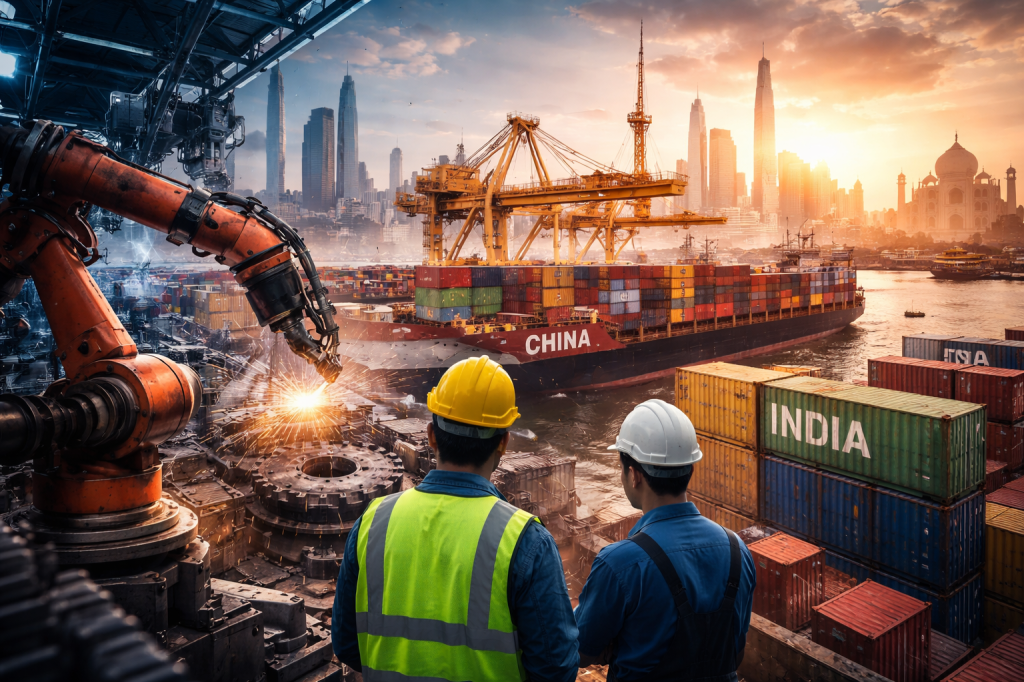
Historical Context and Structural Advantage:
The dominance of China in global machinery exports is not a recent phenomenon but the outcome of a carefully constructed industrial ecosystem spanning over three decades. Since the 1990s, China has systematically built scale through export-oriented industrialization, supported by state-backed financing, infrastructure, and cluster-based manufacturing. The machinery sector—covering capital goods, electrical equipment, and industrial components—became a strategic pillar, enabling China to integrate deeply into global value chains. In contrast, India’s machinery sector evolved more gradually, shaped by domestic demand, fragmented MSME participation, and limited scale efficiencies. This historical divergence has translated into a persistent structural asymmetry where China operates as a price-maker, while India often remains a price-taker in global markets.
The Economics of Scale and Price Compression:
China’s ability to dominate pricing in machinery exports is fundamentally rooted in economies of scale and supply chain integration. Large manufacturing clusters in provinces like Guangdong and Jiangsu enable end-to-end production—from raw materials to finished machinery—within tightly coordinated ecosystems. This reduces transaction costs, logistics expenses, and lead times, allowing Chinese firms to offer machinery at prices often 20–30% lower than global competitors. For Indian firms, particularly MSMEs, the cost structure is significantly higher due to fragmented supply chains, higher logistics costs (often 8–10% of GDP compared to China’s ~5–6%), and limited access to low-cost finance. The result is a persistent pricing pressure where Indian manufacturers are forced to either compress margins or lose market share.
Dumping, Overcapacity, and Strategic Pricing:
A critical dimension of China’s machinery export dominance lies in its ability to absorb domestic overcapacity through aggressive export strategies. With slowing domestic demand in sectors like real estate and infrastructure, Chinese firms increasingly rely on external markets to sustain production. This often leads to “strategic underpricing,” where machinery is exported at prices that may not fully reflect production costs, raising concerns of dumping in global markets. For Indian firms, this creates a dual challenge: competing not just with efficient production but with a pricing strategy that is backed by state support and macroeconomic imperatives. Anti-dumping measures exist but are often reactive and limited in scope, failing to address the broader structural imbalance.
Technology Depth versus Cost Competitiveness:
While pricing is the most visible dimension of competition, the deeper issue lies in technology and product complexity. China has steadily moved up the value chain, transitioning from low-cost machinery to high-precision equipment, robotics, and smart manufacturing systems. Investments in R&D, estimated at over 2.4% of GDP, have enabled Chinese firms to combine cost competitiveness with technological sophistication. India, on the other hand, continues to face gaps in design capabilities, precision engineering, and automation adoption. This creates a paradox: Indian firms are squeezed on price at the lower end while struggling to compete on technology at the higher end, effectively narrowing their competitive space.
Impact on Indian Industry Structure:
The pricing pressure exerted by Chinese machinery exports has significant implications for India’s industrial ecosystem. Domestic manufacturers face declining margins, limiting their ability to reinvest in technology and capacity expansion. MSMEs, which form the backbone of India’s engineering sector, are particularly vulnerable, as they lack the financial resilience to withstand prolonged price competition. Over time, this can lead to deindustrialization in certain segments, increased dependence on imports, and a weakening of domestic value chains. The risk is not just economic but strategic, as reliance on imported machinery can constrain India’s long-term industrial autonomy.
Policy Response: Between Protection and Competitiveness:
India’s policy response has evolved from passive openness to a more strategic approach, including Production Linked Incentive (PLI) schemes, tariff adjustments, and a push for “Atmanirbhar Bharat.” However, these measures face a fundamental tension: protection can provide temporary relief but may also reduce the incentive for firms to innovate and become globally competitive. The real challenge lies in designing policies that enhance productivity rather than merely shielding domestic firms. This includes investments in industrial clusters, logistics infrastructure, technology upgrading, and access to affordable finance. Without addressing these structural issues, policy interventions risk becoming short-term fixes rather than long-term solutions.
The Global Context: Fragmentation and Opportunity:
The global machinery market is undergoing a phase of fragmentation driven by geopolitical tensions, supply chain diversification, and the reconfiguration of trade alliances. While China remains dominant, there is a growing appetite among countries to reduce dependence on a single source. This creates a window of opportunity for India to position itself as an alternative manufacturing hub. However, capturing this opportunity requires more than just cost competitiveness—it demands reliability, quality, and integration into global supply chains. India’s success will depend on its ability to leverage trade agreements, strengthen export ecosystems, and build trust with global buyers.
Futuristic Outlook: From Price Competition to Capability Competition:
Looking ahead, the contest between China and India in machinery exports will increasingly shift from price to capability. The next phase of industrial competition will be defined by digital manufacturing, AI-driven production systems, and sustainability compliance. China is already investing heavily in these areas, while India is still in the early stages of adoption. If Indian firms remain trapped in price-based competition, they risk being perpetually outcompeted. The strategic imperative is to move towards capability-driven competitiveness—where value is created through innovation, customization, and integration rather than just cost reduction.
A Strategic Inflection Point for India:
China’s dominance in machinery exports is not merely a competitive challenge but a structural reality that India must strategically navigate. The pricing pressure faced by Indian firms reflects deeper issues of scale, technology, and ecosystem development. Addressing these challenges requires a long-term vision that goes beyond reactive policies and focuses on building a resilient and competitive industrial base. The choice for India is clear: remain a peripheral player in a price-driven market or emerge as a credible alternative through capability, innovation, and strategic positioning. The coming decade will determine which path India takes.
#MachineryExports #ChinaManufacturing #IndustrialCompetitiveness #MSMEChallenges #GlobalValueChains #PriceCompetition #SupplyChainIntegration #IndustrialPolicy #TechnologyUpgradation #AtmanirbharBharat
 "Connecting communities, empowering nations: Unifying the Regional and Global Economy ."
Leave a comment