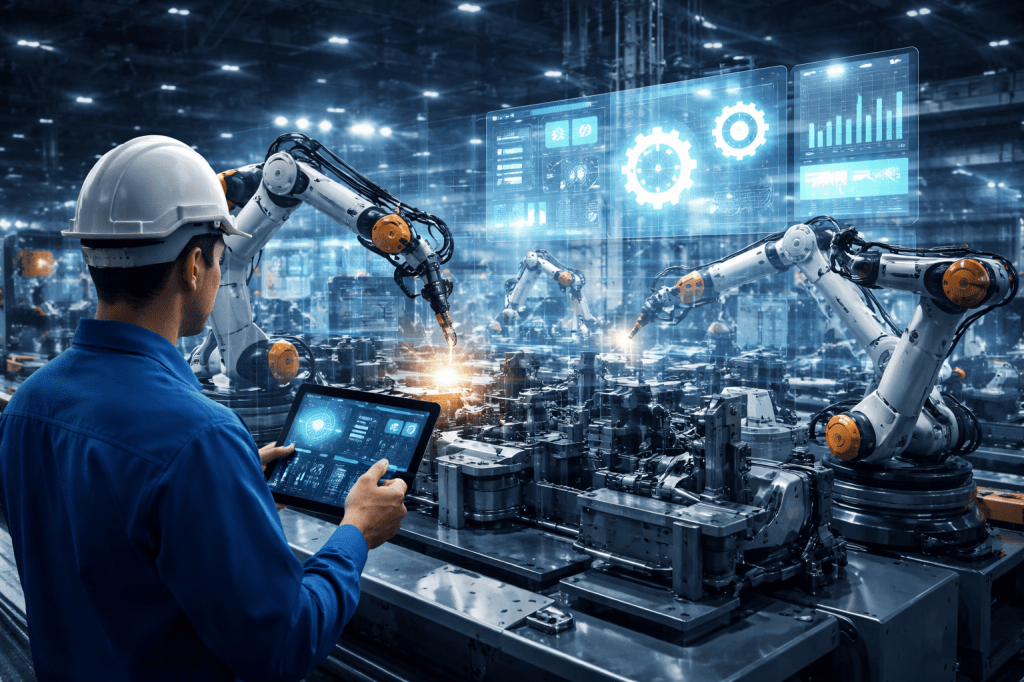
From Mechanization to Intelligence: A Historical Shift in Manufacturing Power
Manufacturing has always evolved through waves of technological transformation—from mechanization to electrification, from automation to digitization. Today, the shift toward artificial intelligence marks a deeper transition: from machines executing predefined tasks to systems that learn, predict, and optimize. However, unlike earlier industrial revolutions that gradually diffused across firm sizes, the current AI wave is unfolding unevenly. The benefits are being captured disproportionately by large firms, while MSMEs—the backbone of industrial employment—remain on the margins. This asymmetry is not accidental; it reflects deeper structural imbalances embedded in capital access, technological preparedness, and institutional support.
Scale as Power: Why Large Firms Are Winning the AI Race
Large manufacturing firms are not merely adopting AI—they are redesigning production systems around it. With access to capital, they invest in predictive maintenance systems, automated quality control, and digital twins that simulate entire factories. These technologies generate high returns in large-scale operations where even marginal efficiency gains translate into significant cost savings. Moreover, large firms possess the data infrastructure required to feed AI systems—standardized processes, connected machines, and integrated ERP systems. In essence, AI is not just a tool for them; it is becoming a strategic asset that strengthens their competitive dominance.
The implication is profound: AI is reinforcing economies of scale. The larger the firm, the greater the ability to extract value from intelligence-driven systems. This creates a self-reinforcing cycle where technological advantage leads to higher productivity, which in turn generates more resources for further technological investment.
MSMEs in the Shadows: Structural Barriers to Adoption
In contrast, MSMEs face a fundamentally different reality. Their hesitation is not rooted in resistance to innovation but in constraints that are both financial and systemic. The upfront cost of sensors, connectivity, and software integration is often prohibitive for firms operating on thin margins. Even when affordable solutions exist, the absence of reliable data and skilled manpower limits their ability to deploy and sustain AI systems.
More critically, MSMEs operate in an environment of uncertainty where return on investment is not immediately visible. Unlike large firms, they cannot afford long gestation periods for technology adoption. As a result, AI remains confined to pilot projects or isolated experiments rather than becoming an integral part of production systems.
This creates what may be termed a “technological exclusion zone,” where MSMEs are aware of AI but are unable to internalize it into their business models. Over time, this gap risks translating into a productivity divide that could reshape industrial hierarchies.
The Illusion of Diffusion: Why AI May Not Trickle Down Naturally
Historically, new technologies have eventually diffused from large firms to smaller ones. However, AI challenges this assumption. Unlike earlier technologies, AI is data-intensive, continuously evolving, and requires ecosystem-level integration. It is not a one-time investment but an ongoing capability.
This means that passive diffusion is unlikely. Without deliberate intervention, the gap between large firms and MSMEs may widen rather than narrow. The so-called “productivity paradox” of AI—where aggregate gains remain muted despite technological advancement—can be partly explained by this uneven adoption. When a large segment of the industrial base remains excluded, overall productivity gains remain suboptimal.
Cluster-Based Transformation: Reimagining MSME Competitiveness
The future of AI in manufacturing, particularly in economies like India, will depend on how effectively MSMEs are integrated into this transformation. The answer does not lie in pushing individual firms to adopt AI independently but in building shared ecosystems.
Cluster-based approaches offer a viable pathway. Instead of each MSME investing in expensive infrastructure, common facilities can provide AI-enabled services such as quality analytics, predictive maintenance, and process optimization on a shared basis. Cloud-based solutions further reduce entry barriers, allowing firms to access AI as a service rather than as a capital investment.
Equally important is the creation of human capital. Training programs must move beyond high-end research to focus on practical data literacy and operational understanding of AI tools. The goal is not to turn MSME workers into data scientists but to make them capable of interacting with intelligent systems effectively.
Policy as a Catalyst: From Incentives to Institutional Design
Policy interventions must evolve from generic digitalization schemes to targeted AI-enablement strategies. Subsidies for pilot projects, support for technology vendors, and incentives for cluster-level infrastructure can accelerate adoption. However, the real challenge lies in institutional design—creating platforms where industry bodies, technology providers, and government agencies collaborate seamlessly.
In this context, the role of industrial associations and cluster development agencies becomes critical. They can act as intermediaries, translating complex technologies into accessible solutions for MSMEs. Without such mediation, the gap between technological potential and practical adoption will persist.
AI as the New Determinant of Industrial Inequality
Looking ahead, the uneven adoption of AI could redefine the structure of manufacturing economies. Firms that successfully integrate AI will operate with higher efficiency, lower costs, and greater resilience. Those that fail to do so risk being pushed into low-value segments or even exiting the market.
This creates a new form of industrial inequality—not just between countries, but within them. The divide will not be between manufacturing and services, but between intelligent manufacturing and traditional manufacturing. In such a scenario, MSMEs could either become agile participants in AI-driven value chains or remain trapped in a cycle of stagnation.
Bridging the Divide Before It Becomes Structural
The story of AI in manufacturing is not just about technology; it is about inclusion. If current trends continue, AI will amplify existing disparities rather than resolve them. The challenge, therefore, is not merely to accelerate adoption but to democratize it.
The future of manufacturing will be defined not by how advanced AI becomes, but by how widely it is shared. The real test for policymakers and industry leaders is whether they can transform AI from a tool of concentration into an instrument of broad-based industrial transformation.
#AIManufacturing #MSMETransformation #IndustrialPolicy #DigitalDivide #SmartFactories #ClusterDevelopment #FutureOfWork #AutomationEconomics #InclusiveGrowth #Industry40
 "Connecting communities, empowering nations: Unifying the Regional and Global Economy ."
Leave a comment