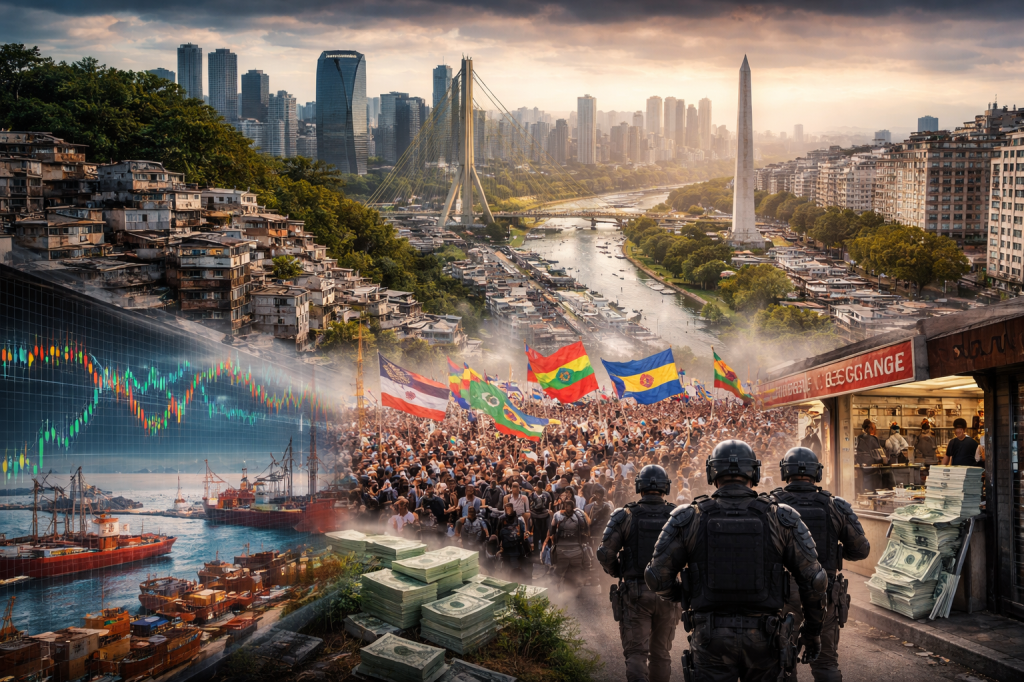
Historical Cycles, New Vulnerabilities in a Fragmented World Order
Latin America has historically oscillated between commodity-driven booms and debt-driven crises—from the debt crisis of the 1980s to the commodity supercycle of the 2000s. However, the current phase is structurally different. The region is not in a full-blown crisis, yet it is also far from stability; it is trapped in what may be called a “slow chaos equilibrium.” Growth rates hovering around 2% are deceptively stable, but beneath this lies a deep erosion of institutional strength, rising political fragmentation, and increasing exposure to global power rivalries. Unlike earlier crises triggered by internal macroeconomic mismanagement, today’s turmoil is a hybrid—part domestic weakness, part global realignment, and part technological disruption.
Brazil at the Crossroads: Fiscal Stress Meets Political Polarization
Brazil, the anchor economy of the region, reflects this contradiction most sharply. Entering 2026 with growth slowing below 2%, the economy is constrained by weak investment demand and cautious consumption despite some support from agriculture and services. Inflation appears under control, yet interest rates remain structurally high, reflecting deeper fiscal anxieties. Public debt approaching 95% of GDP signals not just a fiscal imbalance but a declining policy space. As elections approach, political polarization is intensifying, turning economic management into a contest of narratives rather than solutions. The deeper risk is not just economic slowdown but institutional fatigue—where governance capacity weakens under constant ideological contestation. In a world increasingly driven by AI-led productivity and capital mobility, Brazil risks being stuck in a high-cost, low-productivity trap unless structural reforms align with technological transitions.
Argentina, Venezuela, and the Illusion of Reset
Across the region, attempts at economic reset reveal both ambition and fragility. Argentina’s aggressive reforms have managed to tame hyperinflation from extreme levels, but at the cost of economic contraction and social resistance. This reflects a classic Latin American dilemma: stabilization often precedes political backlash. Venezuela, despite a shift in political control, remains structurally fragile. Years of hyperinflation, institutional collapse, and migration crises cannot be reversed quickly. Any apparent stabilization is fragile, dependent on external support and internal political cohesion that remains uncertain. These cases illustrate a deeper structural issue—policy correction without institutional rebuilding rarely delivers sustained recovery.
Peru and Colombia: Resource Wealth, Governance Deficit
Countries like Peru and Colombia demonstrate another recurring paradox—strong resource bases but weak governance outcomes. Peru’s mining-driven economic potential continues to be overshadowed by political instability, repeated leadership crises, and social unrest. Colombia, meanwhile, faces an intensifying nexus of narcotics-driven violence, corruption, and policy gridlock. Elections in such environments are less about policy continuity and more about regime swings, creating uncertainty that deters long-term investment. The key insight here is that economic fundamentals alone no longer determine growth trajectories; governance credibility has become equally decisive.
Mexico and the Shadow of External Dependence
Mexico’s relatively modest growth outlook reflects its deep integration with the United States economy. While nearshoring opportunities offer upside potential, they also create dependency risks. The upcoming review of trade frameworks and persistent security challenges expose Mexico’s vulnerability to both external policy shifts and internal institutional constraints. The country stands at a strategic inflection point—whether it evolves into a manufacturing powerhouse benefiting from supply chain diversification or remains constrained by structural bottlenecks will depend on governance reforms more than external demand.
The Deeper Structural Fault Lines: Crime, Inequality, and Informality
Beyond macroeconomic indicators, the real fault lines of Latin America lie in structural issues—organized crime, income inequality, and large informal economies. These are not new challenges, but their intensity has increased in the current global context. Criminal networks have evolved into parallel economic systems, influencing politics, labor markets, and investment flows. Informality limits tax capacity, weakening fiscal sustainability. Inequality fuels political volatility, creating cycles of populism and reform reversals. Together, these factors create a self-reinforcing loop where economic fragility feeds political instability, and vice versa.
External Pressures: Between the United States and China
The region’s geopolitical position has become more complex. The United States remains a dominant economic and political influence, particularly through trade and financial systems. At the same time, China’s growing role as a trade partner and investor—especially in commodities and infrastructure—has reshaped regional dependencies. Latin America is increasingly navigating a dual alignment challenge, balancing access to Chinese capital with exposure to US policy shifts such as tariffs and strategic decoupling. This creates a structural uncertainty where external shocks can transmit rapidly into domestic economies.
Technology, Digitalization, and the Uneven Future
One of the few positive undercurrents is digital transformation. Fintech adoption, digital payments, and e-commerce expansion are creating new growth avenues. However, this transformation is uneven and risks widening inequality. Countries that integrate digital infrastructure with industrial policy may leapfrog into new growth trajectories, while others may fall further behind. The rise of AI also introduces new risks—misinformation in elections, job displacement, and productivity divergence—adding another layer of complexity to already fragile systems.
The Myth of Stability: Why 2% Growth is the Real Risk
The most critical insight for the region is that low but stable growth is not a safe zone; it is a danger zone. At around 2% growth, economies generate insufficient jobs, fail to reduce inequality, and struggle to sustain fiscal balances. This creates a silent erosion of social contracts. Unlike high-growth crises that trigger immediate policy responses, slow-growth environments breed complacency, allowing structural weaknesses to deepen over time. Latin America today is not collapsing—it is drifting, and that drift may be more dangerous than a sudden crisis.
Futuristic Outlook: Fragmented Growth or Strategic Reinvention?
Looking ahead, the region faces two divergent pathways. One scenario is continued fragmentation—moderate growth, periodic political shocks, and increasing dependence on external powers. The alternative is strategic reinvention, where countries leverage their resource base, demographic profile, and digital potential to reposition themselves in global value chains. This would require a shift from short-term political cycles to long-term institutional strengthening—something historically elusive in the region.
The real question is not whether Latin America is in turmoil, but whether it can convert this phase of “slow chaos” into a platform for structural transformation. If it fails, the region risks becoming a peripheral player in a rapidly reconfigured global economy. If it succeeds, it could emerge as one of the most strategically important regions of the 21st century—bridging resources, markets, and geopolitical alignments in an increasingly multipolar world.
#LatinAmerica
#BrazilEconomy
#PoliticalPolarization
#SlowGrowthTrap
#FiscalStress
#CommodityDependence
#GeopoliticalTensions
#OrganizedCrime
#InstitutionalFragility
#DigitalTransformation
 "Connecting communities, empowering nations: Unifying the Regional and Global Economy ."
Leave a comment