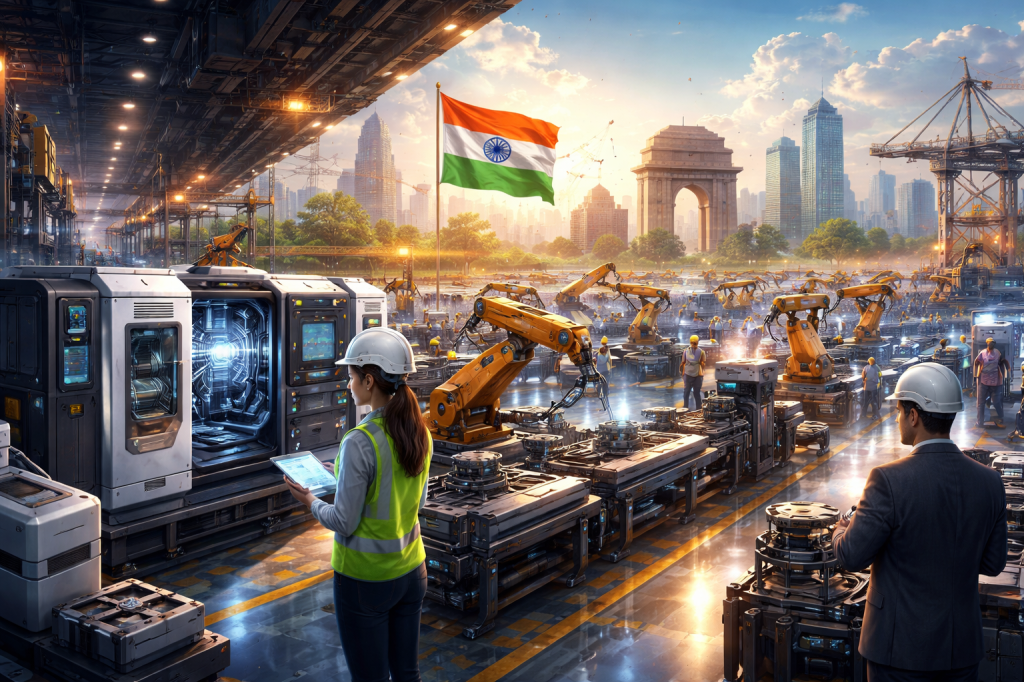
Historical Underinvestment and Structural Dependence
The capital goods and machinery sector has historically been the backbone of industrial revolutions, yet in India, it has remained paradoxically underdeveloped despite decades of industrial policy interventions. From the early post-independence push under heavy industries and public sector dominance to the liberalisation phase of the 1990s, the sector has oscillated between state-led ambition and market-driven fragmentation. While countries like Germany and Japan built globally competitive machinery ecosystems rooted in precision engineering and export discipline, India’s trajectory has been marked by import dependence, especially for high-end machine tools, semiconductor equipment, and advanced manufacturing systems. This structural gap is not merely industrial—it reflects a deeper technological asymmetry that constrains India’s ability to move up the value chain.
The Core of Industrial Competitiveness
Capital goods are not just another sector—they define the productivity frontier of all other sectors. The efficiency of textiles, automotive, electronics, and even agriculture is fundamentally tied to the quality and sophistication of machinery deployed. India’s ambition to become a $5 trillion economy—and eventually a $30 trillion economy under the Viksit Bharat vision—cannot materialize without a robust domestic capital goods ecosystem. Currently, the sector contributes around 12–13% to manufacturing output but relies heavily on imports for critical components, leading to a persistent trade deficit in machinery. This creates a paradox where India is simultaneously expanding manufacturing capacity while deepening technological dependence.
Global Realignments and Strategic Opportunity
The ongoing fragmentation of global supply chains, driven by geopolitical tensions, “China+1” strategies, and increasing trade protectionism, presents a rare window of opportunity. Countries are actively seeking alternative manufacturing bases, and India is emerging as a potential candidate. However, without a strong domestic machinery base, India risks becoming merely an assembly hub rather than a true manufacturing powerhouse. Vietnam and Mexico have already demonstrated how integration into global value chains can be leveraged, but they too face limitations due to technological dependence. India must avoid replicating this model and instead aim for technological sovereignty in capital goods.
From Assembly to Innovation
One of the most critical challenges lies in the transition from low-value assembly to high-value design and innovation. Advanced manufacturing today is increasingly driven by automation, robotics, AI-integrated machinery, and precision engineering. India’s current ecosystem lacks sufficient investment in R&D, design capabilities, and skilled human capital required to build such technologies. The absence of strong linkages between academia, industry, and research institutions further exacerbates this gap. Without addressing this, initiatives like “Make in India” risk becoming “Assemble in India.”
MSME Clusters and the Missing Middle
India’s capital goods sector is heavily populated by MSMEs, particularly in clusters such as Coimbatore, Rajkot, and Pune. These clusters possess strong entrepreneurial capabilities but suffer from fragmentation, lack of scale, limited access to finance, and weak integration into global supply chains. The “missing middle” problem—where firms fail to scale from small to medium and large enterprises—remains a persistent constraint. Cluster-based interventions, technology upgradation schemes, and shared infrastructure facilities can play a transformative role, but they require coordinated policy execution rather than fragmented schemes.
Policy Push vs Ground Reality
Government initiatives such as the National Capital Goods Policy and Production Linked Incentive (PLI) schemes have attempted to address some of these challenges. However, the effectiveness of these policies is often diluted by implementation gaps, bureaucratic delays, and lack of industry alignment. Incentives alone cannot build a globally competitive sector; what is required is a long-term industrial strategy focused on capability building, technology transfer, and global market integration. Moreover, policy must move beyond generic incentives to sector-specific interventions targeting high-potential segments like machine tools, industrial automation, and renewable energy equipment.
The Sustainability Imperative and Green Machinery
As global markets increasingly impose sustainability standards—through mechanisms such as carbon border taxes and ESG compliance—the capital goods sector faces a dual challenge. On one hand, it must produce environmentally sustainable machinery; on the other, it must enable other sectors to transition towards green production. This creates both a risk and an opportunity. Countries that lead in green machinery will dominate the next phase of industrialisation. India, however, is still in the early stages of this transition, with limited domestic capability in energy-efficient and low-carbon technologies.
Towards Industrial Sovereignty or Perpetual Dependence
The future of India’s capital goods sector will determine whether the country emerges as a true industrial power or remains locked in a cycle of dependency. The path forward requires a fundamental shift—from cost competitiveness to capability competitiveness. This means investing heavily in R&D, building domestic champions, fostering industry-academia collaboration, and integrating into global innovation networks. The role of AI, digital manufacturing, and smart factories will be central in shaping this transformation.
However, the most critical question is not whether India can grow its manufacturing sector, but whether it can control the technologies that drive it. Without ownership of capital goods technologies, India’s industrial growth will remain externally dependent and strategically vulnerable. The coming decade will be decisive—either India builds its machinery backbone or continues to import the future it seeks to create.
#CapitalGoods
#MachinerySector
#IndustrialPolicy
#ManufacturingIndia
#TechnologyGap
#MSMEClusters
#SupplyChainShift
#ChinaPlusOne
#GreenManufacturing
#IndustrialSovereignty
 "Connecting communities, empowering nations: Unifying the Regional and Global Economy ."
Leave a comment