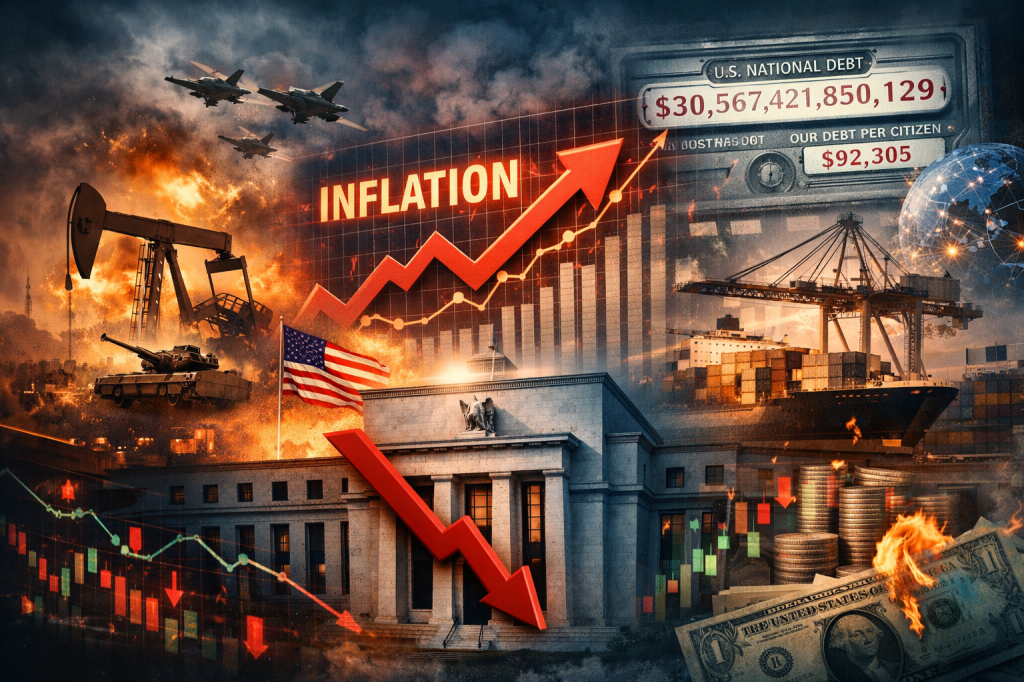
From Bretton Woods Stability to Wartime Volatility
The United States economy, once anchored in the institutional stability of Bretton Woods and post-war industrial dominance, is increasingly entering a phase of structural uncertainty shaped by geopolitical conflicts and internal policy constraints. Historically, wars have acted as both stimulants and distorters of the U.S. economy—from the industrial boom during World War II to the inflationary spiral of the Vietnam War era. However, the current phase differs fundamentally: wars today are not geographically contained, supply chains are globally entangled, and financial markets react in real time. The result is not just cyclical inflation, but a deeper structural inflation embedded in energy, logistics, and defense spending.
War-Driven Inflation: Beyond Demand-Supply Imbalances
Inflation in the present context cannot be explained merely through classical demand-supply mismatches. It is being fueled by persistent geopolitical disruptions—energy shocks from conflict zones, rerouting of trade corridors, and strategic stockpiling by nations. Military expenditure in the U.S. has risen steadily, but unlike earlier wars, it does not translate into domestic industrial expansion at the same scale due to outsourced manufacturing and fragmented value chains. Consequently, inflation becomes “imported” as much as it is domestically generated. This creates a dangerous feedback loop where inflation erodes purchasing power while fiscal spending continues to expand to sustain geopolitical commitments.
A Federal Reserve with Constrained Autonomy
The phrase “no Federal” reflects a growing perception that the U.S. Federal Reserve is losing its traditional autonomy or effectiveness. While technically independent, the Fed today operates under unprecedented fiscal pressure. With U.S. public debt crossing historic thresholds and interest payments consuming a larger share of federal expenditure, aggressive rate hikes to control inflation risk triggering a debt servicing crisis. In such a scenario, monetary policy becomes subordinated to fiscal realities. The Fed is no longer just managing inflation; it is balancing the sustainability of government debt, financial market stability, and global confidence in the dollar.
Debt, Dollar Dominance, and the Illusion of Infinite Cushion
For decades, the U.S. enjoyed what economists call the “exorbitant privilege” of issuing the world’s reserve currency. This allowed it to run persistent deficits without immediate consequences. However, war-driven fiscal expansion combined with tightening global liquidity is beginning to test this privilege. Countries are gradually diversifying reserves, exploring alternative settlement systems, and reducing dependence on the dollar in bilateral trade. While the dollar is unlikely to lose dominance abruptly, its uncontested supremacy is eroding. This transition, even if gradual, implies higher borrowing costs and reduced policy flexibility for the U.S. economy.
De-globalisation, Supply Chain Realignment, and Cost Pressures
The U.S. response to geopolitical tensions has been a strategic shift toward “friend-shoring” and domestic industrial policies. While this enhances national security, it also raises production costs. Moving supply chains away from low-cost regions like China to relatively higher-cost geographies increases inflationary pressures in the medium term. Industrial policy initiatives, subsidies, and protectionist measures may create jobs domestically, but they also distort market efficiencies and increase fiscal burdens. The paradox is clear: economic security is being achieved at the cost of economic efficiency.
Labour Market Resilience vs. Real Wage Erosion
One of the paradoxes of the current U.S. economy is the coexistence of a strong labour market with declining real wages. Employment levels remain robust, but inflation-adjusted incomes have not kept pace. This creates a silent erosion of middle-class stability, leading to increased reliance on credit. Consumer demand, therefore, is sustained not by income growth but by debt expansion—an unsustainable model in a high-interest-rate environment. Over time, this could weaken consumption, which remains the backbone of the U.S. economy.
Financial Markets: Stability Built on Fragility
Equity markets in the U.S. continue to show resilience, often driven by technology stocks and expectations of future growth. However, this resilience masks underlying fragility. High valuations are increasingly disconnected from real economic fundamentals, and liquidity conditions remain tight. Any external shock—be it escalation in geopolitical tensions or a sudden loss of confidence in fiscal sustainability—could trigger sharp corrections. The financial system, therefore, operates in a state of managed stability rather than inherent strength.
Future Trajectories: Managed Decline or Strategic Reinvention?
The future of the U.S. economy will depend on how it navigates three critical transitions. First, whether it can control inflation without destabilizing its debt structure. Second, whether it can maintain dollar dominance in a gradually multipolar financial system. Third, whether it can rebuild domestic productive capacity without excessively inflating costs. If managed carefully, the U.S. could transition into a more balanced, albeit slower-growing economy. However, failure to address these structural contradictions could lead to a prolonged phase of stagflation—low growth combined with persistent inflation.
The End of Economic Exceptionalism?
The U.S. economy is not collapsing, but it is certainly transforming. The era of effortless dominance—fueled by cheap capital, globalisation, and uncontested monetary power—is fading. War-induced inflation and constrained monetary policy are symptoms of a deeper structural shift. The real question is not whether the U.S. will remain a leading economy—it likely will—but whether it can redefine its economic model in a world where power, production, and finance are no longer unipolar. The coming decade will determine whether the U.S. adapts to this new reality or struggles under the weight of its own legacy systems.
#WarEconomy #USInflation #FederalReserveCrisis #GlobalDebt #DollarDominance #StagflationRisk #GeopoliticalEconomics #DeGlobalisation #SupplyChainShifts #EconomicTransition
 "Connecting communities, empowering nations: Unifying the Regional and Global Economy ."
Leave a comment