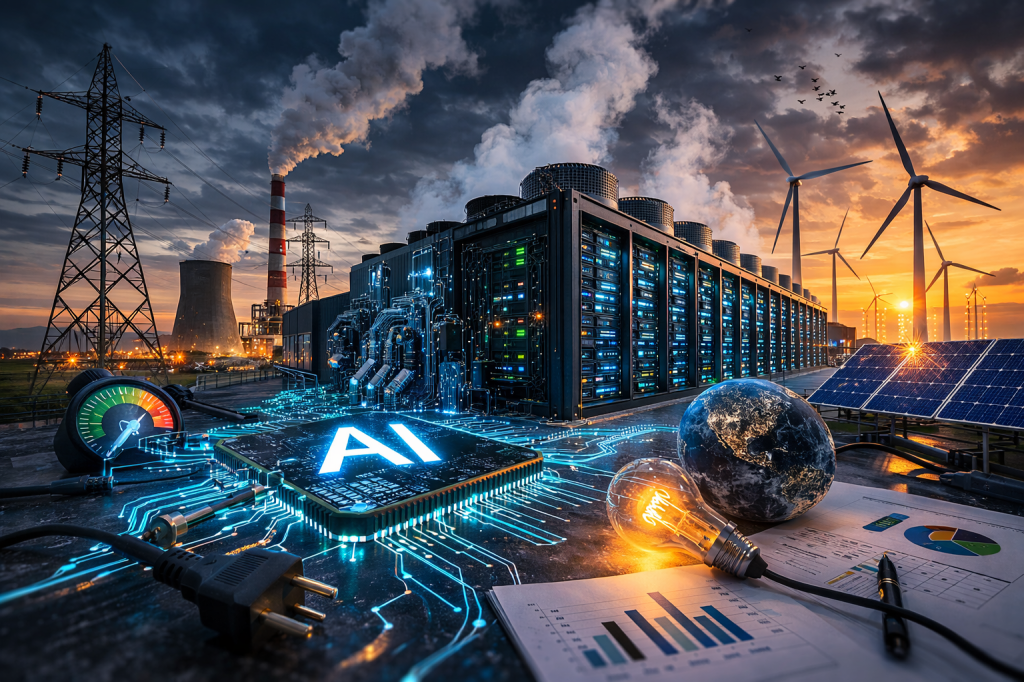
The Silent Cost of the Artificial Intelligence Boom
Artificial Intelligence has rapidly become the centerpiece of technological competition among major economies. Governments, technology companies, and venture capital networks are investing billions of dollars into building increasingly powerful AI systems. The global narrative often frames this development as a race for innovation, productivity, and geopolitical leadership. However, beneath the excitement surrounding generative AI models, autonomous systems, and machine learning platforms lies a far less discussed reality: the enormous energy demand required to sustain the AI revolution.
Unlike earlier digital technologies that primarily relied on incremental computing capacity, modern AI systems require vast computational infrastructure powered by high-performance GPUs, specialized chips, and hyperscale data centers. Training a large AI model can consume as much electricity as several thousand households use in a year. As companies compete to build ever larger models with trillions of parameters, the electricity demand associated with AI computing is growing at an unprecedented rate. The race for artificial intelligence is therefore increasingly becoming a race for energy.
Data Centers: The New Industrial Factories of the Digital Age
In the 20th century, industrial competition was measured in terms of steel production, oil reserves, and manufacturing capacity. In the 21st century, data centers have become the new factories of the digital economy. Hyperscale data centers operated by technology giants such as NVIDIA, Microsoft, Google, and Amazon now consume enormous quantities of electricity to power servers, cooling systems, and networking infrastructure.
According to several energy estimates, global data center electricity consumption may exceed that of many medium-sized countries within the next decade. The explosive growth of generative AI tools has significantly accelerated this trend. Every AI query, image generation, video synthesis, or automated decision-making process requires computational power that translates directly into energy consumption.
The critical issue is that AI computing is not merely increasing demand for electricity—it is doing so at a time when global energy systems are already under strain due to climate commitments, rising industrial demand, and geopolitical disruptions in energy supply chains.
Geopolitics of AI and Energy
The global AI race is increasingly intertwined with geopolitics. Countries view artificial intelligence not merely as a technological innovation but as a strategic asset capable of shaping military power, economic competitiveness, and national security. The competition between the United States and China for leadership in artificial intelligence is often compared to the nuclear or space races of the Cold War era.
However, unlike those earlier technological competitions, the AI race places enormous pressure on energy infrastructure. Countries that possess abundant electricity generation capacity—especially those with large renewable or nuclear energy resources—may gain an unexpected advantage in the AI era. The ability to supply stable, low-cost electricity to massive computing clusters could become as important as semiconductor manufacturing capability.
In this context, energy security is emerging as a hidden dimension of technological power. Nations that cannot sustain the electricity requirements of large-scale AI infrastructure may find themselves dependent on foreign technology platforms or constrained in their digital ambitions.
The Environmental Contradiction
One of the most striking contradictions of the AI revolution is its environmental footprint. At a time when governments are promoting decarbonization and energy efficiency, the expansion of AI infrastructure is pushing electricity consumption sharply upward.
Large data centers require not only electricity for computing but also enormous volumes of water for cooling systems. In several regions, the expansion of AI infrastructure has already begun to compete with local water and energy resources. Communities that host hyperscale data centers sometimes experience rising electricity prices, pressure on local grids, and environmental concerns related to resource consumption.
This raises a critical question: can the world simultaneously pursue large-scale artificial intelligence expansion and ambitious climate goals without fundamentally restructuring the global energy system?
The Emerging Inequality of Digital Power
The AI race may also create new forms of inequality between countries. Advanced AI systems require three critical inputs: data, computing power, and energy. While data can be generated across societies, computing infrastructure and electricity generation are heavily concentrated in a few regions.
As a result, the development of powerful AI systems is increasingly dominated by a small number of large corporations and technologically advanced nations. Developing economies may become dependent users of AI technologies rather than producers, reinforcing existing global inequalities in technological capability.
This concentration of computational power could transform artificial intelligence into a new form of digital monopoly, where a handful of firms control the infrastructure that drives innovation, productivity, and economic decision-making.
The Future: An Energy-Constrained AI World
The long-term sustainability of the artificial intelligence boom will depend not only on breakthroughs in algorithms and semiconductor technology but also on the availability of energy. Without significant advances in energy efficiency, renewable energy deployment, or next-generation power systems such as nuclear fusion, the expansion of AI infrastructure may encounter fundamental physical constraints.
Ironically, artificial intelligence itself may be required to optimize energy systems, improve grid management, and accelerate the transition toward cleaner energy sources. In this sense, the future relationship between AI and energy may become circular: AI will depend on energy, and energy systems will increasingly depend on AI.
A Critical Reflection on the AI Race
The current enthusiasm surrounding artificial intelligence often portrays it as an inevitable technological progression. Yet history shows that every technological revolution is shaped by material constraints—whether it was coal powering the industrial revolution or oil fueling the automobile age.
The AI revolution is no different. Behind the algorithms, neural networks, and digital interfaces lies a physical infrastructure powered by electricity. If the global race for artificial intelligence continues without addressing its energy implications, the world may discover that the true bottleneck of the digital future is not data or computing chips—but power itself.
#ArtificialIntelligence
#AIEnergyCrisis
#DigitalInfrastructure
#AIDataCenters
#EnergySecurity
#TechGeopolitics
#AICompetition
#ElectricityDemand
#DigitalEconomy
#FutureOfTechnology
 "Connecting communities, empowering nations: Unifying the Regional and Global Economy ."
Leave a comment