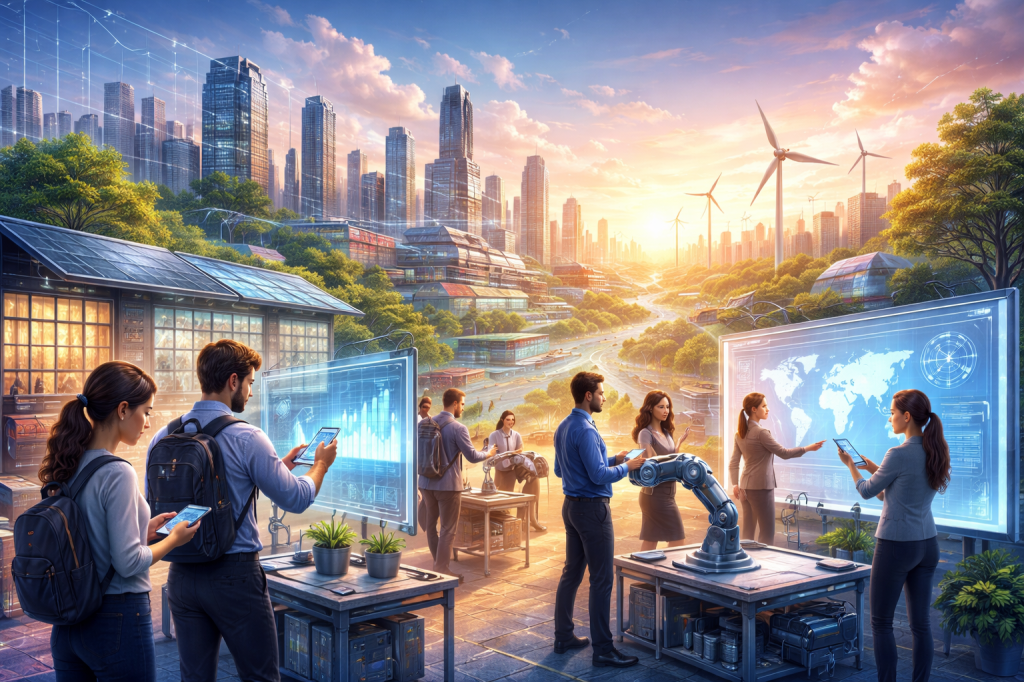
Economic development has never been a linear story. From the industrial revolutions of the nineteenth century to the digital transformations of the twenty-first, nations that succeeded were rarely those that simply copied the past. Instead, they were those that understood the deeper drivers of productivity—human capability, institutional flexibility, and the ability to adapt to technological change. In the present era of artificial intelligence, global supply chain shifts, and digital platforms, the traditional debate about development strategy is once again resurfacing. The prescription increasingly being discussed by economists and policymakers is simple yet profound: invest deeply in human capital, decentralize governance to strengthen education systems, and build a model of services-led manufacturing rather than chasing the industrial pathways of the past.
Human Capital as the New Strategic Infrastructure
Historically, countries built their economic strength through physical infrastructure—railways, ports, factories, and energy systems. While these remain essential, the modern economy is increasingly driven by knowledge and skills. Nations that dominate advanced sectors such as artificial intelligence, biotechnology, advanced manufacturing, and digital services are those that have invested heavily in education, research, and skill development.
Data across the global economy illustrates this shift. Countries with higher investments in education and skill formation consistently demonstrate higher productivity growth. In knowledge-intensive sectors, the value created by human skills often exceeds the value created by physical capital. For instance, the global digital economy is estimated to contribute more than 15 percent of global GDP, and much of this value is generated not by factories but by human expertise in software, design, data science, and system integration.
For emerging economies, this creates both an opportunity and a challenge. The opportunity lies in the fact that talent can travel faster than infrastructure. A well-trained engineer or designer can create global value through digital networks without requiring massive industrial plants. The challenge, however, is that education systems in many countries are still designed for an earlier industrial age. Without large-scale investments in human capital—ranging from primary education to advanced research—the productivity gap between economies could widen dramatically.
Decentralized Governance and the Transformation of Education
A critical element in strengthening human capital lies in governance structures. Centralized education systems often struggle to respond to diverse regional needs, technological changes, and industry requirements. Decentralized governance—where local institutions, universities, and regional governments have greater autonomy—can allow education systems to adapt more dynamically.
Across many parts of the world, regions that combine local governance with strong institutional accountability have been able to build highly responsive education ecosystems. Local governments often understand regional labour markets better than distant national bureaucracies. They can design training programs linked to local industries, encourage partnerships between universities and businesses, and experiment with innovative learning models.
Decentralization also encourages competition and innovation in education. When universities and training institutes are given greater freedom to design curricula, collaborate with industry, and adopt digital technologies, they become laboratories of experimentation. Over time, such systems can produce a workforce capable of navigating rapidly evolving industries such as robotics, renewable energy, digital manufacturing, and advanced logistics.
However, decentralization must be accompanied by strong standards and transparency. Without accountability mechanisms, educational inequality can deepen. The goal is not fragmentation but adaptive governance—systems that combine national vision with local flexibility.
Services-Led Manufacturing: The Emerging Industrial Model
For decades, the dominant development narrative was shaped by the experiences of East Asian economies, where export-led manufacturing powered rapid industrialization. Many countries have attempted to replicate this model by focusing on large-scale factory production. Yet the global industrial landscape has changed significantly.
Modern manufacturing is no longer confined to factory floors. It is increasingly intertwined with services such as design, engineering, logistics, software development, data analytics, and after-sales support. In many advanced industries, services contribute more value than the physical production process itself.
This transformation has given rise to what economists describe as “services-embedded manufacturing.” A modern automobile, for instance, contains not only mechanical components but also complex software systems, digital sensors, connectivity services, and continuous updates through data platforms. Similarly, manufacturing companies increasingly rely on digital twins, predictive maintenance systems, and data-driven supply chains.
For emerging economies, this shift opens a new pathway. Instead of competing solely on low-cost labour in traditional factories, countries can build industrial ecosystems where services enhance manufacturing competitiveness. Engineers, software developers, designers, and logistics specialists become integral parts of industrial production.
This model—services-led manufacturing—blurs the conventional boundary between the services and manufacturing sectors. It allows economies to leverage their human capital while still building industrial capabilities. In many ways, it represents a hybrid development strategy suited to the digital age.
Avoiding the Trap of Yesterday’s Model
The temptation for policymakers is often to replicate historical success stories. However, economic models that worked in the twentieth century may not translate directly into the twenty-first. The global trading system is more fragmented, technological change is faster, and automation is reducing the labour intensity of manufacturing.
If countries attempt to replicate traditional factory-driven industrialization without adapting to these realities, they risk entering a “latecomer trap.” Automation and robotics are already reducing the advantage of low-cost labour. At the same time, global supply chains are becoming more regionalized due to geopolitical tensions and economic security concerns.
This means the competitive advantage of the future will depend less on cheap production and more on innovation, adaptability, and technological integration. Nations that focus exclusively on replicating past industrial models may find themselves investing heavily in sectors that are already transforming.
The Long View: Building Adaptive Economies
Looking ahead, the most successful economies will likely be those that build adaptive systems rather than rigid industrial strategies. Human capital will serve as the foundation of these systems. Decentralized governance will allow institutions to respond quickly to technological shifts. And services-led manufacturing will integrate knowledge, technology, and production into a cohesive economic structure.
In this sense, economic development is increasingly becoming a story about institutional intelligence—the ability of societies to learn, experiment, and evolve. Infrastructure, factories, and trade policies will remain important, but they will be effective only when supported by skilled people and flexible institutions.
The future of development will therefore not be decided by who builds the largest factories, but by who builds the most capable societies. And that transformation begins not with machines, but with people.
#HumanCapital
#EducationReform
#DecentralizedGovernance
#ServicesLedManufacturing
#FutureOfWork
#KnowledgeEconomy
#IndustrialTransformation
#ProductivityGrowth
#DigitalEconomy
#AdaptiveDevelopment
 "Connecting communities, empowering nations: Unifying the Regional and Global Economy ."
Leave a comment