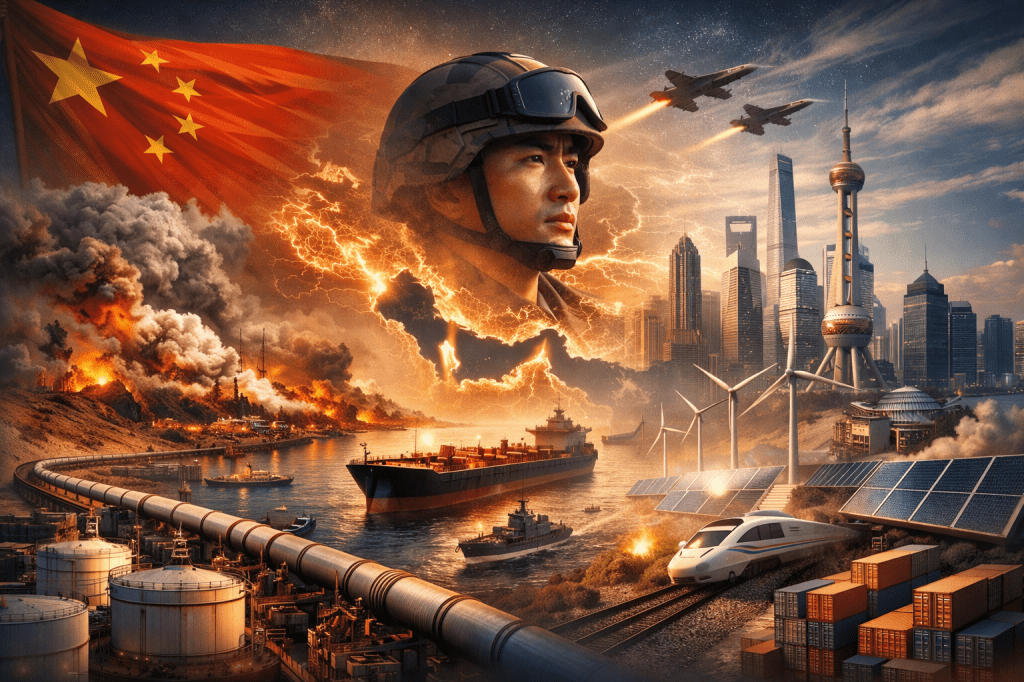
Historical Dependence on Middle Eastern Energy
For more than three decades, China’s rise as the world’s largest manufacturing powerhouse has been closely tied to its access to stable energy supplies. Since the early 1990s, China transitioned from being a modest oil exporter to one of the world’s largest oil importers. Rapid industrialisation, urban expansion, and export-oriented manufacturing created enormous demand for crude oil and natural gas. The Middle East gradually became the backbone of China’s energy security. Today, roughly half of China’s crude oil imports originate from the Gulf region, including major suppliers such as Saudi Arabia, Iraq, Iran, and the United Arab Emirates. Historically, stability in this region allowed China to sustain high levels of industrial output and maintain competitive export pricing in global markets.
However, the growing geopolitical volatility in the Middle East is beginning to challenge this long-standing economic equation. Rising tensions involving regional powers, disruptions to maritime shipping routes, and the possibility of sanctions or military escalation have increased the strategic risks associated with China’s energy dependence.
The Strait of Hormuz and China’s Energy Lifeline
One of the most critical vulnerabilities in China’s energy supply chain lies in the Strait of Hormuz, a narrow maritime passage through which a significant portion of global oil shipments flow. For China, this chokepoint is particularly sensitive because a substantial share of its imported crude oil passes through this route before reaching Chinese refineries.
Any disruption to shipping in the Gulf—whether due to military confrontation, sanctions enforcement, or attacks on tankers—could trigger immediate supply shocks. Even temporary disruptions tend to push global oil prices upward, raising energy costs for manufacturing sectors that rely heavily on fuel, electricity, and petrochemical inputs. China’s export-driven economy is particularly sensitive to such cost pressures because even marginal increases in production costs can affect the competitiveness of Chinese goods in international markets.
Historically, China managed such risks through diversified suppliers and strategic petroleum reserves. Yet the scale of its industrial consumption means that prolonged disruptions could still have measurable macroeconomic consequences.
Rising Energy Prices and Industrial Cost Pressures
If Middle East tensions escalate and global oil prices surge, China’s industrial ecosystem may face several layers of pressure. Manufacturing sectors such as chemicals, plastics, steel, shipping, aviation, and heavy machinery are particularly energy-intensive. Higher crude prices translate directly into increased transportation costs, electricity prices, and raw material expenses.
In the short term, these rising costs may reduce profit margins for Chinese manufacturers. In the medium term, they could alter the global competitiveness of Chinese exports. Many multinational companies that depend on cost-efficient supply chains might begin exploring alternative manufacturing locations, particularly in Southeast Asia or South Asia, where energy costs and geopolitical risks may appear relatively lower.
China’s leadership has already recognised this risk and has accelerated investments in renewable energy, electric mobility, and domestic energy diversification. Yet the transition away from fossil fuels remains a gradual process, and global oil markets will continue to influence China’s economic stability for years to come.
Strategic Diplomacy and China’s Balancing Role
Unlike many Western powers, China has historically maintained relatively neutral diplomatic relations across the Middle East. Beijing has cultivated economic partnerships with countries that are often geopolitical rivals, including Saudi Arabia and Iran. This balanced approach has allowed China to protect its energy interests while avoiding direct military entanglement.
In recent years, China has even attempted to position itself as a diplomatic mediator in regional disputes. Such initiatives reflect a broader strategic objective: stabilising the region sufficiently to protect long-term energy flows and trade routes. However, as geopolitical competition intensifies globally, maintaining neutrality may become increasingly difficult.
The growing involvement of global powers in Middle Eastern politics means that China could eventually face pressure to align more clearly with certain regional actors. Such choices could reshape both its diplomatic strategy and its economic relationships.
Supply Chain Implications for Global Manufacturing
China sits at the center of global manufacturing supply chains. Any disruption to its industrial system has ripple effects across the world economy. If energy costs rise sharply due to Middle East instability, the consequences would extend beyond China itself.
Higher production costs could raise prices for consumer electronics, machinery, textiles, and a wide range of manufactured goods produced in China. Global inflationary pressures could intensify as supply chains absorb the impact of higher transportation and production costs.
At the same time, multinational companies may accelerate supply chain diversification strategies. The concept of “China +1,” which encourages companies to establish secondary production bases outside China, may gain momentum if geopolitical risks begin to affect the stability of Chinese industrial operations.
China’s Long-Term Strategic Response
Recognising these risks, China has already begun implementing long-term strategies aimed at reducing vulnerability to geopolitical disruptions. These strategies include expanding renewable energy capacity, strengthening strategic petroleum reserves, investing in overseas energy assets, and developing alternative transport corridors under initiatives such as the Belt and Road framework.
China has also increased investments in pipeline infrastructure connecting Central Asia and Russia to its domestic energy network. These overland routes are intended to reduce dependence on maritime shipping lanes that could be disrupted during geopolitical crises.
Another critical strategy involves accelerating the transition toward electric mobility and renewable power generation. By reducing reliance on imported fossil fuels, China hopes to build a more resilient energy system capable of supporting long-term economic growth.
A Future of Strategic Competition and Energy Transformation
The evolving tensions in the Middle East highlight a deeper structural reality in the global economy: energy security remains one of the most decisive factors shaping geopolitical influence and economic stability. For China, the stakes are particularly high because its industrial system depends on reliable and affordable energy supplies.
Over the next decade, the interaction between Middle East geopolitics, global energy markets, and China’s industrial strategy will likely redefine the architecture of global trade and manufacturing. Rising geopolitical risks may accelerate the global transition toward renewable energy and alternative supply routes, but the path to such transformation will remain complex and uneven.
In this emerging landscape, China’s ability to balance diplomacy, energy diversification, and technological innovation will determine how effectively it navigates the economic uncertainties created by Middle Eastern tensions.
#EnergySecurity
#MiddleEastGeopolitics
#ChinaEconomy
#GlobalOilMarkets
#StraitOfHormuz
#IndustrialCompetitiveness
#SupplyChainResilience
#Geoeconomics
#EnergyTransition
#GlobalTradeDynamics
 "Connecting communities, empowering nations: Unifying the Regional and Global Economy ."
Leave a comment