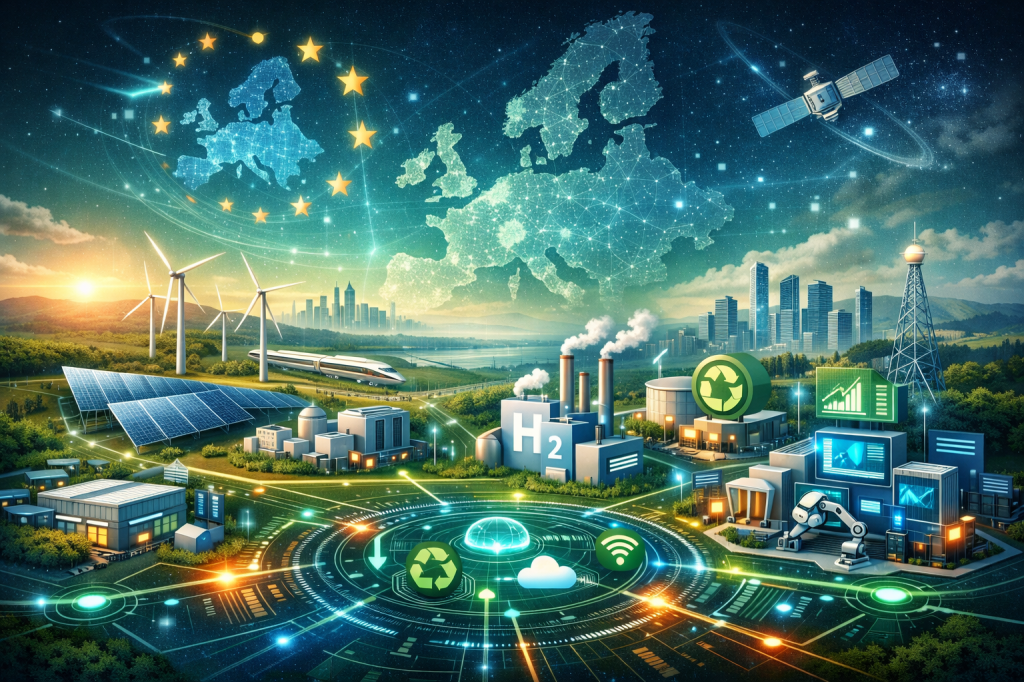
The European Cluster Collaboration Platform (ECCP) has become one of Europe’s most influential instruments for shaping the future of industrial ecosystems. What began in the early 2000s as a simple knowledge-exchange network for clusters has, by 2026, transformed into a sophisticated architecture of green-transition enablers, cross-sector innovation chambers, and resilience-building frameworks. This evolution mirrors Europe’s broader industrial journey—from the post-2008 recovery years to the urgent competitiveness pressures created by geopolitical fragmentation, supply chain security demands, and the global race for technological sovereignty.
From Coordination to Transformation: A Historical Anchor
Over the past two decades, clusters in Europe have shifted from functioning as local competence hubs to serving as structural nodes in pan-European industrial strategies. Initially, the objective was coordination—mapping clusters, facilitating networking, and enabling SME internationalisation. The ECCP now sits at the centre of Europe’s industrial vision by offering strategic tools that directly influence technology adoption, supply-chain redesign, and the integration of climate-neutral production norms. This transformation reflects the EU’s policy pivot after the pandemic, when disrupted supply chains exposed vulnerabilities in pharmaceuticals, electronics, and renewable-energy components, forcing Europe to move from efficiency-seeking globalisation toward resilience-oriented industrial autonomy.
Green Transition Tools: Driving the Next Wave of Competitiveness
ECCP’s green-transition support tools help clusters adopt climate-neutral pathways through sector-specific guidance on renewable integration, circular economy models, and energy-efficient manufacturing. These tools build on Europe’s 2030 and 2050 climate mandates and equip SMEs—traditionally slower in green adoption—with actionable models, peer-exchange labs, and readiness assessments. The critical insight is that Europe no longer views green compliance as regulatory formality; it is a competitiveness imperative. As carbon-border mechanisms and green-premium markets expand, clusters that embed sustainability into production will dominate regional value chains, while lagging clusters risk exclusion from future procurement and export markets.
Cross-Sector Collaboration: The New Driver of Innovation
A notable strength of ECCP’s framework is its emphasis on cross-sector collaboration, recognising that emerging innovations—whether in hydrogen, advanced materials, or industrial AI—do not follow sector boundaries. ECCP’s matchmaking tools and thematic platforms create structured convergence zones where automotive suppliers meet energy-storage specialists, agritech innovators engage with sensor manufacturers, and textile clusters collaborate with digital-solution providers. This model reflects Europe’s broader belief that the next productivity frontier lies in interdisciplinary recombination, not incremental improvements within isolated sectors.
Resilience and Industrial Autonomy: Learning from Global Disruptions
The ECCP has also developed resilience-support tools in response to global shocks—pandemic disruptions, shipping congestion, semiconductor shortages, and geopolitical tensions. These instruments help clusters map dependencies, evaluate sourcing risks, and diversify supply networks. European SMEs often lack the analytical capability to forecast multi-country supply shifts, and ECCP’s data-supported frameworks provide structured pathways to reduce exposure to high-risk inputs. More importantly, the tools embed Europe’s long-term ambition: strengthening industrial autonomy without abandoning global linkages—a philosophy termed “open strategic autonomy.”
A Critical and Futuristic Outlook: The Next Five Years
As Europe enters the 2026–2030 industrial cycle, ECCP’s role will intensify. Rapid advances in AI, robotics, and decarbonisation technologies will compel clusters to constantly redesign business models. The ECCP is likely to evolve from a knowledge platform to a real-time industrial intelligence network, offering predictive analytics, AI-driven cluster benchmarking, and carbon-transition simulations. However, the challenge lies in execution:
– Will SMEs adopt advanced tools quickly enough?
– Can Europe balance protectionist instincts with the need for global partnerships?
– Will clusters overcome fragmentation between high-innovation hubs in Western Europe and emerging industrial zones in Eastern and Southern Europe?
The future competitiveness of Europe’s industrial base depends on how effectively ECCP’s tools translate into on-ground transformation. The platform is strategically positioned, but its impact will hinge on SME capacity building, deeper investment flows, and stronger integration between industrial, digital, and climate policies.
#ECCP
#EuropeanClusters
#GreenTransition
#IndustrialResilience
#CrossSectorInnovation
#DigitalTransformation
#StrategicAutonomy
#SustainableManufacturing
#ClusterCompetitiveness
#FutureIndustrialEcosystems
 "Connecting communities, empowering nations: Unifying the Regional and Global Economy ."
Leave a comment