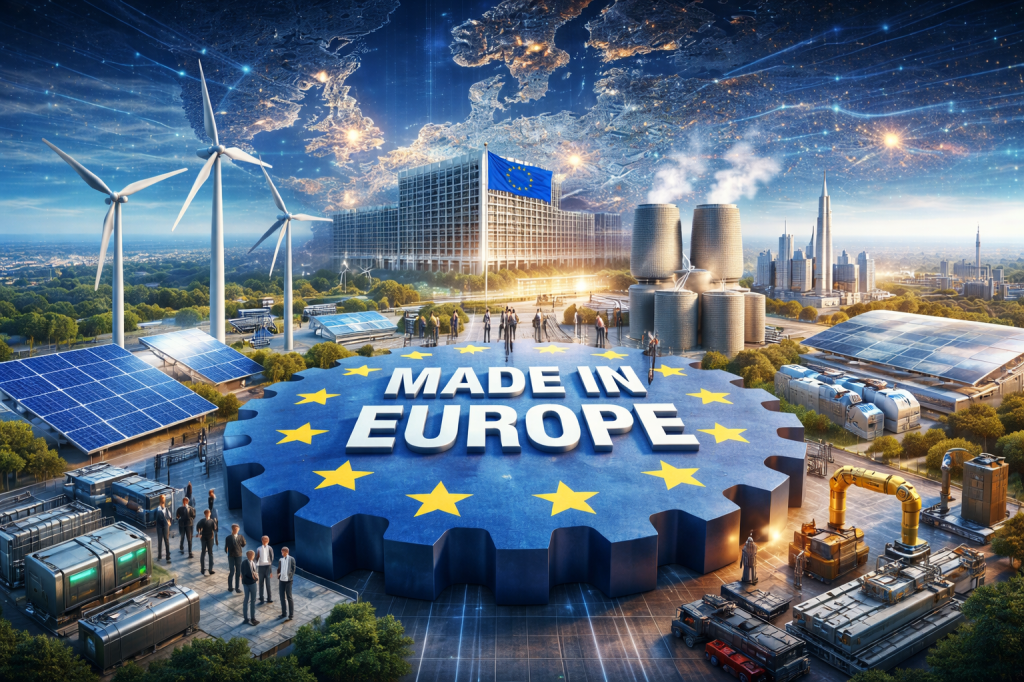
Introduction: Europe’s Long Arc of Industrial Sovereignty
Europe’s industrial landscape has historically been defined by deep technological strengths—Germany’s engineering backbone, France’s nuclear ecosystem, Italy’s manufacturing specialisation, and the Nordic countries’ leadership in sustainability. Yet, the 21st century has confronted the continent with challenges unseen since the post-war reconstruction: supply-chain fragilities exposed during COVID-19, energy insecurity amplified by the Russia-Ukraine conflict, rising costs due to carbon regulations, and aggressive industrial policies from the United States and China. It is within this evolving geopolitical economy that the European Commission’s delayed “Made in Europe” industrial policy must be interpreted—not as a bureaucratic lag, but as a marker of Europe recalibrating its long-term industrial sovereignty.
The Industrial Accelerator Act and the New Logic of Supply-Chain Resilience
The “Made in Europe” framework, aligned with the proposed Industrial Accelerator Act, signals a strategic departure from Europe’s earlier belief in hyper-globalisation. Minimum local-content thresholds in batteries, renewables, and nuclear technologies aim to re-anchor value creation within European borders. Historically, Europe trusted market openness; today, it is cautiously engineering resilience in sectors central to the twin transitions—green and digital. Europe’s reliance on external battery supply chains (particularly from East Asia) and the shocks to its renewable energy equipment markets have compelled policymakers to rethink industrial geography. The policy’s delay reflects internal debate: how to balance competitiveness, compliance with WTO norms, and the urgent need for self-sufficiency without triggering retaliatory industrial nationalism.
Europe’s Industrial Clusters: From Legacy Manufacturing to Strategic Autonomy
European industrial clusters—whether the automotive corridor in Germany, the semiconductor hubs in the Netherlands and Ireland, or the renewables belts across Spain and Denmark—have long been the engines of regional development. But the new industrial strategy shifts their purpose from traditional agglomeration economies to strategic autonomy hubs. The “Made in Europe” framework envisions clusters not just as production zones but as sovereignty infrastructures, embedding R&D, advanced manufacturing, recycling loops, and regulatory compliance into single territories. Historically, clusters were market-driven ecosystems; now, they are becoming policy-driven tools for resilience, reflecting the EU’s desire to match China’s coordinated industrial planning and the U.S. industrial subsidies under the Inflation Reduction Act.
Green Technologies and the New Industrial Burden
Europe’s commitment to climate neutrality has simultaneously been its strength and vulnerability. While the EU leads in offshore wind, nuclear research, and clean hydrogen policy frameworks, its industries face high energy costs, stringent carbon obligations, and global competition from subsidized imports. The “Made in Europe” policy attempts to close this competitiveness gap by insisting that European green technologies incorporate minimum EU value addition. This represents a historical pivot: Europe is shifting from being the world’s norm-setter (through regulatory power) to being a more assertive producer, aiming to reclaim lost manufacturing ground in solar, batteries, and critical minerals processing. Yet the risk is real—if executed poorly, these thresholds may raise costs and slow green deployment, contradicting Europe’s own climate timelines.
Critical Minerals, Nuclear Revival, and Strategic Dependencies
The inclusion of nuclear and critical minerals under “Made in Europe” reveals Europe’s deeper anxieties. Decades of deindustrialisation pushed Europe into dependence on external suppliers for rare earths, battery components, and even enriched uranium. The policy underscores a silent admission: Europe’s energy transition cannot rely on global markets alone. Historically, European nuclear capability placed the region at the forefront of energy security. The new framework seeks to revive this strategic strength, promoting domestic fuel-cycle capabilities, advanced reactors, and cross-border cooperation. But tensions remain—between green political factions skeptical of nuclear energy and pragmatic industrial lobbies demanding long-term predictability.
The Global Ripple Effect: Open Strategic Autonomy or Industrial Fragmentation?
A futuristic perspective reveals that Europe’s choices may reshape global industrial geography. If executed with balance, the “Made in Europe” framework could create a third pole in the global industrial system—distinct from the U.S. subsidy model and China’s state-capitalist production machine. However, the opposite risk looms large: fragmented supply chains, WTO disputes, cost escalations, and strained relations with trading partners. As Europe’s internal debates intensify—particularly within the European Commission and member states with differing industrial capacities—the question is whether the policy will emerge as a unifying industrial vision or a patchwork of protectionist impulses.
A Forward Outlook: Europe’s Industrial Future Depends on Integration, Not Isolation
The delayed launch offers Europe a critical window. Success will depend not merely on mandating local content but on nurturing high-density industrial clusters, accelerating permitting, harmonising standards, deepening digitalisation (AI, automation, quantum), and expanding research networks across the bloc. The future of “Made in Europe” lies in making clusters more competitive than their global alternatives, not simply more protected. Historically, Europe excelled whenever coordination triumphed over fragmentation—from the Single Market to Erasmus to Airbus. The coming decade requires that same collaborative ambition, this time across batteries, renewables, nuclear, and advanced manufacturing.
Europe’s Industrial Reinvention Has Begun, But Its Trajectory Is Uncertain
The “Made in Europe” framework symbolizes a profound shift in Europe’s industrial identity. It is both a corrective to past vulnerabilities and a blueprint for a resilient future. But its effectiveness will depend on Europe’s ability to transform legacy clusters into innovation-led, globally competitive ecosystems. If Europe succeeds, it will redefine what industrial sovereignty means in a multipolar technological era. If it fails, it risks losing ground in the race for strategic industries that will shape the economic and geopolitical architecture of the 2030s and beyond.
#IndustrialSovereignty
#MadeInEurope
#SupplyChainResilience
#StrategicAutonomy
#GreenTechnologies
#CriticalMinerals
#IndustrialAcceleratorAct
#EuropeanClusters
#EnergySecurity
#AdvancedManufacturing
 "Connecting communities, empowering nations: Unifying the Regional and Global Economy ."
Leave a comment