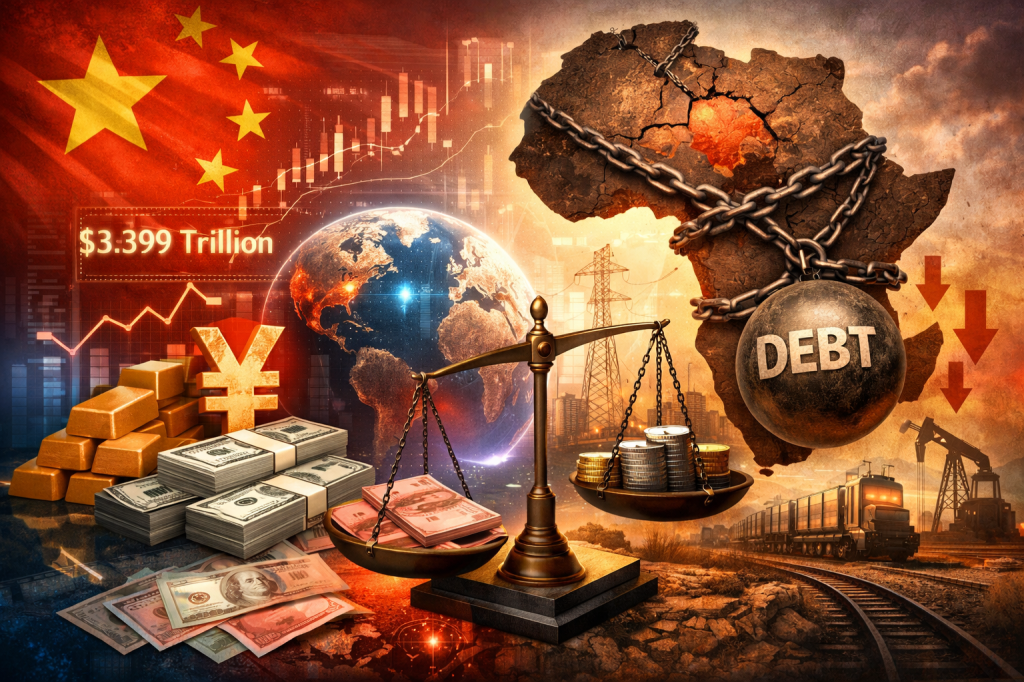
China’s foreign exchange behaviour and its financial engagement with Africa are undergoing a profound rebalancing—one that marks a historic reversal in global capital flows. The simultaneous rise in Chinese dollar reserves and decline in fresh lending to African economies signals not just a cyclical trend but a structural pivot in Beijing’s global financial strategy.
A Decade-High Surge in Dollar Reserves and Its Strategic Interpretation
China’s dollar reserves touching USD 3.399 trillion in January 2026, the highest since late 2015, reflects an interesting moment in the global monetary cycle. The buildup follows seven consecutive months of increases, helped partly by a softer U.S. dollar but also by Beijing’s deliberate policy of maintaining liquidity buffers amid geopolitical uncertainty. Historically, China’s reserves surged during manufacturing-led export booms (2001–2013), but the recent uptick comes despite slower GDP growth, pointing to a strategy focused on risk-proofing the economy.
Simultaneously, China is reducing its exposure to U.S. Treasuries, bringing its holdings down to roughly USD 688 billion by end-2025. The message is clear: Beijing wants the dollar’s liquidity without the political vulnerability of U.S. sovereign instruments. This duality—accumulating reserves while diversifying assets—marks a carefully calibrated hedging strategy as the world edges toward currency multipolarity.
Declining Loans to Africa: From Aggressive Expansion to Selective Engagement
At the same time, China’s lending to Africa has collapsed to USD 2.1 billion in 2024, a 46% decline from previous years and the lowest since systematic tracking began. This is a stark contrast from the USD 28.8 billion peak in 2016, when Belt and Road infrastructure projects dominated Beijing’s foreign policy.
This shift is not sudden; it reflects an accumulated fatigue from debt distress episodes in Zambia, Ghana, and Ethiopia, and a broader reassessment of the long-term commercial viability of megaprojects. Historically, China financed African infrastructure with the expectation of resource-backed repayment or geopolitical goodwill. But today, Beijing is transitioning from “builder-financier” to “collector-investor,” prioritising loan recovery and targeted investments over wholesale lending.
Africa’s Net Outflow to China: A Reversal of Capital Direction
Perhaps the most dramatic development is the reversal of net financial flows. Africa is now paying China over USD 22 billion annually in debt service, exceeding new loan inflows—a trend that did not exist during the first two decades of China–Africa financial cooperation. The five-year swing of USD 52 billion toward net repayments marks a historic turning point in the relationship.
This shift has intensified debates around dependency, debt sustainability, and the long-term consequences of resource-collateralised loans. Yet from China’s perspective, it represents a rational tightening after two decades of rapid capital deployment, especially in sectors such as energy and transport that absorbed over USD 115 billion cumulatively.
From Dollar Loans to Yuan Financing and FDI
A deeper transformation lies beneath the numbers. China is gradually reducing dollar-denominated exposure to sovereign borrowers and moving toward:
Yuan-denominated loans
Private-sector FDI, particularly in manufacturing and logistics
Smaller, commercially viable projects instead of prestige megaprojects
This evolution mirrors China’s own domestic economic transition from heavy infrastructure to high-tech and consumption-driven sectors. In essence, Beijing is exporting not just capital but a new model of disciplined, market-based overseas engagement aligned with its long-term industrial goals.
A Historical Perspective on China–Africa Finance
The early 2000s marked the “golden phase” of China–Africa cooperation, with China funding railways, ports, hydropower, and special economic zones. These projects were emblematic of China’s outward push following WTO accession and Africa’s search for alternatives beyond traditional Western lenders.
However, as global growth slowed and debt vulnerabilities surfaced, both sides began recalibrating. What we are witnessing today is the next logical stage: maturation of bilateral financial ties, where cautious lending replaces exuberant capital flows.
Currency Multipolarity, Risk Hedging, and New Power Equations
Looking ahead, several trends are likely to shape the next decade of China’s financial interaction with Africa and the world:
Shift Toward Currency Multipolarity
China’s rising reserves signal that the dollar remains essential, but the growing use of yuan in Africa hints at future diversification. A partial de-dollarisation in African trade may emerge, driven by China’s digital yuan experiments and cross-border payment systems.
Selective Geoeconomic Engagement
Future Chinese financing will likely concentrate on:
critical minerals,
renewable energy value chains,
logistics hubs, and
digital infrastructure.
This aligns with China’s need to secure inputs for its green transition and advanced industries.
Debt Risk Repricing
African countries will face a new landscape: fewer cheap loans, stricter repayment terms, and a rising emphasis on commercial logic. Beijing’s focus on repayment today may push African governments toward more diversified financing strategies tomorrow.
Renewed Competition with Western Institutions
As China tightens lending, the vacuum may be filled by Western development finance institutions reinforcing “high-standard finance” narratives. The geopolitical contest for African influence will increasingly shift from hard infrastructure to data, technology, climate finance, and supply-chain partnerships.
China’s rising dollar reserves and declining Africa lending are not isolated events—they represent a structural recalibration in global finance. This shift blends historical experience with future positioning, signalling that China is preparing for a more cautious, strategically selective, and currency-diversified future. The China–Africa relationship, once defined by large-scale capital flows, is entering a new era where debt sustainability, currency strategy, and geopolitical competition will shape the next chapter. #
DollarReserves
#ChinaAfricaFinance
#DebtSustainability
#YuanInternationalisation
#GeoeconomicStrategy
#BRITransition
#GlobalCapitalFlows
#CurrencyMultipolarity
#SovereignDebtCrisis
#StrategicDecoupling
 "Connecting communities, empowering nations: Unifying the Regional and Global Economy ."
Leave a comment