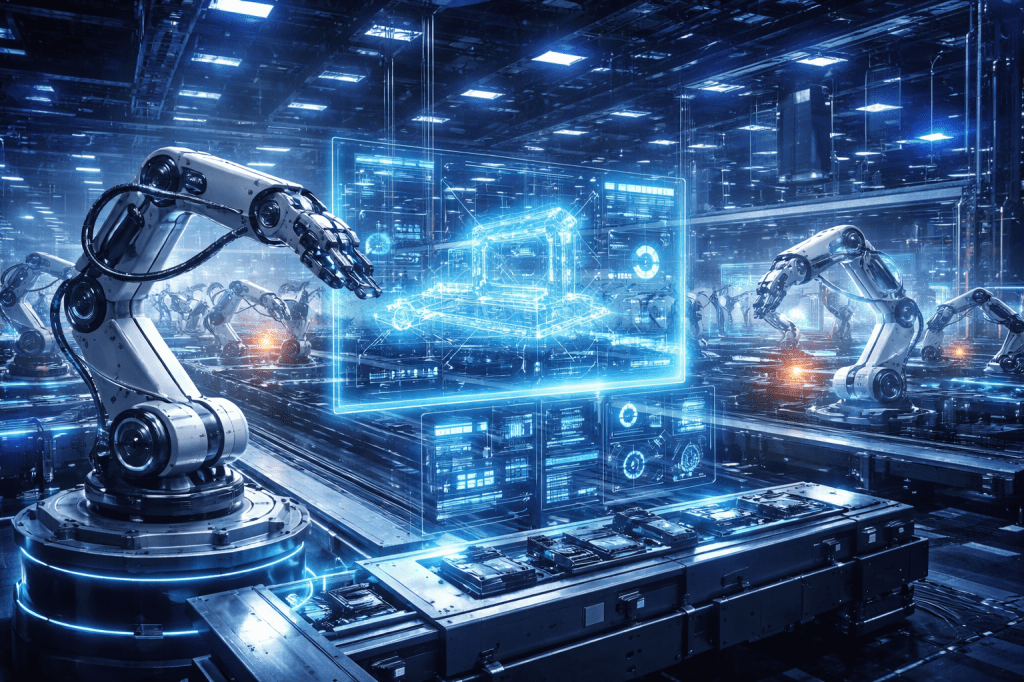
Industrial Automation’s Historical Arc
Industrial automation has evolved through distinct waves—mechanisation in the 18th century, electrification in the early 20th century, programmable logic control in the 1970s, and digital production in the 2000s. Each wave expanded productive capacity but remained limited by rigid systems. Early robots could repeat tasks with precision, but they lacked adaptive intelligence. The long-standing challenge was simple: how can machines perceive, reason, learn, and interact with physical environments the way humans do? This question created the foundation for today’s shift toward AI-driven automation, reshaping how factories, warehouses, logistics networks, and service robots operate.
Rise of AI-Augmented Robotics: NVIDIA’s Inflection Point
The launch of NVIDIA’s expansive AI robotics and automation suite marks a decisive technological pivot—robots are no longer mere tools; they are becoming intelligent agents capable of perception, motion planning, simulation, and autonomous decision-making. This shift is powered by high-performance computing, transformer models, 3D simulation ecosystems, digital twins, and domain-specific AI frameworks. By integrating advanced GPU compute with industrial automation stacks, a new category—AI-augmented physical automation—is emerging, where robots can learn tasks faster, adapt in real time, and perform in complex environments that previously required human intuition.
Why This Shift Matters: Data, Productivity, and Global Competitiveness
Global manufacturing contributes nearly 16% of world GDP, but productivity gains have slowed in the last 15 years. Labour shortages in logistics, warehousing, construction, and precision manufacturing are widening—especially in ageing economies. The International Federation of Robotics (IFR) reports that nearly 553 robots are deployed per 10,000 workers in advanced economies, but adoption remains uneven. With AI-powered robotics, the productivity frontier moves again. Robots begin to perform tasks involving unpredictability: picking deformed objects, managing chaotic warehouse layouts, navigating dynamic shop floors, and adjusting to varied product designs. This represents a leap from deterministic automation to probabilistic, learning-based automation.
The Simulation Revolution: Digital Twins as the New Factory Floor
One of the most transformative developments is the rise of photorealistic simulation. Earlier industrial engineering relied on static CAD modelling, but today, fully simulated digital twins allow companies to train robots, test workflows, and optimise system design before any hardware is deployed. This reduces operational costs, energy consumption, and error rates. AI agents trained in simulation can be transferred (“sim-to-real”) to physical machines with high reliability. Historically, industrial automation required months of integration; now, design-to-deployment cycles are shrinking dramatically—sometimes from months to days.
Risks, Gaps, and Socio-Technical Challenges
While the benefits are immense, the AI-robotics transition raises legitimate concerns. The dependence on high-performance compute infrastructure creates geopolitical risks in semiconductor supply chains. Workforce displacement is a critical issue—automation will eliminate repetitive physical tasks, but new jobs may require advanced skills that many workers lack. Energy consumption of large-scale AI models could challenge sustainability commitments. Cybersecurity risks intensify as robots become connected systems capable of autonomous decision-making. The global regulatory landscape remains fragmented, and developing countries may struggle to keep pace with capital-intensive automation transitions.
Toward Physical AI Ecosystems
The next decade will see the rise of “physical AI ecosystems,” where intelligent robots interact with humans, machines, supply chains, and digital platforms. Cobots will become mainstream in small and medium enterprises. Autonomous mobile robots (AMRs) will manage warehouses end-to-end. Construction sites will deploy AI-driven inspection drones and robotic scaffolding. Precision agriculture will adopt robotics for harvesting, fertilising, and crop monitoring. Healthcare will witness the rise of surgical robots guided by real-time AI. And manufacturing hubs across Asia—especially India, Vietnam, Indonesia—will compete to build integrated automation parks. The world is entering a phase where economic competitiveness is directly correlated with AI intensity and robot density.
#AIautomation #IndustrialRobotics #DigitalTwins #PhysicalAI #SmartManufacturing #AutonomousSystems #Industry40 #FutureFactories #SimulationAI #GlobalCompetitiveness
 "Connecting communities, empowering nations: Unifying the Regional and Global Economy ."
Leave a comment