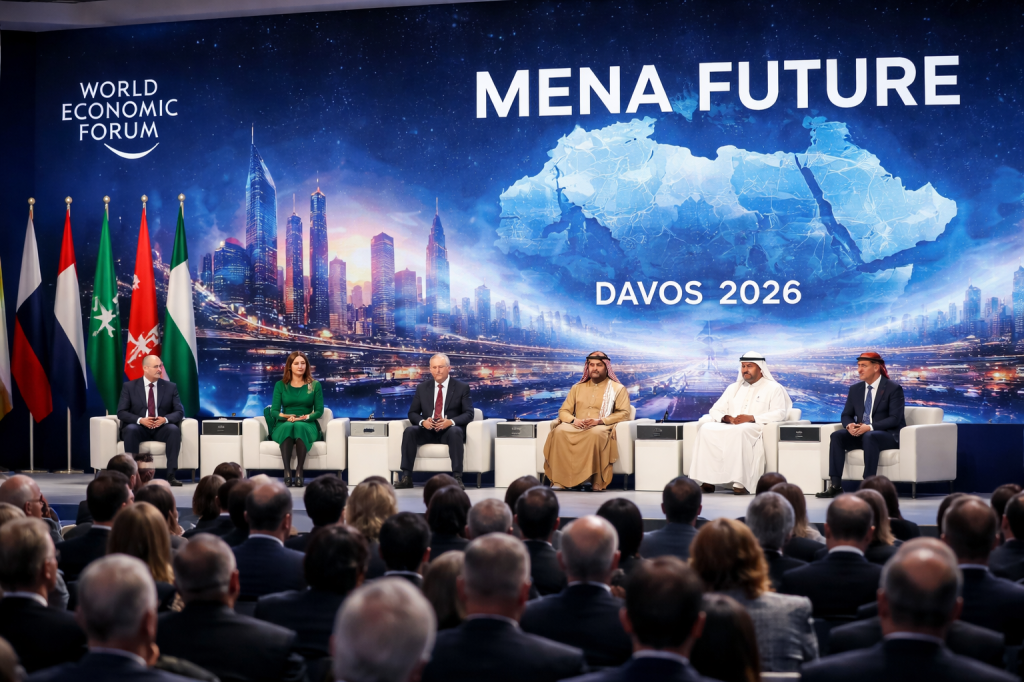
At Davos 2026, the Middle East and North Africa emerged not only as a region grappling with geopolitical uncertainty but also as one steadily positioning itself for long-term transformation. The World Economic Forum’s annual meeting, built around the theme of “A Spirit of Dialogue,” offered a rare window into how MENA leaders are balancing ambition with realism. What stood out this year was a clear strategic shift—moving from reactive crisis-management to proactive institution-building, technology adoption and regional economic integration. While the global environment remains turbulent, the tone from MENA representatives was unmistakably forward-looking and optimistic, signaling an attempt to craft a new narrative for the region.
Much of this optimism was anchored in the economic and policy direction articulated by North African countries, especially Egypt. Speaking at the Forum, Egypt projected an assertive development agenda rooted in private-sector expansion, digital reforms and stronger economic partnerships. The message from Cairo was both simple and strategic: sustainable economic growth now depends on unleashing business ecosystems and modernizing regulatory frameworks. The announcement of a forthcoming Country Strategy Meeting in Egypt later in 2026 further reinforced this approach, symbolizing deeper collaboration between the WEF and Egyptian policymakers and signalling Egypt’s intention to play a more decisive role in shaping global conversations around growth and stability.
Morocco, meanwhile, used Davos to showcase the scale and seriousness of its infrastructure push ahead of hosting the 2030 FIFA World Cup. But the story extends far beyond event preparation. The investments highlighted—from airports and logistics corridors to digital networks and skill development—reflect a wider national strategy aimed at anchoring Morocco more firmly into regional and global economic circuits. The country’s emphasis on youth capability building and sustainable tourism also underscores a broader shift in how MENA nations are attempting to create long-term economic multipliers rather than short-term bursts of activity.
Technology and artificial intelligence emerged as cross-cutting themes that connected Gulf nations, North African economies and broader regional aspirations. The UAE and Saudi Arabia reiterated their commitment to scaling AI adoption, building national skill pools, and embedding advanced digital infrastructure into their economic diversification models. What made this year’s conversations notable was the insistence on inclusive AI—technology that is accessible, ethical and socially aligned. In a region historically shaped by resource-based growth, the pivot toward digital capabilities marks a profound structural change, one aimed at preparing the workforce for a future in which competitive advantage increasingly comes from knowledge ecosystems rather than natural resources.
Yet, beneath the economic and technological optimism, Davos 2026 did not shy away from the political realities shaping the region. Discussions around peace, particularly relating to Gaza and broader Middle Eastern stability, remained central. Leaders acknowledged that while strong economic plans can foster resilience, genuine regional transformation requires durable peace and trust-building among states. The recognition that stability and development are inseparable reflects a mature geopolitical understanding—one that views peace not as a political aspiration alone but as an economic enabler.
What ultimately emerged from the Davos conversations is a portrait of a region ready to rewrite its global economic role. MENA is no longer content with being perceived only through narratives of conflict or volatility. Instead, it is presenting itself as a hub of possibilities—anchored in digital innovation, infrastructure upgrading, rising private-sector dynamism and an expanding commitment to international cooperation. The region’s leaders appear increasingly aware that global economic systems are undergoing a structural shift toward “managed interdependence,” where resilience matters as much as efficiency and where partnerships must outlast crises.
In many ways, the MENA region’s message at Davos was both simple and ambitious: the world may be uncertain, but the region is choosing direction over drift. Its blend of confidence, pragmatism and strategic clarity signals a new phase—one where economic transformation is not merely aspirational but actively unfolding. As global power balances evolve through the rest of the decade, MENA’s steady but determined repositioning may become one of the more quietly significant developments shaping the future of global economic governance.
#Davos2026
#EconomicTransformation
#PrivateSectorGrowth
#DigitalInnovation
#AIAdoption
#RegionalStability
#InfrastructureDevelopment
#StrategicPartnerships
#GlobalInterdependence
 "Connecting communities, empowering nations: Unifying the Regional and Global Economy ."
Leave a comment