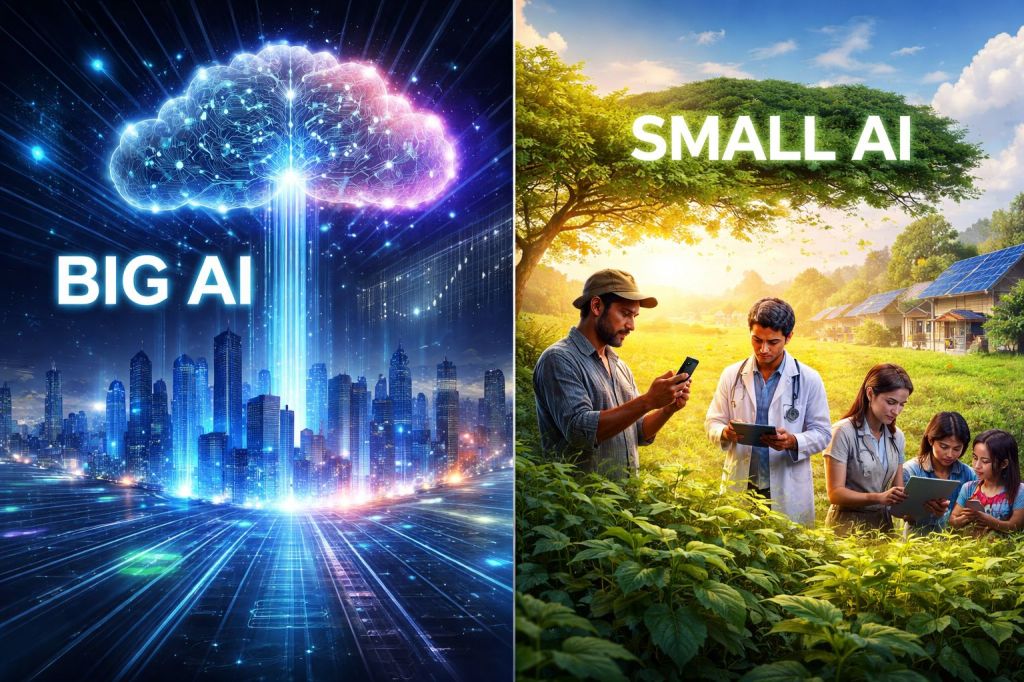
The World Bank President Ajay Banga’s distinction between Big AI and Small AI is emerging as one of the most important intellectual frameworks for understanding how artificial intelligence will reshape global development, labour markets, and economic resilience over the coming decade. This is not merely a technological categorisation—it is a geopolitical lens that reveals how nations will grow, how people will work, and how productivity will evolve in the age of intelligence.
Big AI: The Industrial Revolution of Computation
Big AI refers to large, centralised, resource-intensive models—massive language models, multimodal systems, and generative intelligence that demand gigawatts of electricity, sophisticated semiconductors, and dense data pipelines. Historically, every technological breakthrough—steam power, electricity, the internet—emerged in the industrial core before trickling outward. Big AI follows the same path, dominated by countries with deep capital pools, leading research institutions, and powerful technology corporations.
Big AI carries enormous potential: high-end design automation, drug discovery, financial modelling, and enterprise optimisation. Yet it also amplifies global fault lines. If controlled by a few countries and a small group of corporations, it risks replicating the long-standing historical inequality of the industrial age—where the world’s technological frontier widened the gap between those who had access and those who didn’t. In labour markets, its impact is already visible: white-collar hiring is slowing, repetitive cognitive tasks are being absorbed by automation, and job descriptions in the Global North are being rewritten.
But importantly, Big AI has not yet triggered mass job displacement. Instead, it has induced a more cautious hiring environment in service-heavy economies. The long-term concern lies in how fast these systems scale and who gains ownership of the productivity surplus they create.
Small AI: The Quiet Revolution of Inclusion
Small AI, on the other hand, is the story of democratization. These are lean, localised, low-compute AI tools built for real-world constraints—running on phones, operating in low-bandwidth environments, and designed around the rhythms of everyday life. It is historically similar to the mobile revolution, when feature phones transformed banking in Kenya, market access in India, and micro-entrepreneurship across Southeast Asia.
Small AI is simple, inexpensive, and locally relevant. It diagnoses crop diseases through a picture, improves classroom learning through real-time translation, detects early-stage health risks in rural clinics, and assists micro-enterprises with inventory management. It does not replace human labour—it augments it. This is why Banga calls it a “secret weapon”—because it boosts productivity without threatening employment, especially in emerging economies where livelihoods depend on incremental efficiency rather than large-scale automation.
Across India, Small AI is already expanding farmer income, reducing errors in informal sector operations, and empowering frontline workers in healthcare and education. It represents a new form of “distributed intelligence,” in which development does not wait for data centres, clouds, or high-end chips—it flows directly into the hands of workers.
Technology Has Always Been Unequal
From the printing press to the digital revolution, every wave of innovation has been unevenly distributed. Nations that adopted earlier gained decades of advantage—economic, military, and institutional. AI is no different. Big AI resembles the power concentration of early factories: capital-intensive, infrastructure-heavy, and geographically concentrated. Small AI resembles the later phase of technological diffusion, where tools become lightweight, decentralised, and accessible.
In this historical cycle, emerging markets have a unique opportunity. They may not lead in Big AI infrastructure, but they can leapfrog through Small AI applications—just as they skipped landline telephony and moved straight to mobile.
Employment Impact: A Tale of Two Futures
The employment effects of Big AI and Small AI diverge sharply.
Big AI changes white-collar labour markets, especially in advanced economies. Employers are cautious about roles in customer service, data processing, design support, legal drafting, and content creation—all areas where generative systems excel. We are not witnessing widespread layoffs, but there is a structural slowdown in hiring, creating a bottleneck for new entrants into the labour force.
Small AI does something fundamentally different. It raises productivity without removing people from the value chain. It helps farmers produce more, teachers teach better, nurses diagnose faster, and micro-entrepreneurs operate more efficiently. Instead of replacing jobs, it makes existing jobs more viable—a critical factor in emerging economies facing the pressure of 1.2 billion youth competing globally for only 400 million future jobs.
Thus, the world is simultaneously experiencing anxiety in high-income economies and optimism in developing ones—an unusual divergence rarely seen in technological cycles.
A Futuristic Outlook: Two AI Ecosystems, One Converging Destiny
The next decade will likely witness a dual-track future:
Big AI will shape global industries; Small AI will shape daily life.
Big AI will transform corporations; Small AI will transform communities.
Big AI will be capital-intensive; Small AI will be people-intensive.
For countries like India, Indonesia, Brazil, Nigeria, and Bangladesh, the development strategy will revolve around harnessing Small AI for inclusion while selectively investing in Big AI infrastructure to avoid dependency on global digital powers.
The risk is not that AI will replace jobs—the risk is that countries that fail to build either AI capability will become digitally irrelevant. The challenge, therefore, is to balance industrial ambitions with grassroots empowerment.
The Real Question for the Future
Will AI divide the world into technological haves and have-nots
—or will Small AI create the first truly inclusive intelligence revolution?
History suggests that diffusion eventually prevails. But diffusion is not automatic—it must be designed. Ajay Banga’s framework offers a roadmap for this: let Big AI push the frontier, but let Small AI define the foundation.
The countries that combine both will lead the next stage of global development.
#BigAI #SmallAI #AIInclusion #FutureOfWork #DigitalDevelopment #ProductivityRevolution #EmergingEconomies #TechEquity #AIEmployment #InclusiveGrowth
 "Connecting communities, empowering nations: Unifying the Regional and Global Economy ."
Leave a comment