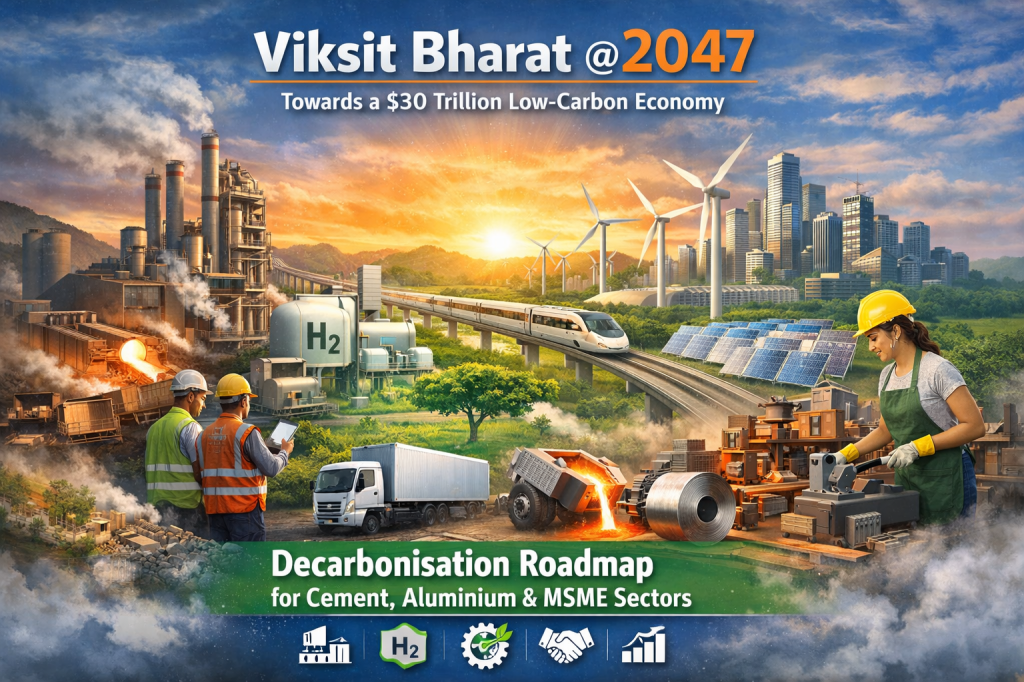
India’s aspiration to become a $30 trillion economy by 2047 is inseparable from the evolution of its industrial base. Historically, industrialisation has driven economic transformation—from the steel-led expansion of the 1950s, to the energy-intensive infrastructure boom of the 1990s, to the MSME-driven growth engine of the early 2000s. But as the country moves toward Viksit Bharat @2047, a new development paradox has become central: how to accelerate industrial growth while simultaneously achieving deep decarbonisation. With industry contributing nearly 24% of India’s total greenhouse gas emissions, this transition is not optional—it is foundational to safeguarding long-term competitiveness.
Industry at a Crossroads: Growth Imperatives and Carbon Pressures
Sectors such as cement, aluminium, and MSMEs sit at the heart of India’s growth story. Cement is the backbone of infrastructure, producing over 380 million tonnes annually; aluminium is a critical input for mobility, renewable energy, and the digital economy; and MSMEs represent over 30% of GDP, 45% of manufacturing output, and 110 million jobs. Yet these very sectors are also among the most carbon-intensive, shaped by decades of fossil-heavy energy systems, historical under-investment in R&D, and global underpricing of carbon costs.
Internationally, the landscape is shifting rapidly. The European Union’s CBAM, the U.S. clean-tech race, and Southeast Asia’s low-carbon manufacturing push are rewriting the rules of competitiveness. For Indian industry, the question is no longer whether decarbonisation is needed—it is whether it will be a catalyst for global integration or a barrier.
A New Institutional Push: NITI Aayog’s Sectoral Decarbonisation Effort
Responding to this urgency, NITI Aayog constituted Technical Working Committees on Cement, Aluminium, and MSME decarbonisation—a rare cross-sectoral effort recognising both scale and heterogeneity in India’s industrial landscape. The committees engaged ministries, industry associations, academic experts, and technology leaders, culminating in the launch of the report:
“Decarbonisation Roadmap for Aluminium, Cement, and MSME Sectors.”
The report represents a significant institutional shift: government, industry, and knowledge partners co-creating a credible and scalable pathway, moving beyond pilot projects toward sector-wide transformation.
Hard-to-Abate, But Impossible to Ignore
Cement and aluminium are labelled hard-to-abate for structural reasons—process emissions, heat intensity, and material chemistry. MSMEs, on the other hand, face a different problem: fragmented energy use, low technology adoption, informal practices, and limited access to green finance. This three-pronged challenge reflects India’s industrial diversity and requires differentiated but coordinated action.
The roadmap emphasises a phased approach:
• Short-term (2025–2030): energy efficiency, waste heat recovery, electrification, digital monitoring
• Medium-term (2030–2040): green hydrogen blending, low-carbon materials, circularity
• Long-term (2040–2050): full-scale fuel switching, carbon capture, green supply chains
The insight is clear: decarbonisation is not a single leap but an evolving technology curve, where competitiveness depends on early adoption.
The MSME Challenge: Green Transition Without Exclusion
India’s 63 million MSMEs must navigate a world where buyers demand traceability, regulators demand compliance, and global markets demand low-carbon production. Historically, MSMEs were shielded from these pressures. Today, they sit at the frontline of new carbon-linked trade regimes. Without support, the risk is dual: exclusion from global value chains and domestic job vulnerability.
The roadmap addresses this by outlining pathways that combine low-cost technologies, shared infrastructure, cluster-level decarbonisation, digital monitoring tools, and green finance mechanisms—including blended finance and credit enhancement.
Competitiveness in a Carbon-Constrained Global Economy
Decarbonisation is often misunderstood as a cost. The roadmap recognises it as an economic opportunity. Low-carbon materials are becoming premium products. Markets are shifting toward lifecycle-based procurement. Global capital is flowing disproportionately into green technologies. India’s long-term competitiveness will depend on how quickly industries internalise the economics of carbon pricing, resource efficiency, and technology modernisation.
Historically, India’s industrial transitions—whether adoption of LPG reforms in the 1990s or GST in 2017—were resisted initially but later became accelerators of productivity. Decarbonisation has the same potential to modernise value chains and deepen India’s integration into global markets.
A Critical Step Toward a Resilient Industrial Future
The launch of the decarbonisation roadmap at the Dr. Ambedkar International Centre was more than a report release—it was a signal of collective intent. Ministries, industry associations, think tanks, and technology partners participated with a shared understanding: India cannot reach Viksit Bharat @2047 without a low-carbon industrial system.
This roadmap provides:
• A common framework for collective action
• Technology and cost pathways aligned with India’s unique industrial context
• A bridge between local competitiveness and global sustainability norms
• A foundation for green jobs and inclusive growth
But it is not the final destination. India’s decarbonisation journey will require continuous iteration, adaptive policy, and large-scale industry participation.
Growth, Green Transition, and National Ambition
As India positions itself as a global manufacturing hub, the coming decades will define whether it seizes the opportunity to lead in low-carbon industrial policy or becomes vulnerable to external regulatory shocks.
The roadmap’s message is clear: India’s industrial growth and India’s climate commitments are not competing goals—they are mutually reinforcing pillars of a resilient, competitive, and future-ready economy.
#ViksitBharat2047
#Decarbonisation
#NetZeroTransition
#GreenIndustrialPolicy
#LowCarbonManufacturing
#HardToAbateSectors
#SustainableMSMEs
#IndustrialCompetitiveness
#EnergyTransition
#ClimateActionIndia
 "Connecting communities, empowering nations: Unifying the Regional and Global Economy ."
Leave a comment