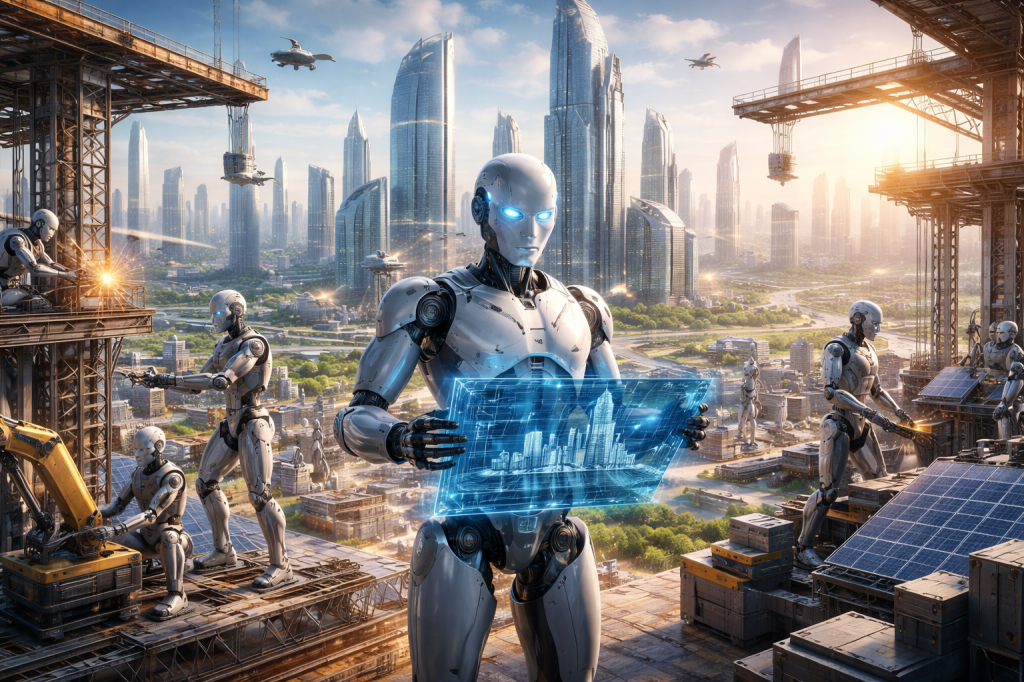
Human civilisation has always grown by expanding the productivity of each individual. From the plough to the steam engine, from electricity to computers, every great economic leap has followed an expansion in what a single human can produce within a unit of time. Today, we stand at the threshold of a far more disruptive transformation—one that questions the very formula on which centuries of economic thinking have been built. If the economy is simply average productivity per person multiplied by the number of people, then the arrival of general-purpose humanoid robots and fully autonomous vehicles breaks the second variable entirely. For the first time in history, the productive population is no longer limited by biological birth, lifespan, or human capability. It can expand infinitely.
From Human Constraints to Machine Multipliers
Historically, productivity was bound by human physical strength, cognitive limits, and working hours. Even the most industrialised societies could not escape the fundamental bottleneck: labour supply. Robotics in the 20th century mechanised factories, but robots remained specialised—built for single tasks and restricted environments. The leap now underway is qualitatively different. General-purpose humanoid robots are designed not as factory arms but as workers: capable of mobility, perception, problem-solving, and autonomous decision-making. Combined with autonomous vehicles—logistics systems that can move products, people, and raw materials without rest—the productive capacity of an economy detaches from human labour constraints.
This is the moment where microprocessors start doing what the population growth curve once did for economies. The labour force becomes software-driven, expandable, scalable, and nearly inexhaustible.
The Economics of Abundance: A Historical Perspective
The idea of an “age of abundance” is not new. After the Industrial Revolution, economists like John Stuart Mill predicted an era where material needs would be easily met. Yet every era of growth—from steam to electricity to computing—still depended on human workers as the core of economic activity. Even the digital revolution of the last 30 years made workers more productive but never replaced the worker as the centre of the economic equation.
What is different today is the convergence of AI with robotics. Historically, machines replaced muscle, not mind. AI now replaces decision-making, learning, adaptability, and coordination—functions once believed to be uniquely human. This blurs the boundary between “labour” and “technology” in unprecedented ways. For the first time since Adam Smith wrote about labour productivity in The Wealth of Nations, the very definition of labour is being rewritten.
The Decline Toward Zero Cost: Goods, Services, and the New Market Structure
When AI-driven robots can build anything—from homes to cars to microchips—and autonomous systems can deliver it, the cost of production collapses. Not instantly, but directionally. Goods that once required expensive labour, complex supply chains, or multiple specialised skill sets become cheap because the marginal cost of deploying another robot is tiny compared to training or compensating a new worker.
Services traditionally seen as “human only”—elderly care, retail assistance, security, maintenance, cooking, construction—are increasingly replicable with intelligent robotics. Economic history shows that cost declines drive expansion: from printed books to automobiles to computing power. With AI-robotic systems, this decline could approach near-zero for many sectors. That creates the possibility of universal access to high-quality goods and services—what futurists describe as the next phase of the global economy.
The New Productivity Frontier: Infinite Labour, Expanding GDP
If productivity per unit of labour increases exponentially, and the number of labour units (i.e., humanoid robots) can increase without biological constraints, the ceiling for GDP becomes theoretically infinite. This challenges the worldview of classical economists who built systems assuming scarcity. It also challenges current statistical systems—GDP, labour force participation, unemployment rate—all built around the human worker. When “labour” becomes a software parameter, economic modelling must evolve.
The futurist view is that the next global superpower will be the country that builds and deploys humanoid robots fastest, not the one with the largest population or the cheapest labour. The competitive advantage shifts from demographic size to robotic scale.
The Politics and Risks of a Limitless Economy
While the narrative of abundance is compelling, the transition will be disruptive. Societies face several critical risks:
Economic Displacement: Human workers may struggle to find roles where AI outperforms them in speed, accuracy, and cost.
Inequality of Access: If only a few corporations or nations control robotic labour, wealth concentration may intensify.
Resource Bottlenecks: Even limitless robots require rare minerals, energy, and advanced semiconductors—industries still facing geopolitical tension.
Regulation and Ethical Dilemmas: Governments have always regulated labour; regulating “synthetic workers” will raise unprecedented debates.
Security and Autonomy Risks: Intelligent robots integrated into infrastructure create new vulnerabilities—hacking, system failure, or misuse.
These challenges demand political, technical, and ethical frameworks that match the scale of technological change.
The Future Beyond Abundance: What Happens After the Cost Curve Collapses
If economies truly enter an era where manufactured goods and most services cost close to nothing, the traditional market logic changes. Human creativity, experience, relationships, culture, and problem-solving—the “economy of meaning”—could become central. Wealth may shift from material possession to access to knowledge, identity, and shared experiences. Economic growth might be measured not in tonnes of output but in the quality of life and the advancement of scientific discovery.
In effect, humanity moves from survival economics to possibility economics.
Entering the Post-Scarcity Frontier
General-purpose humanoid robots and autonomous systems do not merely automate work—they dismantle the limits on economic growth that have defined human civilisation for thousands of years. The future economy is no longer bound by population, labour markets, or physical capability. It becomes a system where intelligent, scalable, tireless machines expand production at rates previous generations could not imagine. The path will be turbulent, filled with ethical and political tensions, but the destination—if governed wisely—points to a prosperity beyond scarcity, where human ambition becomes the primary constraint rather than human capacity.
#HumanoidRobotics
#AutonomousEconomy
#AgeOfAbundance
#AIProductivity
#PostScarcity
#InfiniteLabourForce
#EconomicFutures
#RoboticsRevolution
#ZeroCostEconomy
#AITransformation
 "Connecting communities, empowering nations: Unifying the Regional and Global Economy ."
Leave a comment