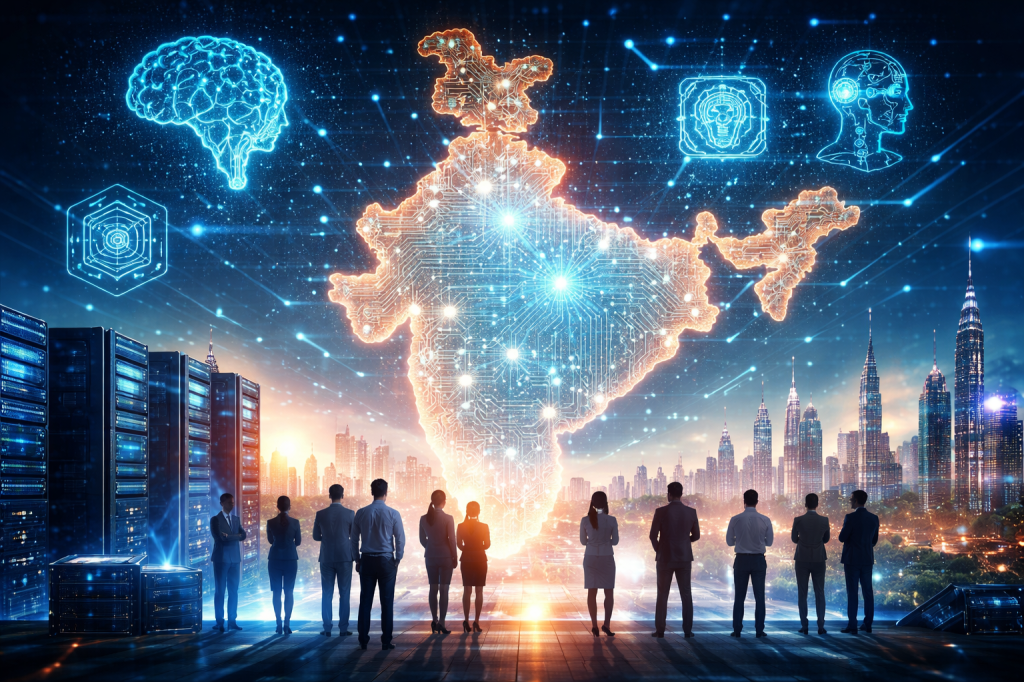
Artificial Intelligence has become the defining technological race of the 21st century. The United States scaled its AI dominance through deep-tech universities, venture capital, and a culture of high-risk innovation. China mobilised state power to build massive data ecosystems, sovereign AI platforms, and the world’s largest GPU clusters. Taiwan quietly became indispensable by leading the global semiconductor supply chain. And India—despite having the world’s largest pool of software engineers—somehow watched the first AI revolution unfold from the sidelines.
Why did this happen in a country known for talent, frugal engineering, and IT excellence? And is it too late to play catch-up?
India’s challenge is not brains; it is the structure of our innovation economy.
A Historical Pattern: India Optimises, Others Innovate
India’s story with technology has always followed a pattern:
We adopt global technologies fast.
We optimise and scale them efficiently.
But we rarely create fundamental breakthroughs.
This is not because we lack capability. It is because we built an economy where risk-taking was discouraged, corporate R&D was thin, and government research spending was spread across too many fragmented institutions.
For decades, India’s R&D-to-GDP ratio has hovered around 0.6–0.7%, compared to:
United States: ~3.5%
China: ~2.4% and rising rapidly
South Korea & Israel: ~4–5%
India’s private-sector R&D spending is concentrated in pharmaceuticals, autos, and IT services—but not in deep-tech, hardware, or frontier AI. We became global champions in outsourcing, not in breakthrough innovation.
This structural under-investment meant we did not build the foundational layers of AI—semiconductors, GPUs, large research labs, proprietary datasets, or strong university-industry ecosystems.
The Data-Center Push: India’s Late Entry Into the AI Infrastructure Race
AI today runs on three pillars:
1. Compute (GPUs, data centers)
2. Data (large, structured, high-quality datasets)
3. Talent (researchers, engineers, domain specialists)
India already has pillar three. We lead in STEM graduates and IT services. But we lagged badly in pillars one and two.
Only in the last few years has India started aggressively building AI-ready infrastructure:
Major conglomerates investing in cloud and compute
Billion-dollar data-center parks across Mumbai, Hyderabad, Noida
Early commitments from global GPU suppliers
IndiaAI Mission aiming at 30,000+ GPUs and national compute grids
The Tata Group’s recent multi-billion-dollar AI bet is a strong signal. But one company alone cannot fix decades of under-investment. Every major Indian corporate needs to treat AI as a 20-year national imperative, not a short-term project.
Why India Missed the First Wave: A Critical Look
1. Low R&D Culture
Our economy rewards cost efficiency, not invention.
Indian firms historically avoided long-gestation research, unlike Silicon Valley, Shenzhen, or Hsinchu.
2. Fragmented Academic-Industry Linkages
India has brilliant researchers; industry has capital.
But they rarely collaborate deeply, slowing innovation cycles.
3. Lack of Foundational Hardware Capabilities
Without chips, AI scale is impossible.
Taiwan built TSMC; India remained dependent on imports.
4. Limited Sovereign Data Strategy
AI leaders built national data ecosystems.
India’s digital public infrastructure is strong, but sectoral datasets (health, agriculture, manufacturing) are still not AI-ready.
5. Regulatory Caution
India’s data and AI policies evolved slowly, creating uncertainty for early innovators.
Is It Too Late? The Futuristic Outlook
The next decade of AI is not about chatbots or apps.
It is about:
AI-powered manufacturing
AI-driven governance
AI-enabled public infrastructure
AI in agriculture, health, logistics, and education
Sovereign AI platforms for national competitiveness
In this second wave, India has structural advantages:
The world’s largest digital population
UPI-gradient public infrastructure
The world’s biggest data-rich service economy
A young workforce hungry for upskilling
A government finally pushing compute and semiconductor missions
The scale to become the global back-office of AI-enabled industries
India does not need to win the race for foundational models.
India needs to win the race for applied AI across 1.4 billion people, a $4 trillion economy, and thousands of MSME-heavy sectors.
That opportunity is still open—and massive.
The Way Forward: From Optimization Nation to Innovation Nation
For India to lead the next AI wave, three shifts are non-negotiable:
1. Triple R&D Spending
Corporate India must move from 0.3% R&D intensity to at least 1.5–2% by 2035.
2. National AI Infrastructure
A sovereign compute grid, domestic GPU clusters, and semiconductor fabs must become national missions.
3. AI as a Public-Good Platform
Sectoral datasets (health, agriculture, logistics, MSMEs) should be anonymized and used to build India-first AI models for real economic problems.
If we do this, India will leap from being a nation of optimizers to a nation of inventors.
Final Words: The Second Chance Is Bigger Than the First
India missed the early AI wave because we hesitated to invest in innovation.
But AI is still in its infancy.
The next breakthroughs will come in sectors where India has scale, complexity, and real-world diversity.
India’s strength has always been in turning late entry into strategic advantage—IT services, mobile penetration, digital payments, and now digital public infrastructure.
If India boldly invests, builds sovereign compute, and turns its talent into deep-tech innovators, the question will no longer be,
“Why didn’t India lead AI?”
It will be,
How did India become the world’s largest AI-driven economy so quickly?#AILeadership
#InnovationEcosystem
#RAndDInvestment
#DigitalInfrastructure
#ComputePower
#SovereignAI
#TechPolicyIndia
#DeepTechRevolution
#DataCentresGrowth
#FutureOfIndiaTech
 "Connecting communities, empowering nations: Unifying the Regional and Global Economy ."
Leave a comment