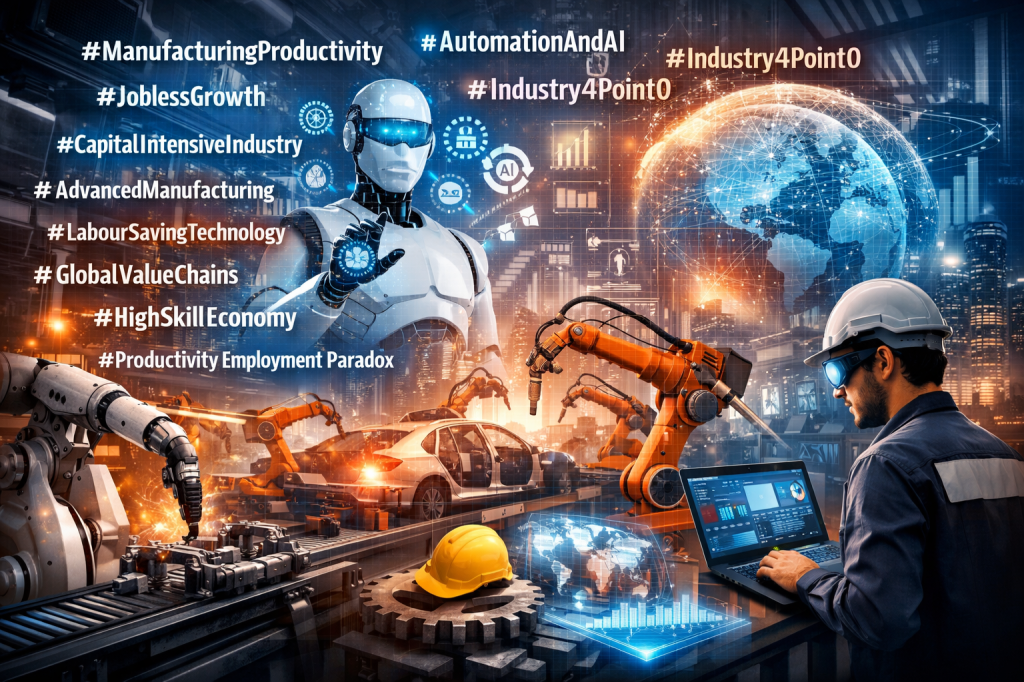
Manufacturing in advanced economies has undergone a profound transformation over the last four decades. Once the backbone of mass employment, it has evolved into a capital-, technology-, and knowledge-intensive sector where output growth is increasingly decoupled from job creation. The experience of developed countries demonstrates a critical paradox: manufacturing productivity can rise sharply even as employment stagnates or declines. Understanding this paradox is essential for interpreting the future of industrialisation, employment policy, and economic growth in the 21st century.
From Fordism to Digital Factories: A Historical Shift
In the post-war decades, manufacturing growth in developed countries followed a Fordist logic: higher output required more workers, and productivity gains were incremental. This model peaked in the 1960s–70s. From the 1980s onward, a structural break occurred. Automation, computer-numerical control (CNC) machines, enterprise software, robotics, and later artificial intelligence fundamentally altered production processes. Manufacturing output no longer scaled with labour; it scaled with capital, data, and design.
This shift explains why developed economies could sustain or even expand manufacturing output while steadily reducing the number of workers employed in factories.
The United States: Output Expansion, Employment Compression
The experience of the United States is emblematic. Between the late 1980s and early 2010s, US manufacturing labour productivity more than doubled. Each worker, on average, produced far more value per hour than before, driven by automation, digital supply-chain management, and lean manufacturing practices.
Yet manufacturing employment fell sharply over the same period. The sector shed millions of jobs even as factories continued to produce comparable or higher volumes of goods. The explanation lies not in industrial decline, but in industrial efficiency. A modern US automobile plant, for example, produces vehicles with a fraction of the workforce required in the 1970s, using robotic assembly lines, real-time quality control, and just-in-time logistics.
This illustrates a crucial point: productivity growth protected manufacturing output and competitiveness, but it did not protect manufacturing jobs.
Germany: High Productivity Anchored in Engineering Excellence
Germany presents a different but complementary model. German manufacturing is globally competitive, export-oriented, and technologically sophisticated. Post-2000 productivity gains were driven by precision engineering, automation, and Industry 4.0 integration rather than labour expansion.
Despite relatively stable output and strong global market share in machinery, automobiles, and chemicals, manufacturing employment declined over time. Germany’s celebrated vocational training system did not aim to maximise factory employment, but to maximise worker efficiency and quality. A smaller, highly skilled workforce now produces higher-value goods with tighter tolerances, lower defect rates, and greater energy efficiency.
Here, productivity growth preserved industrial strength, not employment volume.
Japan: Robotics as a Response to Demographics
In Japan, the productivity–employment relationship is shaped by demographics. With a shrinking and ageing workforce, Japan adopted robotics not only for efficiency but for survival. Manufacturing productivity grew steadily as firms substituted machines for labour, especially in electronics, automotive components, and precision instruments.
Employment in manufacturing remained flat or declined slightly, not because of de-industrialisation, but because automation compensated for labour shortages. Japan demonstrates a future-oriented lesson: in ageing societies, productivity growth becomes a substitute for labour availability, not merely a cost-cutting strategy.
Why Productivity Rises Faster Than Employment
Across developed economies, several structural forces explain why productivity growth does not translate into manufacturing job growth:
Automation replaces routine and repetitive tasks, allowing fewer workers to produce more output.
Global value chains offshore labour-intensive stages of production while retaining high-value design, R&D, and assembly domestically.
Policy and corporate strategy prioritise competitiveness, quality, and resilience over employment intensity.
Technological learning curves reward scale and capital deepening, not labour absorption.
As a result, manufacturing becomes more productive, more profitable, and more export-competitive—yet less labour-absorbing.
The Futuristic Outlook: Manufacturing as a High-Productivity Core
Looking ahead, developed-country manufacturing is unlikely to reverse this trend. AI-driven factories, autonomous quality inspection, digital twins, and predictive maintenance will further raise output per worker. Employment growth, where it occurs, will be concentrated upstream and downstream—in design, software, logistics, maintenance, and services linked to manufacturing—rather than on the factory floor.
The lesson from developed economies is stark but instructive: manufacturing can still be a pillar of GDP growth and technological leadership without being a mass employer. Productivity, not payroll size, has become the defining metric of industrial success.
Implications Beyond the Developed World
For countries aspiring to industrialise today, this experience carries a warning and an opportunity. Manufacturing-led growth can raise incomes and productivity, but it cannot be assumed to solve employment challenges automatically. The future belongs to economies that understand manufacturing not just as a job engine, but as a productivity engine embedded within a broader ecosystem of skills, services, and innovation.
In advanced economies, manufacturing did not die—it became smarter, leaner, and far less labour-hungry.
#ManufacturingProductivity
#AutomationAndAI
#Industry4Point0
#JoblessGrowth
#CapitalIntensiveIndustry
#AdvancedManufacturing
#LabourSavingTechnology
#GlobalValueChains
#HighSkillEconomy
#ProductivityEmploymentParadox
 "Connecting communities, empowering nations: Unifying the Regional and Global Economy ."
Leave a comment