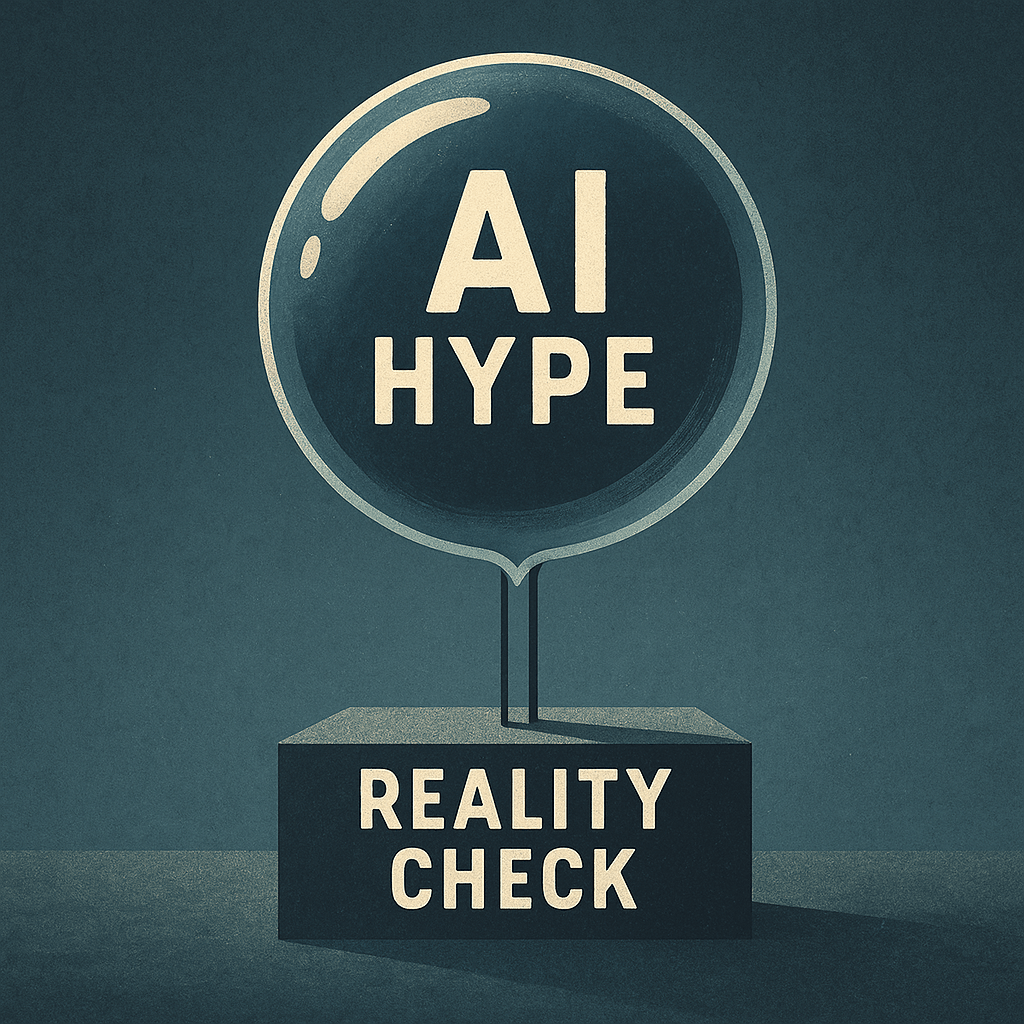
The world is living through an intense wave of excitement around artificial intelligence—an excitement that many analysts increasingly describe as bordering on a bubble. Global markets, corporations, investors, and governments have placed unprecedented faith in the power of AI to transform economies, reshape labour markets, and unlock new forms of productivity. Yet beneath the optimism lies a growing fear: Are we inflating another technology bubble—one that might not be able to sustain its weight?
This fear does not arise from cynicism but from historical memory, structural economic signals, and the critical analysis of what constitutes real value in technological revolutions.
A Historical Perspective: Every Revolution Begins With Overconfidence
To understand the anxiety around an AI bubble, we must look backward.
The Dot-Com Bubble (1999–2000):
The internet was truly revolutionary, yet markets moved faster than the technology itself. Companies with no revenue and no clear products attracted billions in investment simply because they had “.com” in their name. When reality caught up, valuations collapsed, but the technology itself survived and transformed the world.
The Crypto & Blockchain Surge (2017–2022):
Here too, enthusiasm exceeded readiness. While the underlying technology remains powerful, the speculative frenzy around tokens and exchanges led to repeated collapses.
Electric Vehicles & Clean Tech Bubbles:
Some clean-tech companies saw enormous valuations during the 2020 energy transition push, only to fall drastically as markets reassessed fundamentals.
The pattern is familiar:
Real technological shifts create genuine economic value, but they also generate speculative imbalances. AI today is walking the same tightrope.
Why the Fear of an AI Bubble Is Rising Now
1. Explosive Valuations, Limited Revenue Models
The valuations of AI chipmakers, cloud-AI startups, and foundation model companies have skyrocketed. Some AI firms today are valued higher than established industrial giants despite:
No stable revenue streams
High burn rates
Unclear pathways to profitability
Costly infrastructure dependencies (GPUs, data centers, energy)
This mismatch between valuation vs. value creation echoes previous bubbles.
2. Over-Centralization of the Supply Chain
The global AI ecosystem is heavily concentrated:
One company dominates AI chips
Two–three firms control large foundation models
Cloud infrastructure is dependent on a handful of hyperscalers
This creates systemic vulnerability. Any disruption in chips, data centers, or regulatory interventions could trigger a sudden correction.
3. Unrealistic Expectations of Immediate Productivity Growth
Historically, major technologies take time to transform productivity:
Electricity took 40+ years to reshape industries.
Computers took 20+ years to show up in productivity statistics.
Yet today, governments and companies expect AI to deliver instant growth, solve labour shortages, and raise GDP within a year or two. Economists call this expectation gap the “AI productivity paradox.” If AI fails to deliver fast enough, markets may sharply reprice expectations.
4. Cost Structures Are Growing Faster Than Earnings
Training large models costs billions of dollars:
Massive data centers
Expensive GPUs
Rising energy consumption
Increasing inference costs
If commercial applications do not scale in parallel, even leading firms may face financial stress.
The Critical Question: Is AI Overhyped or Underestimated?
Paradoxically, both can be true.
AI may be overhyped in market valuations but underappreciated in long-term societal impact.
Overhyped in the Short Term:
Too much capital flowing into untested ideas
Startups promising capabilities that do not exist
Unrealistic forecasts for immediate economic returns
Excessive dependence on a few foundational models
Underestimated in the Long Term:
AI will not merely automate tasks—it will redesign entire sectors
It could push scientific discovery, materials research, genomics, climate modelling
AI-driven automation may redefine labour markets and global competitiveness
Nations that fall behind in AI may face long-term technological dependency
Thus, the bubble fear is not about whether AI has value; it is about whether short-term excitement is overshadowing deeper structural realities.
A Futuristic Outlook: What Happens If the Bubble Bursts?
If a correction comes, it will reshape the global technological landscape in several ways:
1. Consolidation Will Become Extreme
Only a handful of AI firms with sustainable revenue will remain.
Just as the dot-com crash produced Amazon and Google, an AI correction will create dominant survivors.
2. Funding Will Shift From Hype to Core Architecture
Investors will demand:
Real profitability
Energy-efficient models
Transparent AI safety and governance structures
Domain-specific AI applications (healthcare, agriculture, manufacturing)
3. Countries Will Internalize the Strategic Risk
Nations may accelerate:
Domestic chip manufacturing
National AI cloud infrastructure
Trusted AI certification regimes
Energy-AI coordination (green data centers)
4. The Next AI Wave Will Be More Scientific
After a bubble correction, AI will integrate deeply with:
Materials science
Quantum computing
Biotechnology
Robotics
Climate adaptation systems
This is where long-term transformation truly lies.
The Fear of an AI Bubble Is Healthy—If It Leads to Better Decisions
The fear of an AI bubble is not a warning against innovation; it is a reminder to build AI ecosystems with:
Economic realism
Energy discipline
Long-term infrastructure
Ethical and regulatory preparedness
Human-centred design
History shows that every major technological transformation passes through a phase of hype. What matters is whether societies and markets learn in time to avoid reckless speculation while still encouraging breakthrough innovation.
AI may be moving at unprecedented speed, but thoughtful governance and rational investment can ensure that even if a bubble forms, the long-term benefits of this revolution endure.#AIBubble
#TechValuations
#MarketCorrection
#AIEconomy
#ProductivityParadox
#SpeculativeHype
#AIEcosystem
#DigitalDisruption
#FutureTechnology
#InnovationRisk
 "Connecting communities, empowering nations: Unifying the Regional and Global Economy ."
Leave a comment