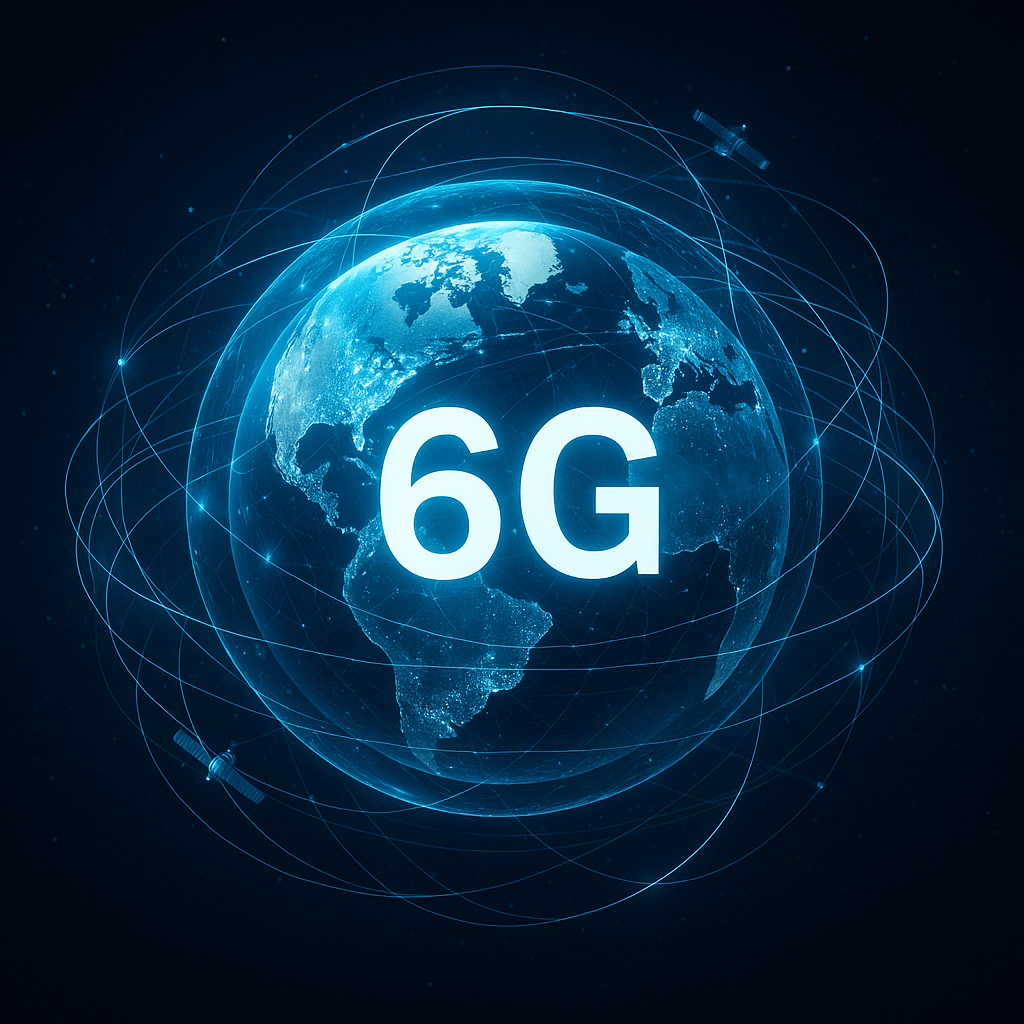
The future of telecom networks stands at a defining moment in history — a transition from connected devices to connected intelligence. From the telegraph and Morse code in the 19th century to the digital revolutions of the 20th and 21st centuries, telecommunications have consistently reshaped human civilization. Each generation of network technology — from 1G’s analog voice to 5G’s smart and low-latency digital ecosystem — has expanded our ability to communicate, transact, and innovate. Now, the world looks toward 6G, a technology that promises to erase the boundaries between the physical, digital, and biological realms.
6G, or the sixth-generation wireless technology, is being designed to operate in the Terahertz (THz) frequency spectrum, enabling data transfer speeds of up to one terabit per second and latency below one millisecond. Unlike earlier generations, 6G will be inherently intelligent, built natively with artificial intelligence (AI) and machine learning (ML) for self-optimization, self-healing, and predictive performance. The aim is not merely faster communication but an entirely new experience of connectivity — one that enables holographic telepresence, immersive virtual reality, and real-time tactile communication across continents. It will support up to ten million devices per square kilometer, creating an ultra-dense web of smart sensors, robots, vehicles, and human–machine interfaces. Importantly, 6G will integrate terrestrial, satellite, and edge-computing systems to ensure global coverage, connecting even the remotest parts of the planet.
The 6G ecosystem is being shaped by a powerful coalition of global operators, technology providers, and specialized innovators. Leading telecom operators include AT&T in the United States, NTT DOCOMO in Japan, Orange in France, Reliance Jio and Bharti Airtel in India, Vodafone Group in the UK, SK Telecom and KT Corporation in South Korea, China Mobile in China, and Deutsche Telekom in Germany. They are joined by Telefónica of Spain, Verizon in the US, Singtel in Singapore, and e& in the UAE. Technology giants such as Huawei, Nokia, Ericsson, Samsung, Apple, Google, and NVIDIA are developing the hardware, software, and AI frameworks that will power these networks. Specialized firms like Metawave and Pivotal Commware are pioneering advanced antenna systems, while companies like NXP Semiconductors and Solvay are producing the components and materials required for ultra-high-frequency communication.
India’s “Bharat 6G Mission,” launched in 2023, marks an important turning point for emerging economies that aim to participate in global standard-setting rather than merely adopting technologies developed elsewhere. By emphasizing research, indigenous design, and partnerships with global institutions, India is positioning itself as a key player in the next telecom revolution.
The broader future of telecom will depend on three interlinked pillars: artificial intelligence, satellite integration, and edge computing. AI-driven core networks will autonomously manage and optimize performance, ensuring minimal downtime and improved user experience. Edge computing will process data closer to where it is generated, enabling real-time applications in areas such as autonomous vehicles, smart factories, and remote healthcare. Satellite networks will bridge terrestrial gaps, providing high-speed, low-latency connectivity across oceans, deserts, and mountains. Together, these elements will create what experts describe as a “network of networks” — a globally synchronized digital nervous system where physical distance loses its meaning.
Historically, each generation of telecom innovation has reflected the aspirations and anxieties of its time. The 1G era of the 1980s brought the first taste of voice mobility, while 2G in the 1990s revolutionized text communication. 3G in the 2000s opened the mobile internet, paving the way for the social media age. 4G in the 2010s fueled the app economy and streaming revolution, and 5G in the 2020s laid the groundwork for smart manufacturing and the Internet of Things. Now, 6G in the 2030s will extend this trajectory by embedding intelligence directly into networks — a leap from connected devices to cognitive ecosystems.
However, this transformation will not be without challenges. The Terahertz spectrum required for 6G demands new materials, new hardware, and high capital investment. Energy consumption will surge unless telecom infrastructure is powered by renewable sources, and sustainability will become a critical parameter of success. Cybersecurity risks will intensify as networks become more autonomous and data-rich, necessitating new standards for quantum-safe encryption and AI-driven threat detection. Moreover, geopolitical competition between major economies — particularly the US, EU, China, Japan, and India — could fragment the development of global 6G standards, slowing interoperability and innovation.
Looking ahead, the telecom networks of the late 2030s will likely evolve into context-aware, self-learning systems capable of anticipating human needs. This concept, often referred to as “ambient intelligence,” envisions a world where factories reconfigure themselves dynamically, vehicles communicate directly with one another, and education or healthcare can be delivered through immersive virtual experiences. The network will cease to be an invisible infrastructure and instead become a conscious partner in human life — adaptive, predictive, and sustainable.
In the end, the 6G revolution represents more than technological progress; it symbolizes humanity’s pursuit of seamless, intelligent, and inclusive communication. Success in this new era will depend on how effectively nations and companies balance innovation with ethics, speed with security, and efficiency with environmental responsibility. The countries that build not just faster networks but smarter, fairer, and greener ones will define the telecom order of the mid-21st century — an age where intelligence itself travels at the speed of light.6G #TelecomFuture #AIConnectivity #SmartNetworks #DigitalIndia #NextGenTech #Telecom2030 #GlobalInnovation #SatelliteIntegration #FutureOfConnectivity
 "Connecting communities, empowering nations: Unifying the Regional and Global Economy ."
Leave a comment