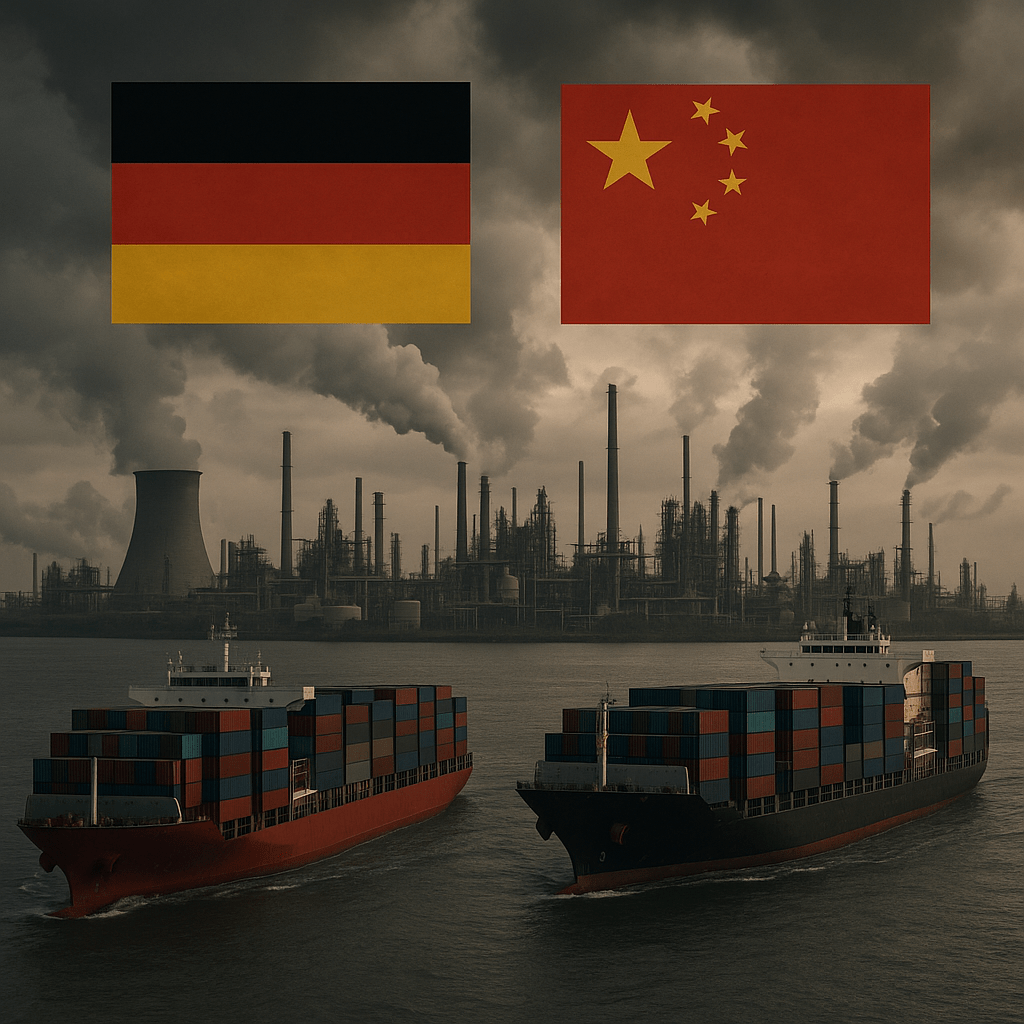
A Historical Turn in Trade Dynamics
For much of the post-Cold War period, Germany stood as the industrial powerhouse of Europe — its manufacturing base supplying the world with automobiles, chemicals, and machinery. Yet, in 2025, the trade compass has tilted. Reuters data reveals that China has overtaken the United States as Germany’s largest trading partner for the first eight months of the year. German exports to the U.S. have fallen by over 7% year-on-year, while imports from China have risen by more than 8%. This shift signals not just statistical fluctuation but a deeper structural realignment in global commerce.
Historically, Germany’s export engine depended on American demand and stable transatlantic cooperation. However, as global supply chains evolve under new industrial and geopolitical realities, China’s gravitational pull on trade networks has become impossible to ignore. What began as a low-cost manufacturing story two decades ago has now matured into a sophisticated industrial ecosystem that can both supply and compete with Europe’s best.
Manufacturing Pressure: The Chemical and Industrial Squeeze
The most visible stress point in this transition is Europe’s chemical sector — once a pillar of German industrial might. The Times recently reported that companies like INEOS, one of Europe’s leading chemical producers, are warning of existential pressure from cheap Chinese imports, particularly in butanediol (BDO) and related inputs. These imports are not simply undercutting prices; they are reshaping cost structures, investment logic, and employment stability within Europe’s manufacturing heartland.
The concern echoes the broader pattern of de-industrialization risk — where high energy prices, stricter environmental norms, and slower innovation cycles have weakened Europe’s competitiveness. As Chinese firms leverage economies of scale and state-backed subsidies to push into high-value segments, German industry faces a dual challenge: maintaining technological edge while preserving domestic jobs.
China’s Resilience Amid Global Headwinds
Contrary to Western narratives about a slowing Chinese economy, China’s manufacturing output is forecast to grow by around 2.8% in 2025, according to Interact Analysis. While this may seem modest compared to past double-digit growth, it represents stability and adaptability in a volatile global environment. Chinese manufacturing is now less about volume and more about strategic positioning — dominating supply chains for batteries, electronics, and advanced materials.
This resilience highlights China’s long-term play: using export diversification and industrial upgrading to consolidate influence. It is not merely exporting goods; it is exporting standards, technologies, and dependencies.
The New Geoeconomic Landscape
The shift in trade flows between Germany and China is not an isolated episode but part of a broader reconfiguration of the global value chain. The era of transatlantic industrial dominance is giving way to a Eurasian axis of production and consumption. German companies are increasingly tied to Chinese inputs — from critical minerals to intermediate goods — creating a paradox where strategic autonomy and economic pragmatism clash.
For Germany, the stakes are existential. Its export-led model, the foundation of its post-war success, now faces a structural squeeze from both ends: American industrial policy (through the Inflation Reduction Act and reshoring incentives) and Chinese production overcapacity. The resulting “sandwich effect” threatens to hollow out segments of Germany’s Mittelstand — the small and medium enterprises that underpin its industrial fabric.
Future Outlook: From Dependency to Redesign
To navigate this transition, Germany and the broader EU will need to rethink supply-chain architecture along three fronts:
1. Strategic Diversification: Building alternate sourcing partnerships in India, ASEAN, and Latin America to reduce over-reliance on Chinese intermediates.
2. Technological Sovereignty: Investing in automation, green chemistry, and digital twins to offset cost disadvantages.
3. Industrial Diplomacy: Aligning trade, environmental, and industrial policies to create level playing fields while avoiding outright protectionism.
Failure to adapt could accelerate a gradual erosion of industrial leadership. Success, however, would position Europe as a resilient and value-driven manufacturing bloc capable of balancing efficiency with security.
Reflection
This is more than a trade story — it is a mirror to the changing nature of globalization. The “Made in Germany” brand, once synonymous with unmatched engineering excellence, is now competing against a “Made by China” ecosystem defined by scale, integration, and speed. The 2025 trade data underscores a turning point: the world’s manufacturing centre of gravity has already shifted eastward.
If the 20th century was the age of German industrial order, the 21st is fast becoming the age of Chinese industrial orchestration — where supply chains are not just logistical systems but instruments of geopolitical leverage.
#GlobalTrade #ChinaGermany #ManufacturingShift #Deindustrialization #SupplyChains #IndustrialPolicy #ChemicalIndustry #TradeFlows #EconomicStrategy #FuturisticOutlook
 "Connecting communities, empowering nations: Unifying the Regional and Global Economy ."
Leave a comment