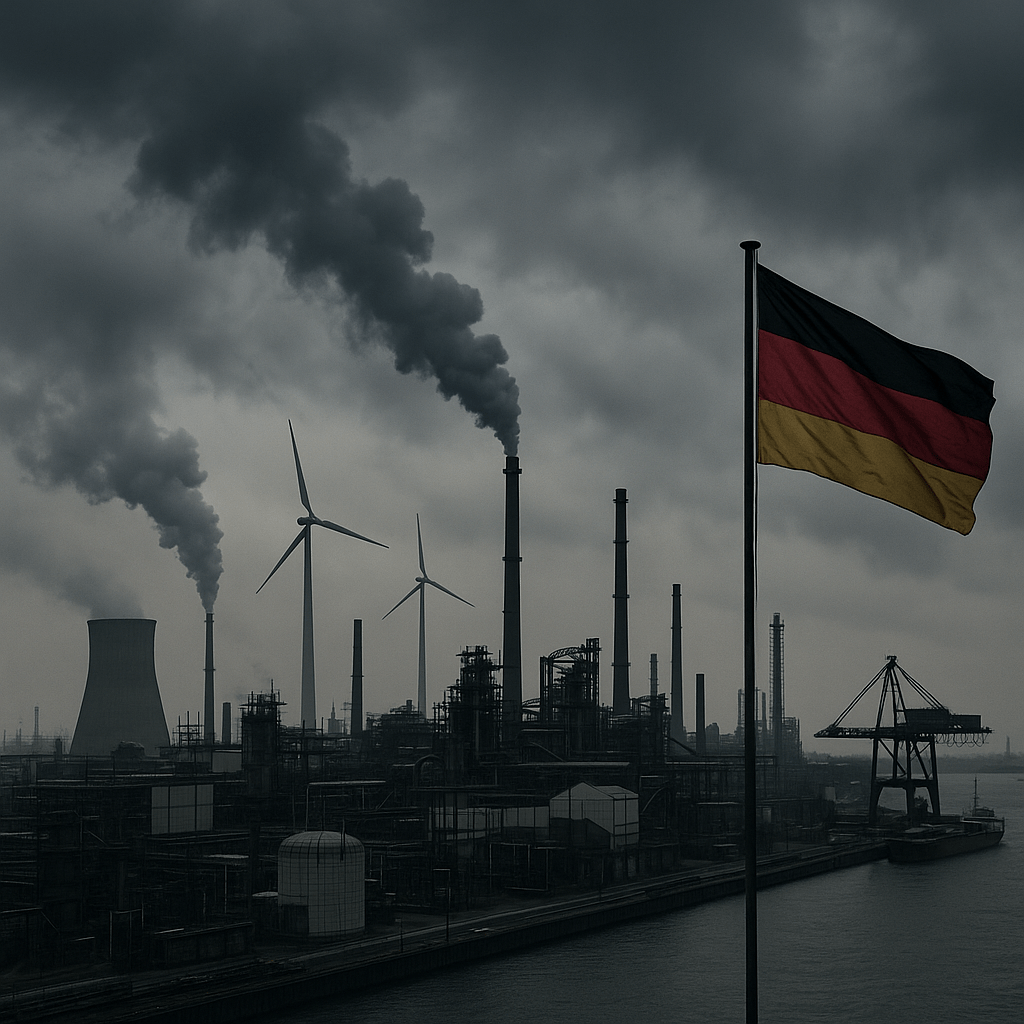
The Waning Powerhouse of Europe
Germany — once hailed as the “engine of Europe” — is now facing an extended period of economic stagnation. The challenges are not new; they are cumulative results of structural weaknesses that have persisted over time. As Europe’s largest economy, Germany’s slowdown inevitably sends shockwaves across Italy, the UK, and the broader European Union (EU) value chain. The situation is not merely cyclical; it reflects deep-rooted transformations in energy, demography, and global trade patterns.
Historical Perspective: From Miracle to Malaise
Post–World War II Germany was a model of industrial efficiency. The Wirtschaftswunder or “economic miracle” of the 1950s and 1960s was driven by manufacturing excellence, skilled labor, and export competitiveness. For decades, Germany built its prosperity on the strength of the Mittelstand — small and medium-sized enterprises that powered its export-led growth.
However, by the early 2010s, the signs of stress began to appear. Heavy dependence on exports, particularly to China and the U.S., made the German economy vulnerable to global slowdowns. The 2022 energy crisis — intensified by the Russia–Ukraine war — further exposed Germany’s overreliance on cheap Russian gas and its slow transition to renewable energy. What was once a competitive advantage has now turned into an Achilles’ heel.
Contemporary Challenges: The Structural Crisis Deepens
Germany’s present-day malaise is a mix of high energy costs, aging population, regulatory overhang, and stagnant productivity. Industrial giants such as BASF have scaled down or relocated operations to countries with more favorable energy and tax regimes. This trend signals not just temporary relocation but a potential reconfiguration of Europe’s industrial geography.
Key issues include:
Energy transition costs: The accelerated push toward green energy, though necessary, has increased short-term costs for industry.
Demographic decline: A shrinking workforce and aging population reduce innovation capacity and consumer demand.
Overregulation: Complex EU rules and domestic bureaucracy are eroding the efficiency of industrial operations.
Global competitiveness: China’s rise in electric vehicles, machinery, and green technologies is directly challenging German exports.
These combined pressures have created what many analysts call a “German productivity trap.” Growth forecasts for 2025–2026 remain below 1%, with the IMF projecting only modest recovery — insufficient to offset inflation and social expenditure burdens.
Spillover Effects Across Europe
Germany’s slowdown is not an isolated event. Italy and the UK — though structurally different — are intertwined through trade, investment, and supply chains.
Italy: Dependent on German machinery and automotive demand, Italy’s manufacturing sector feels the pinch of reduced orders. However, Italy’s smaller domestic market and higher public debt make fiscal stimulus limited.
United Kingdom: Post-Brexit trade frictions and weak European demand have reduced the UK’s export opportunities. London’s financial markets, long linked to continental industries, are now contending with new uncertainties.
As Germany accounts for nearly one-third of EU industrial output, a prolonged downturn risks dragging the entire Eurozone toward a “low-growth equilibrium.”
Policy Fatigue and Industrial Rethink
While policymakers in Berlin emphasize fiscal restraint and environmental responsibility, critics argue that Germany’s policy stance is too conservative for a time that demands bold reinvention. The lack of strategic industrial policy — compared to the U.S. Inflation Reduction Act or China’s industrial subsidies — has made German firms less competitive globally.
The European Union, too, faces a dilemma: how to balance fiscal discipline with industrial renewal. Protectionist measures are on the rise, but without innovation, such measures merely delay structural adaptation.
Germany’s challenge is therefore philosophical as much as economic — it must decide whether to remain a cautious, rules-bound economy or evolve into a dynamic innovation leader once again.
Futuristic Outlook: Reinventing the European Core
Looking ahead, Germany’s revival depends on three strategic pivots:
1. Reindustrialization with Green Tech: Germany must turn its climate goals into a competitive edge by investing aggressively in green hydrogen, circular manufacturing, and AI-driven energy optimization.
2. Digital Transformation of the Mittelstand: The backbone of German industry must embrace automation, data-driven decision-making, and digital supply chain integration.
3. Labor and Demographic Reforms: Immigration policies, reskilling initiatives, and productivity-linked wage structures are vital to offset demographic decline.
If Germany succeeds, it can lead Europe into a new phase of “Smart Industrial Renaissance.” Failure, however, could mark the erosion of Europe’s economic centrality in a multipolar world dominated by U.S.–China technological competition.
Dependence to Resilience
Germany’s economic malaise is not the end of the story — it is a wake-up call. The next decade will test Europe’s ability to adapt to a changing global order. Italy and the UK, facing their own structural challenges, will either sink deeper into the continental slowdown or seize this opportunity for renewal.
The path forward lies not in nostalgia for past industrial might but in crafting a new European competitiveness model — one built on innovation, sustainability, and strategic autonomy.
#GermanyEconomy #EuropeanCrisis #IndustrialPolicy #Mittelstand #GreenTransition #DemographicChallenge #BASF #EnergyCrisis #EUValueChain #EconomicOutlook
 "Connecting communities, empowering nations: Unifying the Regional and Global Economy ."
Leave a comment