A Sharp Correction to Global Trade Optimism
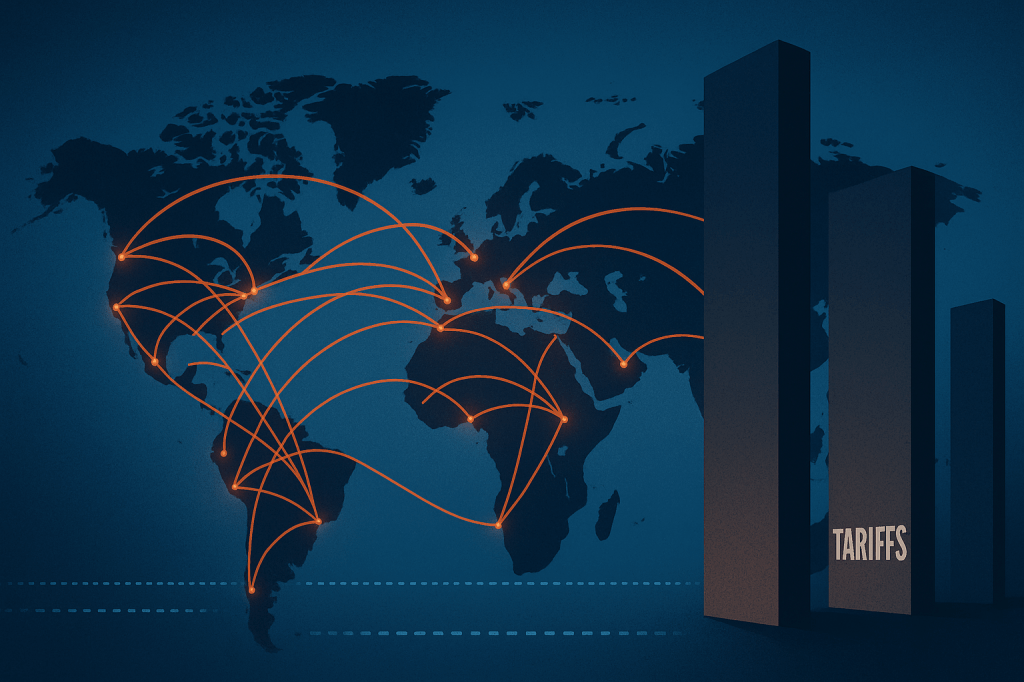
The World Trade Organization (WTO) has sent a jolt through the global economic community by slashing its merchandise trade growth forecast for 2026 to just 0.5%, down sharply from the 1.8% projected earlier. This downgrade represents not just a cyclical slowdown but a structural shift in the way global trade is evolving.
For context, the world recorded a 2.8% trade expansion in 2024 and expects a temporary rebound to 2.4% in 2025—fueled mainly by front-loaded imports as businesses rush to beat tariff deadlines. But the WTO now warns that this momentum will evaporate as tariffs bite deeper and inventory surges fade.
At the center of this slowdown lies the ripple effect of U.S. protectionist policies—particularly under President Donald Trump’s renewed tariff regime. The delayed impact of these measures, combined with widening policy uncertainty across continents, has created a chilling effect on investment, supply chains, and trade volumes.
A Historical Perspective: Lessons from Earlier Trade Shocks
The current deceleration evokes strong parallels with previous protectionist cycles.
In the 1930s, the Smoot-Hawley Tariff Act triggered a cascade of retaliatory measures, contributing to the Great Depression.
In the 1970s and 1980s, stagflation and currency realignments led to trade slowdowns that reshaped industrial competitiveness.
The 2008 financial crisis again underscored how global trade can collapse under systemic uncertainty, with recovery taking several years.
Yet, unlike those earlier episodes, the post-2020 trade world is defined by fragmented globalization — a shift from interdependence to strategic autonomy. Nations are reorienting supply chains for security rather than efficiency, marking a profound departure from three decades of liberalization.
Why the Slowdown Matters: Beyond Tariffs
The WTO’s downgrade goes beyond a numeric revision — it’s a symptom of deeper structural fatigue in the global trade system.
1. Protectionism’s Spread:
What began as a U.S. tariff strategy to counter China has now spread to sectors like clean tech, semiconductors, and even agriculture. Nearly 70% of global trade is now subject to some form of restrictive policy.
2. Erosion of Confidence:
Businesses face rising costs, opaque regulations, and fears of future disruptions. This is reducing cross-border investment appetite — a crucial driver of trade.
3. Service Trade Slowdown:
Even the high-growth service sector is cooling, with WTO projections showing a decline from 6.8% in 2024 to 4.4% by 2026. Digital trade, financial services, and travel remain strong but insufficient to offset goods trade weakness.
4. Geoeconomic Fragmentation:
Parallel trading blocs are emerging — U.S.-led Western alliances versus China-centered regional partnerships. This bifurcation threatens the universal principles of the WTO itself.
A World of Front-Loading, Not Free Flow
The WTO report notes that 2025 may see a temporary trade boost, largely due to companies rushing to import goods before tariffs escalate further. This artificial surge, however, masks the deeper malaise — much like a patient who feels energetic after taking painkillers, only to relapse later.
By 2026, when the front-loaded inventories deplete, global trade could resemble stagnation, with manufacturing and logistics sectors feeling the sharpest contraction.
The Economic Domino Effect
A projected 0.5% trade growth in 2026 could drag global GDP growth down to 2.6% from 2.7% in 2025. Export-oriented economies such as Germany, South Korea, and Vietnam are likely to face the heaviest pressure. For developing nations, especially in Asia and Africa, weaker global demand may translate into reduced fiscal space, currency pressures, and employment losses in export-linked industries.
The WTO’s Director-General, Ngozi Okonjo-Iweala, has rightly called the outlook “bleaker,” yet she underscored the resilience of the rules-based trading system — a system now under its most severe test since the WTO’s inception in 1995.
The Futuristic Outlook: From Trade Quantity to Trade Quality
While the short-term forecast looks grim, the future of global trade may lie not in expansion by volume but in transformation by value. Three emerging trends could redefine the next decade:
1. Digital and AI-Driven Trade:
The surge in AI tools, quantum computing, and blockchain-led logistics could reduce inefficiencies and create “intelligent trade flows.” Trade in data, software, and digital assets will become the new growth frontier.
2. Regionalization and Friend-Shoring:
The world is witnessing a pivot toward trusted trade partners rather than open-market access. The India–Middle East–Europe Corridor (IMEC), ASEAN+ frameworks, and African Continental Free Trade Area (AfCFTA) point to the rise of regional connectivity.
3. Green and Sustainable Trade:
Carbon border adjustments, renewable supply chains, and climate-linked tariffs will gradually make sustainability a trade currency. The “greening” of global value chains could spark a new form of economic diplomacy.
A Critical Reflection: Can the WTO Reinvent Itself?
The WTO’s latest warning serves as both a forecast and a litmus test of its relevance. The organization must now address questions it has long avoided:
Can it enforce fair play amid nationalistic industrial policies?
Can it adapt rules for AI, data flows, and carbon trade?
And most critically — can it restore trust among its members when multilateralism itself is in retreat?
If it fails to evolve, global trade governance may drift toward “mini-lateral” or regional coalitions, weakening the very principles that enabled decades of prosperity.
The Slowdown as a Signal, Not a Sentence
The WTO’s downgrade to 0.5% global trade growth in 2026 is not just a statistical correction — it’s a strategic wake-up call. The world is entering a phase where trade is no longer guaranteed as a driver of growth. Instead, it will be a differentiator between economies that adapt to new realities and those that remain trapped in the old globalization model.
As protectionism rises and policy uncertainty grows, countries that balance resilience with openness — investing in technology, sustainability, and partnerships — will shape the next era of commerce. The age of “free trade” may be fading, but the age of intelligent trade is only beginning.
Ten important keywords with #
#GlobalTrade #WTOForecast #TariffImpact #Protectionism #DigitalTrade #SupplyChain #EconomicOutlook #Geoeconomics #SustainableTrade #AIandTrade
 "Connecting communities, empowering nations: Unifying the Regional and Global Economy ."
Leave a comment