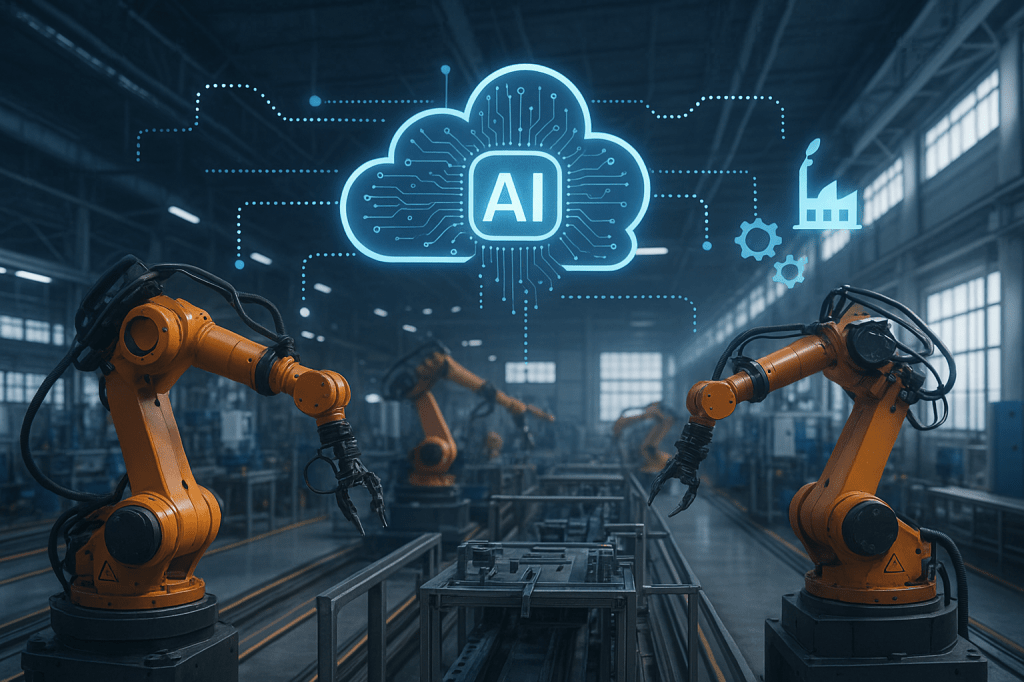
Artificial Intelligence (AI) and digital modernization are no longer optional for manufacturing—they are survival tools. Across Europe, and particularly in Germany, the manufacturing sector is embracing AI to strengthen automation, efficiency, and sustainability. Yet, the continent still faces a persistent challenge: while its firms are investing, they lag behind global peers in scaling AI-driven transformation.
Historical Perspective: From Industry 4.0 to AI-First Manufacturing
Germany pioneered the Industry 4.0 narrative in the early 2010s, positioning itself as a leader in automation and digital manufacturing. This vision laid the foundation for today’s AI-powered factories, where smart robotics, predictive analytics, and digital twins reshape industrial operations. However, Europe’s focus on gradual integration and regulatory caution contrasts sharply with the aggressive scaling seen in the U.S. and China.
U.S. trajectory: Tech-first adoption, venture capital-backed AI platforms, and early integration into manufacturing ecosystems.
China’s trajectory: State-driven industrial policies, massive robotics deployment, and AI embedded in “Made in China 2025.”
Europe’s trajectory: Innovation-rich but fragmented, with regulatory leadership but limited cross-border industrial integration.
The Current Landscape: Germany as Europe’s Case Study
Germany remains Europe’s manufacturing powerhouse and a key test case for AI modernization. Firms like Siemens, Bosch, and BMW are embedding AI in:
Real-time quality inspection (AI-powered cameras reducing defect rates)
Energy management (optimizing production to meet carbon-neutrality goals)
Circular manufacturing (designing recycling loops with AI-based efficiency)
Government-led frameworks such as Germany’s AI Strategy 2025 and GAIA-X seek to ensure that AI development respects European values of data sovereignty and security, making Germany both a leader and a cautious regulator.
EU-Level Policy Push: Building AI Ecosystems
Recognizing the productivity gap with the U.S. and China, the European Union has launched ambitious ecosystem-level initiatives:
AI Factories (2025–26): At least 15 new shared AI infrastructure hubs to triple Europe’s AI computing power.
InvestAI Facility: €20 billion dedicated to AI Gigafactories, advancing generative AI and large-scale automation R&D.
Green Transition Mandate: Embedding AI in Europe’s sustainability strategy to optimize resource use and meet climate neutrality targets.
These initiatives reveal a policy pivot: rather than leaving AI adoption solely to corporate strategy, the EU is building collective infrastructure to democratize AI access for SMEs, startups, and cross-border industries.
Key Challenges
1. Productivity Gap: Despite innovation, only about 44% of large European firms have scaled AI. Without rapid adoption, Europe risks losing its industrial competitiveness.
2. Skills Shortage: Upskilling workers for AI-integrated systems remains a bottleneck. Unlike the U.S. with flexible labor markets or China with top-down reskilling drives, Europe’s approach is slower.
3. Data Infrastructure: Fragmented data ecosystems limit scalability of AI across borders. Initiatives like GAIA-X are still evolving.
4. Global Competition: U.S. and Chinese firms set faster standards for industrial AI, raising the stakes for Europe’s ability to export and compete.
Opportunities for Europe
Sustainability as Advantage: By embedding AI into circular manufacturing and resource efficiency, Europe could lead the green-industrial revolution.
Collaborative Ecosystems: Pan-European AI factories could create a shared innovation base, similar to Airbus in aerospace.
Regulatory Power: The EU’s “Brussels Effect” can shape global AI standards for industry, positioning Europe as a rule-setter in digital manufacturing.
Futuristic Outlook: What’s Next?
Looking ahead to 2030, Europe’s manufacturing transformation will depend on:
Unified AI Ecosystems: Scaling shared infrastructure beyond national boundaries.
AI-Augmented Workers: Using AI copilots and training platforms to support—not replace—Europe’s skilled workforce.
Sovereign AI Supply Chains: Reducing reliance on U.S. cloud platforms and Chinese hardware by developing European chips, cloud services, and AI compute.
Green-First Industrial Model: Making sustainability not just compliance but a competitive export edge.
Europe at a Crossroads
European manufacturing stands at a critical juncture. Germany shows how AI can reinforce productivity and sustainability, but scaling remains the continent’s Achilles heel. The EU’s bold investments in AI Factories and Gigafactories may finally provide the collective infrastructure needed to close the productivity gap.
If Europe can integrate AI, digital modernization, and green transition into a single unified industrial ecosystem, it could transform from a cautious follower into a global leader in sustainable, AI-driven manufacturing. But the window of opportunity is narrow, and the next five years will determine whether Europe’s industrial base thrives—or merely survives—in the AI age.
#AImanufacturing
#DigitalTransformation
#Industry40
#GermanIndustry
#GreenTransition
#Automation
#EUInnovation
#AIEcosystems
#SustainableManufacturing
#FutureOfIndustry
 "Connecting communities, empowering nations: Unifying the Regional and Global Economy ."
Leave a comment