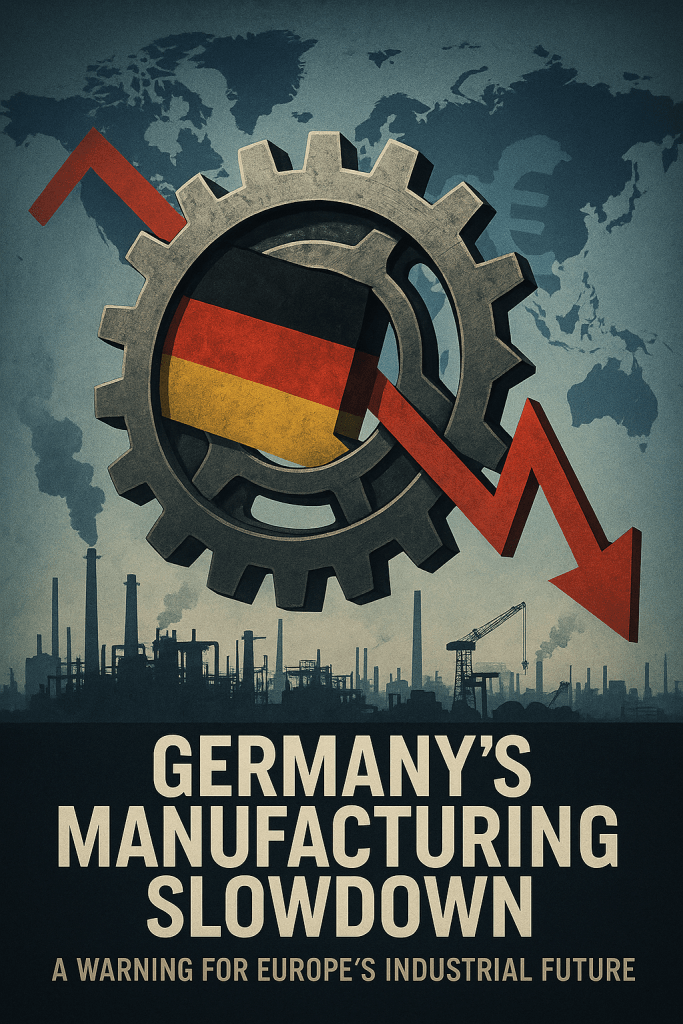
Germany has long been the powerhouse of Europe, its engineering and export-oriented industries serving as the backbone of the Eurozone’s economy. From the post–World War II recovery, when the “Wirtschaftswunder” (economic miracle) made Germany synonymous with industrial resilience, to its role in driving European integration, German manufacturing has shaped not only domestic prosperity but also Europe’s global standing. Yet, as 2025 unfolds, Germany’s industrial engine is showing signs of deeper fatigue — raising questions about whether incremental reforms will be enough to restore momentum.
The Current Decline: Numbers That Speak
Forecasts for 2025 are stark. Germany’s engineering sector is expected to contract by around 5%, a sharper downturn than the earlier projected 2% decline. Exports — traditionally the lifeblood of the economy — are likely to fall 2.5% this year, under pressure from rising domestic costs, sluggish global demand, and the resurgence of protectionism. Even modest recovery hopes for 2026, pegged at about 1% growth, are conditional on whether promised reforms are enacted in time.
The problem is not just cyclical. Imports from China into Germany are surging in categories like copper, apparel, and toys — evidence of global trade diversion. With U.S. tariffs pushing Chinese exporters toward Europe, German producers face intensified competition in their home market at the very moment they are struggling with costs and regulation.
A Historical Echo: From Strength to Structural Strain
Germany’s export-led model worked exceptionally well during the 1980s and 1990s, when globalization expanded, European markets integrated, and China became a reliable partner in supply chains. The model also carried the country through the 2008 global financial crisis, largely by leaning on robust demand from emerging markets.
But history also shows that when Germany’s industrial base is too reliant on external demand, cracks appear. The Eurozone debt crisis revealed this vulnerability a decade ago, and today’s slowdown echoes the same structural issue: high dependence on exports in a world increasingly shaped by tariffs, supply chain fragmentation, and geopolitical tension.
The Eurozone Picture: A Mixed Bag
At the broader European level, industrial output remains weak. Eurozone production showed only a 0.3% month-on-month rise in July and a modest 1.8% year-on-year gain. Germany led with a 1.5% monthly boost, but France and Spain posted declines. The imbalance reflects not only Germany’s industrial heft but also the uneven resilience of Europe’s southern economies.
The challenge is systemic: Europe lacks a coordinated industrial strategy strong enough to counter rising costs, green transition demands, and external shocks. Without stronger integration and investment, even Germany’s rebound will have limited spillover.
—
Futuristic Outlook: Can Germany Reinvent Its Model?
Looking ahead, Germany and the EU face a strategic choice. Relying on incremental reforms — modest tax adjustments, regulatory tweaks, and selective subsidies — may stabilize production temporarily but will not restore long-term competitiveness. The future requires:
Green Industrial Transformation: Aligning engineering strength with clean energy technologies, from hydrogen to advanced battery systems.
Digital Manufacturing Leadership: Scaling Industry 4.0 into Industry 5.0, integrating human-centric design with robotics, AI, and digital twins.
Strategic Diversification: Reducing overdependence on exports to China or the U.S., and investing in partnerships with Africa, Latin America, and Southeast Asia.
Resilient Supply Chains: Building European autonomy in critical inputs like semiconductors, rare earths, and high-end machinery.
Risks of Delay
If reforms lag, Germany risks entering a cycle of “managed decline,” where modest recoveries never outpace structural pressures. Rising competition from China, the U.S., and even emerging economies could gradually erode Germany’s comparative advantage in precision engineering and industrial exports. More alarmingly, the Eurozone’s overall stability depends heavily on German industrial strength. A sustained German slump would reverberate across Europe — politically as well as economically.
Germany’s present slowdown is more than a temporary dip; it is a stress test for the entire European industrial model. Historically, Germany has reinvented itself in times of crisis — from postwar recovery to reunification. The question now is whether it can transform once again, not by relying on globalization’s tailwinds, but by reimagining its industrial base for a fragmented, digital, and green global economy.
If it succeeds, Germany may once again lead Europe into a new phase of industrial resilience. If it falters, Europe risks losing its last great anchor in global manufacturing.#GermanyManufacturing
#EurozoneEconomy
#GlobalTradeShifts
#ExportDecline
#IndustrialReforms
#ChinaImports
#GreenTransition
#Industry40to50
#SupplyChainResilience
 "Connecting communities, empowering nations: Unifying the Regional and Global Economy ."
Leave a comment