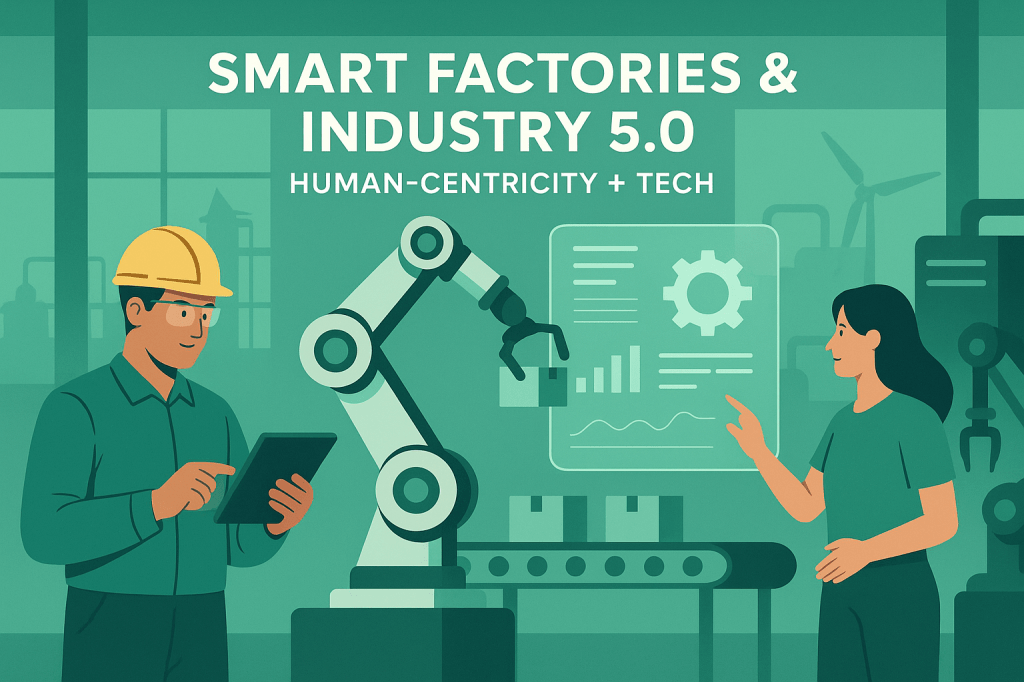
The industrial journey that began with steam engines in the late 18th century is now entering its most human-centered phase: Industry 5.0. After decades of mechanization, electrification, automation, and digitization, we are witnessing a profound transformation where human intelligence and creativity are merging with artificial intelligence, robotics, and digital ecosystems. Unlike the purely efficiency-driven objectives of earlier industrial revolutions, Industry 5.0 places people, sustainability, and resilience at the heart of production systems.
From Machines to Minds
Industry 1.0 (18th–19th Century): The age of steam power and mechanized production. It brought factories, urbanization, and a new workforce dynamic, but also harsh labor exploitation.
Industry 2.0 (Late 19th–20th Century): Electrification, assembly lines, and mass production revolutionized efficiency but reinforced the idea of workers as replaceable cogs.
Industry 3.0 (Mid–Late 20th Century): Automation, computing, and electronics entered factories, reducing human drudgery but raising fears of widespread job displacement.
Industry 4.0 (Early 21st Century): Digitization, IoT, cloud computing, robotics, and data-driven manufacturing created the “smart factory.” Efficiency soared, but the human role often diminished.
Now, Industry 5.0 seeks to correct these imbalances, emphasizing that technology should augment human capabilities, not erase them.
Smart Factories Today: The Industry 4.0 Legacy
Smart factories under Industry 4.0 have achieved remarkable advances:
Internet of Things (IoT): Real-time monitoring of machines, reducing downtime and predictive maintenance.
Robotics & Automation: Collaborative robots (cobots) work alongside humans to handle repetitive or dangerous tasks.
Digital Twins: Virtual replicas of production lines simulate performance, optimize operations, and minimize risk.
But while these innovations boosted efficiency, critics argue they often neglected the human dimension—leading to alienation of workers, over-dependence on automation, and vulnerabilities in the face of global supply chain shocks.
Industry 5.0: Human-Centric, Resilient, and Sustainable
A systematic review of smart factory research indicates that Industry 5.0 moves beyond efficiency to focus on human-machine collaboration, resilience, and sustainability.
Human-Machine Collaboration: Advanced AI and robotics will not replace humans but act as intelligent assistants, enhancing decision-making, creativity, and problem-solving. For example, in product design, AI may generate thousands of prototypes, but human intuition will select the design with cultural and emotional resonance.
Resilience: COVID-19 and geopolitical disruptions highlighted fragility in global supply chains. Industry 5.0 emphasizes adaptive and decentralized models where factories can reconfigure operations rapidly.
Sustainability: With rising global climate pressures, smart factories will align with circular economy principles, focusing on resource efficiency, renewable energy, and minimal waste production.
The Role of Policy, Standards, and Frameworks
Just as standardized gauges and safety regulations shaped earlier industrial revolutions, policy frameworks will determine whether Industry 5.0 can scale effectively. Key areas include:
Ethical AI Governance: Ensuring fairness, transparency, and accountability in algorithms used in manufacturing.
Global Standards: Harmonized protocols for IoT, robotics, and cybersecurity to enable interoperability across borders.
Worker Rights & Reskilling: Policies to protect workers from displacement and ensure continuous learning for evolving job roles.
Green Regulations: Incentivizing industries to adopt energy-efficient technologies and adhere to carbon neutrality goals.
Without robust frameworks, Industry 5.0 risks replicating the exploitative or exclusionary patterns of earlier eras.
Critical Challenges Ahead
While the vision of Industry 5.0 is compelling, several critical challenges loom:
1. Digital Divide: Emerging economies may struggle to adopt human-machine collaboration technologies at the same pace, risking a new form of industrial inequality.
2. Over-Reliance on Technology: As digital twins and AI-driven systems expand, vulnerabilities to cyber-attacks and systemic failures increase.
3. Workforce Anxiety: Despite rhetoric of collaboration, fears of displacement remain, particularly in semi-skilled roles.
4. Policy Lag: Innovation often outpaces regulation. Without proactive governance, ethical and environmental concerns may be sidelined.
A Futuristic Outlook
By 2040, factories may evolve into hybrid ecosystems, where humans, cobots, and AI systems work in synchronized harmony. A designer in Bangalore could co-create products with AI models hosted in Tokyo, while robotic arms in Germany manufacture them using sustainable materials tracked via blockchain.
Jobs of the Future: Roles will shift toward creativity, ethical oversight, and system integration. The worker of tomorrow will need to be both technically adept and culturally adaptive.
Sustainable Manufacturing Hubs: Countries leading in green energy and circular economy models will become magnets for smart factory investments.
Resilience as Strategy: Future supply chains will prioritize flexibility over scale, ensuring production continuity during disruptions.
The lesson from history is clear: each industrial revolution brought both prosperity and displacement. Industry 5.0 has a unique chance to rewrite this narrative by making humans indispensable partners in production, not expendable resources.
The transition to Industry 5.0 represents more than just a technological upgrade—it is a philosophical reorientation of industry. The promise lies in balancing efficiency with empathy, resilience with responsibility, and technology with human values.
If guided by thoughtful policies and inclusive frameworks, Industry 5.0 could become the first industrial revolution that does not leave large sections of society behind. But if left unchecked, it could reinforce divides, accelerate surveillance, and deepen inequities. The choice lies in whether we treat Industry 5.0 as just another efficiency drive—or as a true turning point in industrial history#Industry5.0
#SmartFactories
#HumanMachineCollaboration
#DigitalTwins
#Sustainability
#Resilience
#IoT
#Robotics
#PolicyFrameworks
#FutureOfWork.
—
🔑 Key Takeaways:
Industry 5.0 emphasizes human-machine collaboration, sustainability, and resilience.
Historical lessons show that every industrial revolution reshaped both economies and societies.
Policies, ethical standards, and reskilling will determine whether Industry 5.0 delivers inclusive prosperity.
The future of factories will be hybrid, human-centric, and sustainability-driven—but only if we build it consciously.
 "Connecting communities, empowering nations: Unifying the Regional and Global Economy ."
Leave a comment