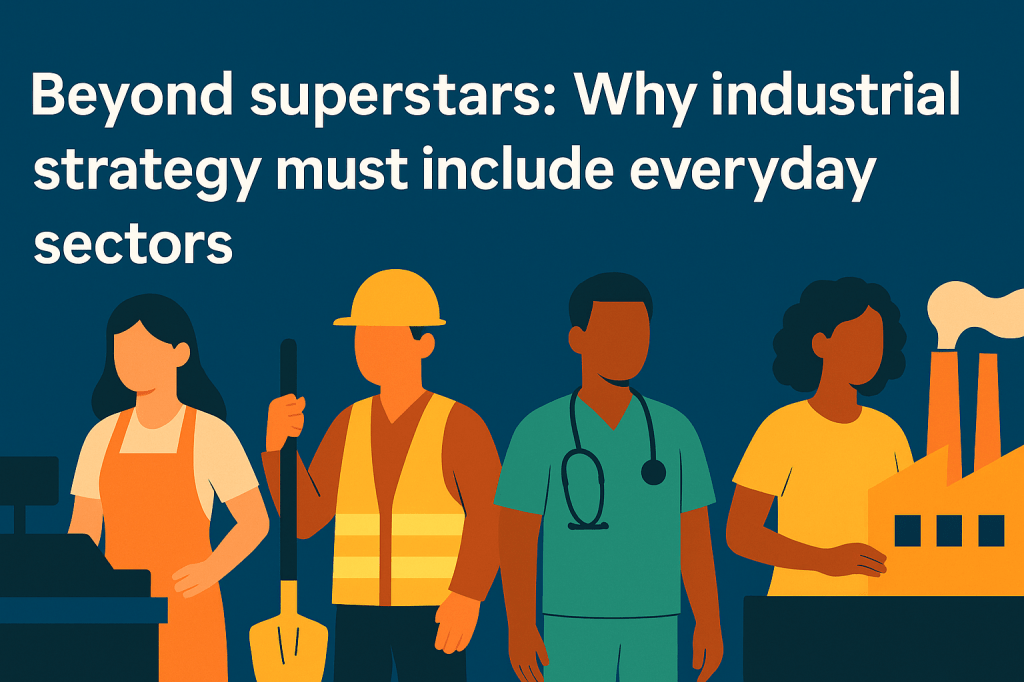
Industrial policies worldwide often carry a strong bias toward “superstar” sectors—those that attract headlines, foreign investments, and political pride. High-tech industries such as semiconductors, artificial intelligence, or aerospace typically dominate national strategies. These sectors are indeed important, as they symbolize technological edge and global competitiveness. But an overemphasis on them risks creating a distorted industrial vision that leaves behind the majority of workers and businesses engaged in everyday sectors such as retail, construction, logistics, and health services.
The reality is that most economies are built on the backbone of these everyday industries. For instance, in India, retail employs more than 40 million people, making it one of the largest sources of jobs. In the U.S., construction and health services together account for a significant share of GDP growth and employ tens of millions. Yet, these sectors often remain under-served in terms of innovation funding, infrastructure support, and skill development programs. Industrial policy, if skewed toward elite industries, risks exacerbating inequality in both incomes and opportunities.
From a strategic standpoint, concentrating resources only on “superstars” can make an economy vulnerable. If global demand shifts, or if a supply chain shock disrupts these sectors, the ripple effects can be destabilizing. Everyday sectors, by contrast, offer resilience—they provide steady employment, cater to domestic demand, and ensure broader participation in growth. Ignoring them risks widening the gap between a high-productivity minority and a low-productivity majority.
What is needed is an industrial strategy that balances ambition with inclusion. Governments should continue to nurture high-tech champions but must also expand investment in skill development for service workers, in infrastructure that improves logistics for small retailers, and in public health systems that support both care delivery and job creation. For example, targeted reskilling programs in construction could raise productivity and wages, while better transport infrastructure could reduce costs for small manufacturers and traders. Such interventions not only boost competitiveness but also make growth more equitable.
The call for inclusive industrial policy is not just about fairness—it is about efficiency. A workforce that is trained, a transport system that is reliable, and a health sector that is robust together create a stronger foundation for growth than any isolated pocket of technological success. Policymakers must recognize that economic resilience depends as much on the strength of “ordinary” industries as it does on the glamour of “superstars.”IndustrialPolicy
#InclusiveGrowth
#EverydayEconomy
#RetailSector
#ConstructionJobs
#HealthServices
#SkillDevelopment
#InfrastructureGrowth
#JobCreation
#EconomicResilience
 "Connecting communities, empowering nations: Unifying the Regional and Global Economy ."
Leave a comment