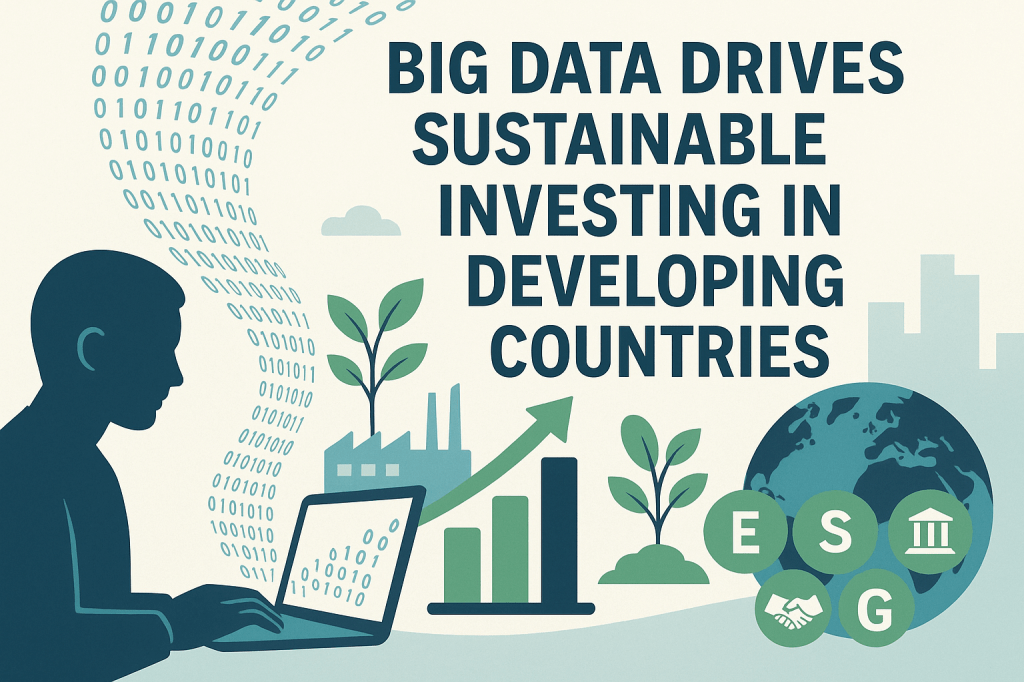
Sustainable investing—anchored in Environmental, Social, and Governance (ESG) principles—has often been seen as a luxury limited to advanced economies with strong financial systems. Yet, recent econometric evidence suggests that the story is changing. Big data, when paired with the right enabling conditions, is quietly reshaping how developing countries approach sustainable finance.
Big Data as a Game-Changer
At its core, ESG investing relies on transparency: measuring carbon footprints, labor conditions, governance practices, and long-term risks. In developing economies, however, such data has traditionally been patchy or unreliable. This is where big data becomes transformative. By integrating satellite imagery, social media analytics, real-time financial records, and digital payment trails, investors now have a sharper lens to evaluate both risks and opportunities. For instance, crop yield monitoring through remote sensing not only supports food security policies but also informs investors about the long-term viability of agribusiness projects.
Why Macroeconomic Stability Matters
The research highlights a critical nuance: technological adoption alone does not guarantee successful ESG integration. Macroeconomic stability—particularly low inflation and predictable monetary conditions—creates the environment where big data tools can function effectively. Without stability, investor confidence erodes, and even the best analytics lose traction. In this sense, the study argues that ESG adoption thrives not in high-growth environments per se, but in economies where stability anchors expectations.
Beyond GDP Growth
A striking insight is that GDP growth alone is insufficient to drive sustainable investment. Many developing countries post impressive growth numbers but fail to attract long-term ESG capital. Why? Because growth without structural financial and technological support often masks vulnerabilities. Weak digital infrastructure, inconsistent regulations, and underdeveloped capital markets can all undercut ESG potential. Big data reduces informational asymmetries, but it cannot substitute for policy and institutional reforms.
Policy and Investor Implications
For policymakers, the lesson is clear: investing in data ecosystems—digital infrastructure, open data platforms, fintech linkages—is just as important as chasing headline GDP growth. For investors, the implication is equally critical: ESG opportunities in emerging markets should be assessed not only through growth metrics but also through the lens of data availability and macroeconomic stability. Countries that successfully align these elements are likely to become the next hotbeds of sustainable finance.
The Broader Outlook
As sustainable investing becomes mainstream, developing countries have an opportunity to leapfrog traditional barriers by leveraging big data. But the challenge is twofold: building the digital backbone that sustains data-driven finance and ensuring macroeconomic environments remain stable enough for investors to trust the numbers. In the end, the future of ESG in the Global South may rest less on GDP charts and more on gigabytes of reliable, real-time data.
#BigData
#SustainableInvesting
#DevelopingCountries
#ESG
#DigitalInfrastructure
#MacroeconomicStability
#FinancialInclusion
#EmergingMarkets
#DataDrivenFinance
#GreenGrowth
 "Connecting communities, empowering nations: Unifying the Regional and Global Economy ."
Leave a comment