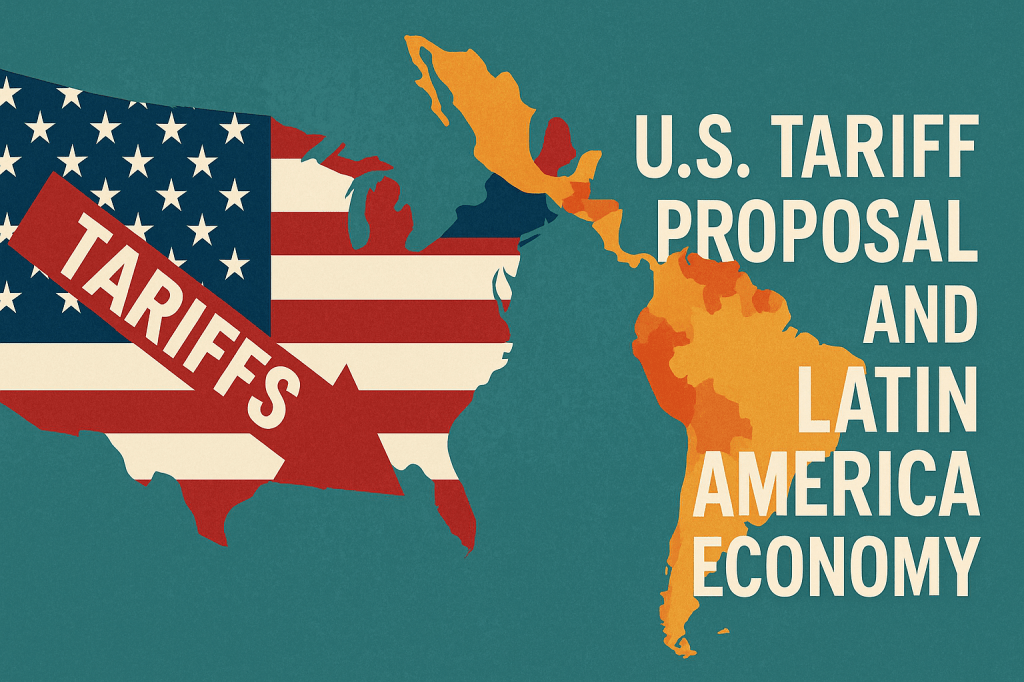
In a bold and controversial move, the United States under President Donald Trump has unveiled a sweeping tariff proposal targeting Latin American imports, marking a significant departure from the multilateral free-trade approach of past administrations. Effective August 1, 2025, the proposed tariff structure increases baseline rates from 10% to between 15% and 50%, with the harshest penalties reserved for nations with strained diplomatic relations—Brazil being a primary example.
This unilateral escalation in trade barriers is not merely a symbolic gesture. It carries tangible and immediate consequences for Latin America, a region heavily reliant on exports, particularly of commodities and manufactured goods. For a continent still recovering from post-pandemic disruptions, rising inflation, and slowing global demand, the timing of this trade shock could not be more precarious.
Brazil: The Hardest Hit
Brazil, Latin America’s largest economy, finds itself directly in the crosshairs. Select sectors, including steel, aluminum, and chemicals, now face potential tariffs as high as 50%. The repercussions are severe—economists estimate a potential GDP contraction of 0.8% to 1.2% in 2025 alone if these tariffs are fully implemented. The shockwave is already being felt across industrial zones in São Paulo and Rio de Janeiro, where canceled export contracts, layoffs, and factory slowdowns have begun to surface. Moreover, Brazil’s agricultural exports—already vulnerable to price fluctuations and climate uncertainty—face an uphill battle in maintaining competitiveness in U.S. markets.
Mexico: Caught in the Middle
While Mexico’s government has called the new tariffs “unfair,” its officials continue to hold out hope for last-minute negotiations to prevent full-scale implementation. The country’s export-heavy manufacturing base, particularly in auto parts and electronics, is directly exposed. Any disruption here is not just an economic setback for Mexico—it threatens North American supply chain stability, with ripple effects for U.S. carmakers and consumers alike. Nevertheless, with the U.S. leveraging tariffs as a diplomatic bargaining chip, Mexico’s options are politically and economically constrained.
Regional Spillovers and Commodity Shock
Beyond Brazil and Mexico, the broader Latin American region faces cascading effects. Nations like Chile, Peru, and Colombia—whose economies are highly dependent on commodities such as copper, oil, and agricultural goods—may see declining export values due to both tariffs and secondary market shifts. Already, early signs point to downward pressure on commodity prices, which could squeeze fiscal revenues and exacerbate deficits in countries struggling with debt servicing and social spending needs.
The International Monetary Fund (IMF) and leading private-sector analysts have moved quickly to downgrade regional growth forecasts. Brazil’s and Mexico’s outlooks are particularly grim, but smaller economies like Ecuador, Bolivia, and Paraguay, which often depend on one or two major exports, may suffer even greater proportional damage. Some scenarios project contraction in GDP for countries that fail to redirect trade flows quickly.
Market Jitters and Investor Caution
Financial markets have reacted with a mix of alarm and calculation. Latin American currencies experienced increased volatility, while regional equity indices dipped before stabilizing. Though global markets appear to have priced in the tariffs without widespread panic, investor confidence in Latin American stability has taken a hit. Foreign direct investment, already under pressure from rising global interest rates and uncertainty, could decline further if businesses reassess the risks of relying on U.S.-bound trade.
The Politics of Tariffs and the Future of Global Trade
What makes the current situation especially significant is not just the scale of the tariffs, but the signal they send about U.S. trade policy. President Trump’s proposal marks a reversion to a tariff-centric approach reminiscent of the 1930s Smoot-Hawley era, challenging decades of progress toward a rules-based global trading system. For Latin America, the lesson is sobering: reliance on a single dominant trading partner is increasingly risky in an era of populist protectionism and transactional diplomacy.
Governments across the region are scrambling for responses. Brazil has hinted at countermeasures and legal appeals through the World Trade Organization (WTO), but immediate retaliation remains unlikely. Most Latin American countries are instead focusing on damage control—preparing support packages for affected exporters, engaging in emergency trade diplomacy, and exploring diversification of export markets, especially in Asia and Europe.
Strategic Realignments: An Unintended Opportunity?
Ironically, some analysts argue that this crisis may be a turning point for Latin America to reduce its dependence on the U.S. and deepen regional integration or pivot towards alternative trade partnerships. Trade deals with the European Union, China, and ASEAN could gain traction. Similarly, countries may invest in boosting domestic value chains and industrial upgrading, spurred by the need for economic resilience.
Yet, such structural shifts are neither quick nor easy. They require coherent policy planning, infrastructure upgrades, and political consensus—all difficult under the region’s current fiscal constraints and social tensions.
A Test of Economic Resilience
The new U.S. tariff regime, if sustained, threatens to upend Latin America’s economic trajectory at a critical juncture. While some nations may find ways to adapt or even turn adversity into opportunity, the short-term pain is undeniable—lost revenues, rising unemployment, and growing geopolitical tension. More than ever, Latin America needs strategic foresight, diplomatic agility, and regional solidarity to weather the storm and chart a new path forward in a shifting global order.
#TariffPolicy #LatinAmerica #BrazilEconomy #MexicoExports #CommodityPrices #TrumpTariffs #USLatinTrade #GlobalTrade #EconomicImpact #Geopolitics
 "Connecting communities, empowering nations: Unifying the Regional and Global Economy ."
Leave a comment