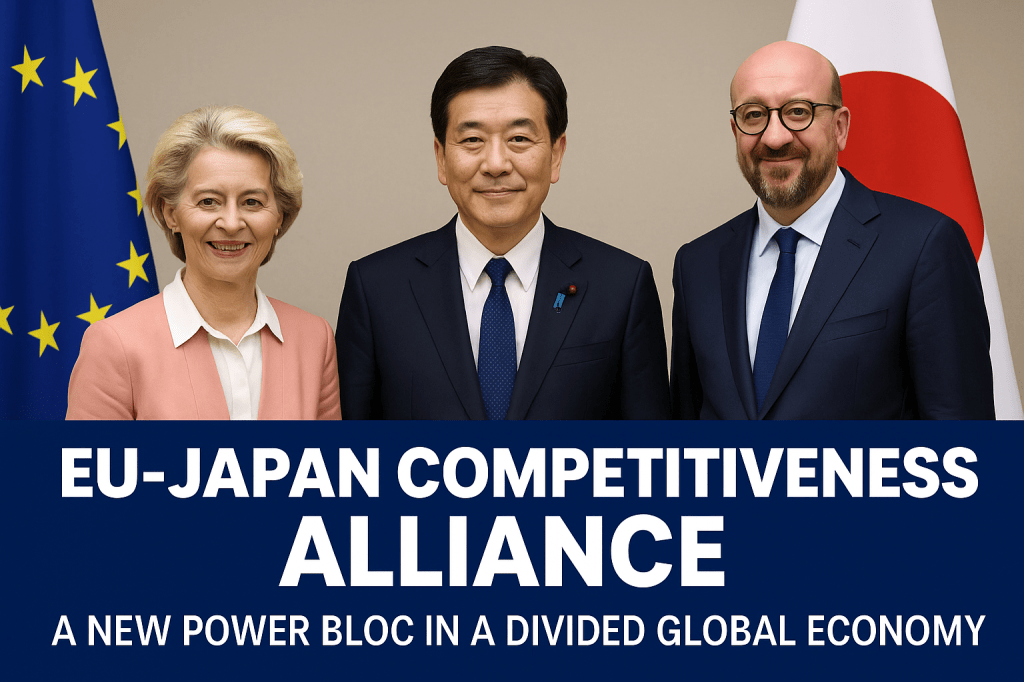
In a significant geopolitical and economic move, the European Union and Japan have formally launched a “Competitiveness Alliance” aimed at bolstering cooperation across trade, defense, and technology. This partnership, announced during the 30th EU-Japan Summit in Tokyo, is not merely symbolic—it reflects deepening anxieties over the evolving world order, particularly the growing influence of the United States and China. More importantly, it signals a strategic pivot toward building resilience in supply chains, countering economic coercion, and fostering technological independence.
The alliance comes at a pivotal time. Just a day earlier, Japan finalized a bilateral trade agreement with Washington, reflecting Tokyo’s careful diplomacy in balancing its interests between major powers. Yet the decision to simultaneously deepen its ties with the European Union suggests a broader hedging strategy—one that recognizes the volatility of U.S. trade policy and the long-term assertiveness of China’s economic playbook. In this context, the alliance is less about exclusivity and more about securing autonomy in an increasingly fragmented global economy.
Supply Chain Sovereignty: The Core of the Alliance
At the heart of the EU-Japan Competitiveness Alliance is the shared concern over economic coercion and the weaponization of trade dependencies. Both Brussels and Tokyo have faced various forms of pressure—Japan from Chinese export controls and the U.S.’s unpredictable tariff regimes; the EU from a range of U.S. tech restrictions and Chinese industrial dumping. This alliance seeks to jointly counter these pressures by reinforcing supply chains for critical materials, especially semiconductors, rare earths, and green technologies.
Supply chain sovereignty has become a buzzword in both European and Japanese policy circles. For the EU, the COVID-19 pandemic exposed its vulnerability in pharmaceutical and medical supplies, while the Russia-Ukraine conflict spotlighted its energy dependence. Japan, similarly, suffered supply shocks in semiconductors and battery components. Their alliance aims to jointly invest in and protect these supply chains from future disruptions and geopolitical manipulation.
Technological and Regulatory Alignment
Another critical pillar of the alliance is regulatory cooperation, particularly around emerging technologies like AI, quantum computing, cybersecurity, and green energy. By aligning standards, the EU and Japan aim to shape global norms in these areas—effectively counterbalancing China’s state-driven tech model and the often extraterritorial nature of U.S. digital regulation.
This is not just about rulemaking; it’s a direct economic strategy. Countries that set global standards in technology are more likely to control value chains, direct investment flows, and protect their firms in export markets. The EU-Japan framework can serve as a platform to assert their voices in forums like the WTO, OECD, and G7, where rules of the digital and green economy are being contested.
Defense and Economic Security: An Integrated Vision
Although the alliance is framed around economic competitiveness, its subtext clearly extends into defense and security cooperation. Japan’s recent national security strategy has elevated economic security to a top-tier priority, and the EU’s own strategic compass has increasingly blurred the line between economic and defense interests. Joint initiatives may include secure technology sharing, cybersecurity coordination, and resilient infrastructure development.
This integrated vision reflects the emerging reality that economic competitiveness is inseparable from national security. Both regions are recalibrating their foreign policies around the notion of “de-risking,” not decoupling—a recognition that interdependence cannot be fully undone but must be restructured.
Implications for the United States
The alliance is likely to be viewed in Washington with a mix of approval and apprehension. On one hand, it reinforces the broader Western effort to contain China’s rise through economic coalitions. On the other, it could signal growing unease among U.S. allies over America’s unpredictable trade and industrial policies.
Despite a fresh trade deal between the U.S. and Japan, there is lingering skepticism in Tokyo about the long-term reliability of American commitments. The Inflation Reduction Act (IRA), for instance, introduced protectionist subsidies that frustrated many allies. Similarly, the EU has been critical of U.S. moves perceived as undermining global trade rules, including export restrictions on chips and sweeping sanctions regimes. The new alliance could be seen as a subtle attempt to create a buffer against future U.S. economic unilateralism.
For U.S. firms, the alliance could bring mixed outcomes. On the positive side, aligned standards between the EU and Japan could lower costs and promote smoother operations across those markets. However, if the alliance results in exclusive supply chains or discriminatory industrial policies, U.S. tech giants and manufacturers may find themselves at a competitive disadvantage.
Global Power Rebalancing
In the larger geopolitical landscape, the EU-Japan alliance is emblematic of a multipolar world in flux. As the U.S. and China drift further apart, middle powers and blocs are carving out space to protect their own interests. This alliance, therefore, is not a rejection of the U.S. or a provocation to China—but rather a pragmatic recalibration to ensure that neither dominates the global rules-based order unchecked.
The alliance also sets a precedent. It may inspire similar regional or bilateral groupings—such as between South Korea and the EU, or India and the EU—as economies seek partners that offer both political stability and strategic alignment. In a world where economic resilience is a form of security, such partnerships are bound to proliferate.
Final Thoughts
The EU-Japan Competitiveness Alliance is more than a diplomatic milestone; it is a strategic shift that reflects the realities of a fractured, contested global economy. It underscores a growing recognition that competitiveness today requires coordination—across borders, across sectors, and across institutions. For the United States, it’s a reminder that while alliances remain strong, they are not unconditional. Economic policy, like foreign policy, must be seen through the lens of shared trust and mutual benefit. Failing that, even the most trusted partners will hedge.
#EUJapanAlliance #GlobalTrade #EconomicSecurity #SupplyChainResilience #Geopolitics #TechnologyStandards #StrategicAutonomy #TransnationalPartnerships #USChinaTensions #MultipolarWorld
 "Connecting communities, empowering nations: Unifying the Regional and Global Economy ."
Leave a comment