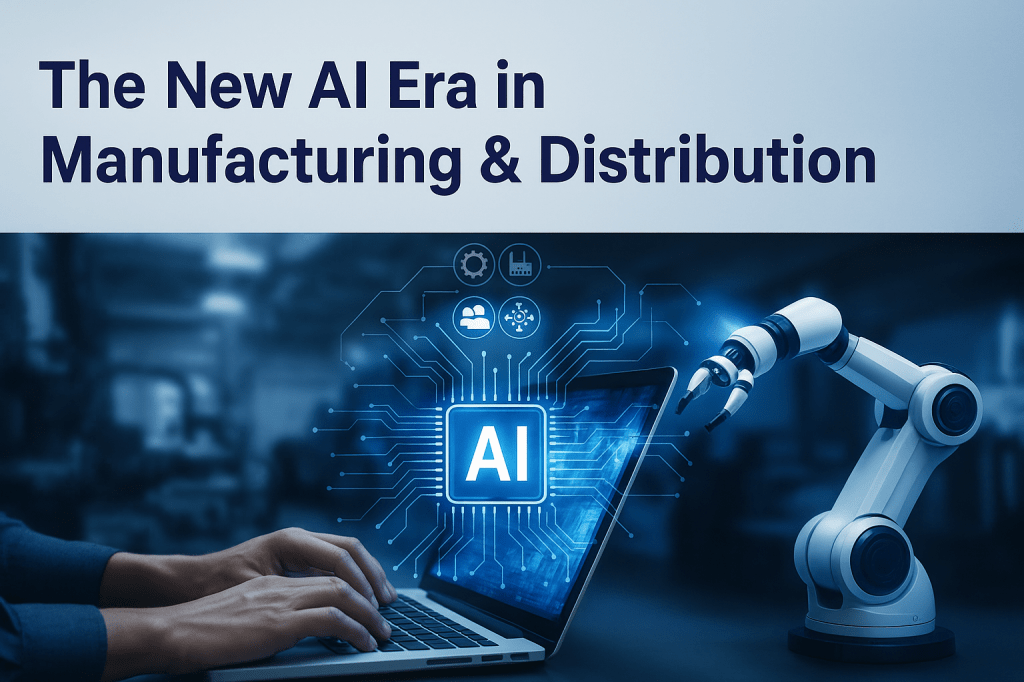
The manufacturing and distribution landscape is undergoing a transformative shift, with Artificial Intelligence (AI) emerging as a critical enabler of cost efficiency, streamlined operations, and data-driven decision-making. A recent study has revealed a compelling insight: 72% of manufacturers who implemented AI technologies experienced significant cost reductions and improvements in operational efficiency. This statistic underscores a pivotal trend—AI is not just a futuristic concept, but a practical tool reshaping core industrial processes today.
At the heart of this transformation is AI’s ability to process vast amounts of data in real-time, detect anomalies, optimize workflows, and predict maintenance needs before a failure occurs. In manufacturing, AI-powered predictive maintenance alone can prevent costly downtime by flagging equipment issues before they escalate. Similarly, AI-enabled robotics and automation are redefining the speed and accuracy with which products are assembled, packaged, and shipped.
In distribution, AI is being leveraged to forecast demand patterns with remarkable precision. By analyzing historical sales data, market trends, and seasonal variables, AI systems help companies minimize stockouts and excess inventory—both of which are notorious cost centers. The result is a smarter supply chain that responds dynamically to changing market needs, enhances customer satisfaction, and boosts bottom-line results.
However, the value AI brings extends beyond technical operations. Strategic decision-making is increasingly guided by AI-driven analytics, offering insights that were once hidden in complex data sets. From identifying inefficiencies in procurement to customizing logistics routes based on real-time traffic and weather data, AI empowers decision-makers to act swiftly and accurately.
Despite its benefits, integrating AI into manufacturing and distribution is not without challenges. Many firms face hurdles such as high upfront investment costs, skills gaps, and legacy systems that are not AI-compatible. Overcoming these barriers requires a structured approach—beginning with small-scale pilot projects, investing in workforce training, and selecting AI tools that align with existing infrastructure.
For organizations contemplating AI adoption, the question is no longer if, but how to get started effectively. A phased roadmap that begins with identifying high-impact areas—such as quality control, inventory management, or predictive maintenance—can serve as a strong foundation. Partnering with experienced technology vendors and continuously measuring ROI can further guide AI investments toward long-term value creation.
As the manufacturing and distribution sectors grapple with rising costs, labor shortages, and global competition, AI offers a path forward grounded in precision, efficiency, and adaptability. The data speaks for itself: businesses that embrace AI today are likely to become the resilient, high-performing leaders of tomorrow. The new AI era isn’t just about automation—it’s about intelligent evolution.#ArtificialIntelligence
#ManufacturingInnovation
#OperationalEfficiency
#CostReduction
#PredictiveMaintenance
#SmartSupplyChain
#AIIntegration
#DataDrivenDecisions
#DistributionOptimization
#IndustrialAutomation
 "Connecting communities, empowering nations: Unifying the Regional and Global Economy ."
Leave a comment