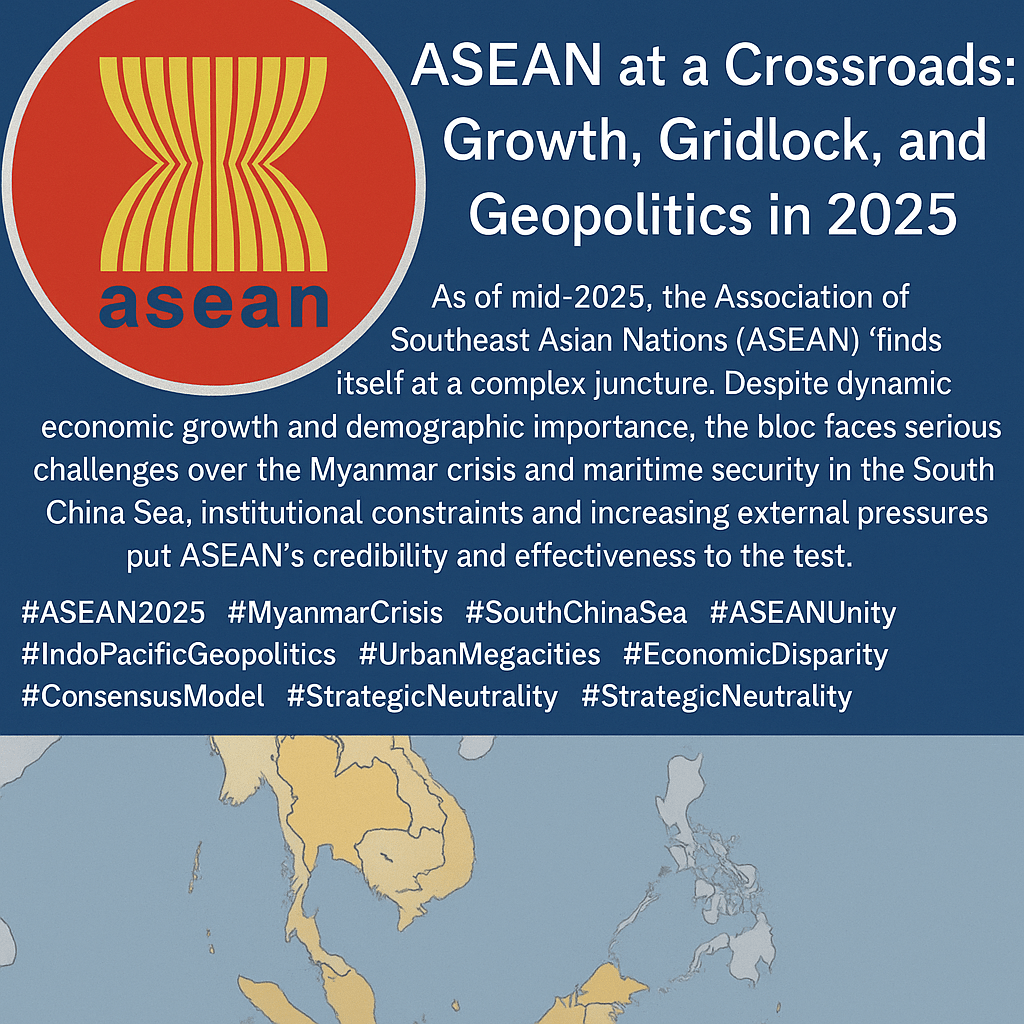
As of mid-2025, the Association of Southeast Asian Nations (ASEAN) finds itself standing at a complex juncture—marked by vibrant economic dynamism on one hand and deep political and institutional challenges on the other. Comprising ten member countries and nearly 680 million people, ASEAN has emerged as a critical player in the global economy, especially within the Indo-Pacific architecture. Yet, its ability to assert strategic coherence and deliver effective governance is increasingly under scrutiny.
At the heart of ASEAN’s internal political turmoil lies the Myanmar crisis, which has seriously tested the bloc’s diplomatic credibility. The 2021 military coup plunged the country into civil conflict and humanitarian catastrophe, challenging ASEAN’s core principle of non-interference. Despite repeated calls for constructive engagement and a Five-Point Consensus, ASEAN has failed to enforce any meaningful solution. Myanmar has been excluded from several high-level ASEAN forums, but without a clear mechanism for enforcement or compliance, this symbolic move has done little to resolve the crisis. The bloc’s inability to even agree on who represents Myanmar highlights its fractured internal consensus.
Simultaneously, maritime security in the South China Sea remains an unresolved flashpoint. Member states such as Vietnam, the Philippines, Malaysia, and Brunei continue to face mounting territorial pressure from China. However, the lack of unity within ASEAN—stemming from the divergent strategic priorities of member countries—has repeatedly thwarted efforts to finalize a legally binding Code of Conduct with China. Some ASEAN members, notably Cambodia and Laos, lean closely towards Beijing, weakening the regional response and casting doubt on ASEAN’s relevance in addressing security challenges.
These fault lines are a direct consequence of what is often referred to as the “ASEAN Way”—a framework grounded in consensus, non-interference, and informality. While it has historically allowed for peaceful coexistence among highly diverse political systems, it now impedes ASEAN’s capacity to take decisive stances on human rights violations, authoritarianism, and transnational threats like drug trafficking and refugee movements. The bloc is increasingly seen as avoiding difficult questions rather than confronting them—a perception that risks undermining its credibility both regionally and globally.
Despite these governance limitations, ASEAN remains a powerhouse of economic growth. Several member nations, including Vietnam, Indonesia, and the Philippines, are among the fastest-growing economies in the world. The region’s youthful population, expanding middle class, and accelerating urbanization have made it a magnet for investment. Yet economic disparities within ASEAN are stark. Singapore, with one of the world’s highest per capita incomes, stands in sharp contrast to countries like Cambodia and Laos, where poverty and weak infrastructure remain significant barriers to inclusive growth.
Urbanization is also transforming the socio-economic landscape. Megacities like Jakarta, Manila, Bangkok, and Ho Chi Minh City are emerging as regional growth poles, driving technological innovation, real estate booms, and consumer demand. However, they are also grappling with infrastructure bottlenecks, environmental degradation, and social inequality—issues that require coordinated regional responses which ASEAN’s structure is ill-equipped to deliver.
Externally, ASEAN sits at the epicenter of great power competition, particularly the escalating US-China rivalry. The Indo-Pacific has become a strategic battleground, with ASEAN countries caught between security partnerships with the United States and deep economic integration with China. While ASEAN seeks to maintain “strategic neutrality,” it struggles to articulate a unified position, making it vulnerable to external coercion. India’s deepening trade relationship with ASEAN—now its fourth-largest partner—adds yet another layer of geopolitical and economic complexity.
From a strategic standpoint, ASEAN is both indispensable and insufficient. Its sheer demographic weight and geographic centrality make it vital to global supply chains, energy corridors, and digital connectivity routes. Yet its institutional design—a consensus-bound, state-centric body with no enforcement mechanisms—renders it inadequate in moments of crisis. The global community’s expectations for ASEAN to act as a pillar of stability in the Indo-Pacific are rising, but the bloc’s ability to meet those expectations remains uncertain.
ASEAN in 2025 represents a paradox: a region of immense economic promise and demographic vitality, burdened by political divisions, institutional fragility, and strategic ambiguity. Its survival and relevance will depend not just on its economic performance, but on whether it can evolve into a more coherent, decisive, and rules-based community. Failing to address these internal contradictions could reduce ASEAN to a passive bystander in a region where it ought to be a leading voice.
#ASEAN2025
#MyanmarCrisis
#SouthChinaSea
#ASEANUnity
#IndoPacificGeopolitics
#UrbanMegacities
#EconomicDisparity
#ConsensusModel
#StrategicNeutrality
#ASEANGrowth
 "Connecting communities, empowering nations: Unifying the Regional and Global Economy ."
Leave a comment