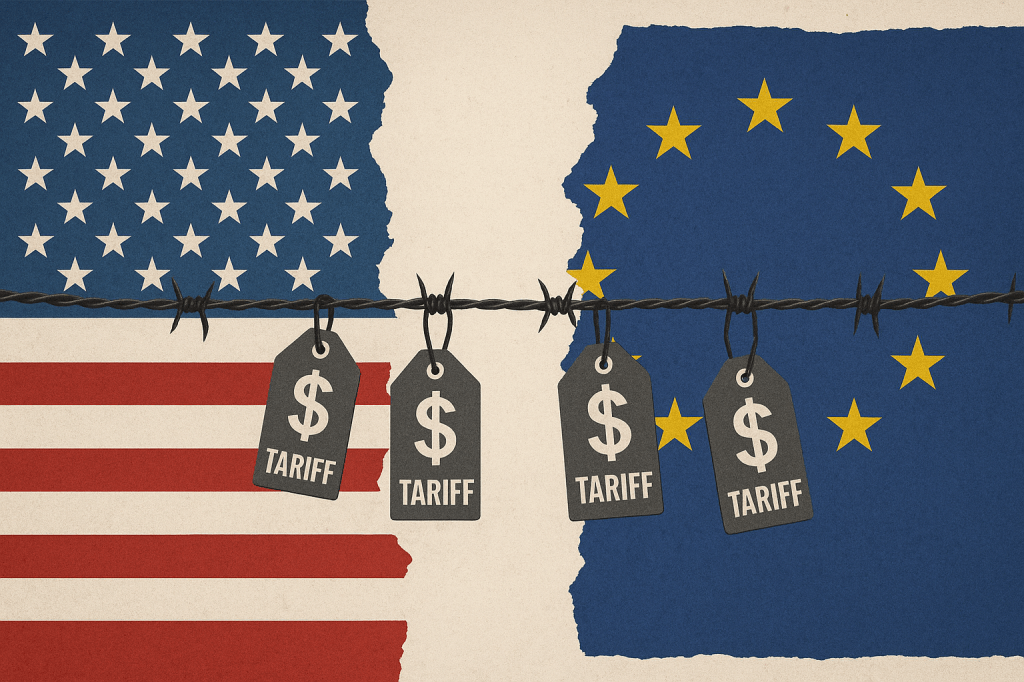
The world is once again witnessing escalating trade tensions, this time between two of the largest economic powers—the United States and the European Union (EU). At the heart of the standoff lies a potentially devastating tariff war, triggered by President Trump’s recent announcement that a 30% tariff on all EU imports will take effect from August 1, 2025, if a broader trade agreement fails to materialize. This is not merely another skirmish in trade diplomacy—it could fundamentally alter the fabric of transatlantic economic relations.
The Escalating Tariff Regime
Over the past few months, the trade landscape between the US and the EU has been steadily deteriorating. Since March 2025, the US has already rolled out targeted tariffs: 50% on EU steel and aluminum, 25% on European automobiles, and 10% on all other goods. The latest proposed blanket tariff of 30% on all EU imports—if enacted—will dramatically compound these existing barriers.
According to trade experts and policymakers, this move could “effectively wipe out” transatlantic trade. Given that EU-US bilateral trade reached nearly $1 trillion in 2024, and accounts for approximately 30% of global trade in goods and services, the economic stakes are enormous. This is not simply a tit-for-tat tariff scenario—it’s a systemic risk to global trade flows.
Negotiations: A Race Against Time
In response, EU negotiators have launched an urgent diplomatic offensive, holding high-level meetings in Washington in hopes of reaching a deal before the August 1 deadline. While there was optimism earlier in the year when both sides reportedly came “tantalizingly close” to a framework agreement, the latest unilateral move from the US has significantly hardened EU sentiment.
European leaders have expressed deep disappointment and concern, warning that the proposed tariffs would disproportionately harm industries on both sides of the Atlantic. In a bid to de-escalate, the EU has so far held back on retaliation—but has made it clear that it is ready to strike back with countermeasures targeting up to €93 billion in US products, including consumer goods, technology, and agricultural exports.
The Underlying Dispute: Fairness or Coercion?
President Trump has justified these tariffs by accusing the EU of maintaining unfair tariffs and non-tariff barriers on US products. He argues that these steps are necessary to “reset” the trade relationship and level the playing field. However, EU trade officials and former trade chiefs have countered by labeling the US approach as a form of economic coercion, urging Brussels to invoke its anti-coercion trade instruments if the talks collapse.
This standoff reflects not just a disagreement over numbers and trade balances but a deeper clash over norms, multilateralism, and the use of economic tools as instruments of foreign policy. While the US insists on bilateral leverage and renegotiation, the EU remains committed to a rules-based trade order.
Economic and Political Consequences
If this trade conflict escalates, the consequences could be profound—not just for the US and EU but for the global economy. Both regions are already navigating inflationary pressures, supply chain realignments, and post-pandemic recovery challenges. A tariff war could lead to higher consumer prices, slower GDP growth, and disruption of critical supply chains, especially in sectors like automobiles, aerospace, chemicals, and machinery.
Moreover, the political ripple effects cannot be ignored. As Europe heads toward parliamentary elections in 2025 and the US braces for a potentially tumultuous election year, the weaponization of trade could become a defining theme in both domestic and international politics.
Brinkmanship or Breakdown?
What we are witnessing is a classic case of brinkmanship. Both the US and EU know that a full-blown tariff war would be mutually destructive. Yet, without compromise, they risk walking straight into it. The coming days will be crucial. If negotiations fail and tariffs take effect, it would mark one of the most significant ruptures in transatlantic economic history in recent decades.
The world will be watching as August 1 approaches—not just to see whether a deal is reached, but to understand what the outcome signals for the future of global trade diplomacy. Will cooperation prevail, or will conflict define the next phase of US-EU relations?
#US-EUTradeTensions #TariffWar #TransatlanticTrade #TradePolicy #TrumpTariffs #EUResponse #GlobalEconomy #BilateralTrade #Protectionism #EconomicDiplomacy
 "Connecting communities, empowering nations: Unifying the Regional and Global Economy ."
Leave a comment