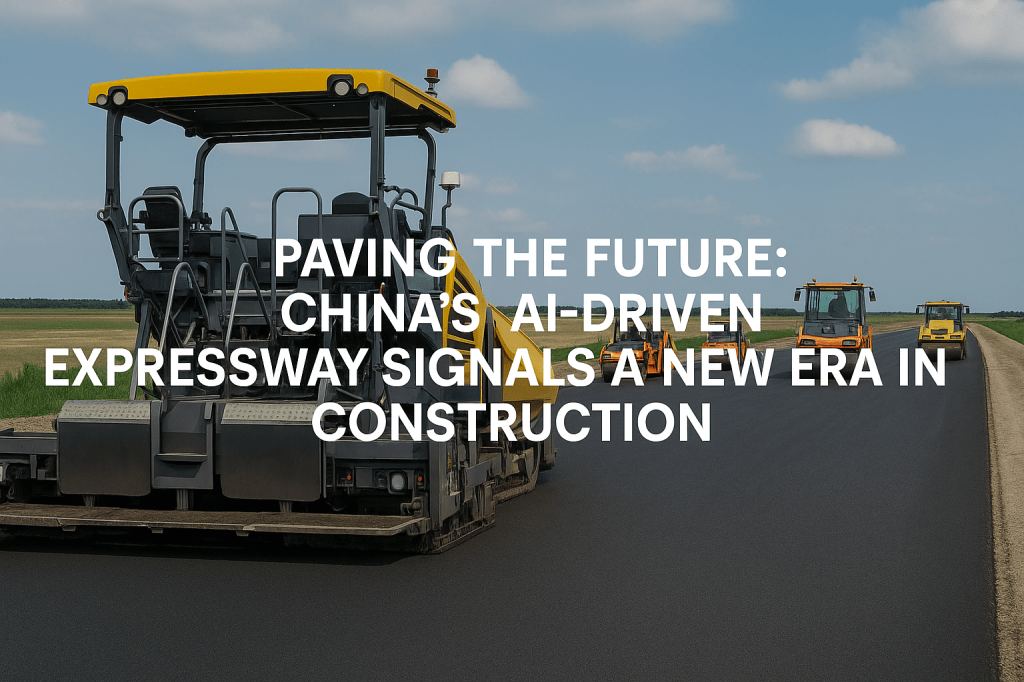
In a historic leap for infrastructure technology, China has successfully completed a 157.79-kilometer stretch of the Beijing-Hong Kong-Macao Expressway using a fully autonomous fleet of AI-powered machinery. This project marks a significant milestone in construction history, showcasing the potential of advanced automation in civil engineering and transport infrastructure.
Led by Sany Heavy Industries, the initiative employed a range of unmanned construction vehicles including a 20-meter-wide autonomous paver, six 13-tonne double-drum rollers, and three 30-tonne rubber-wheeled rollers. These smart machines were synchronized through cutting-edge algorithms and guided by China’s Beidou satellite navigation system, which enabled centimeter-level precision. Remarkably, the entire execution involved zero human workers on-site, underscoring a transformative shift in how large-scale infrastructure can be built in the future.
The autonomous systems handled complex and varied tasks—grading, asphalt laying, compaction, and edge trimming—accomplishing each with high efficiency and accuracy. A standout performance came from the SAP200C-10 paver, which impressively laid a 19.25-meter-wide stretch in a single pass, further illustrating the sheer capacity of AI-integrated construction systems.
The implications of this achievement are multifaceted. Firstly, it demonstrates how automation can drastically reduce labor costs while enhancing safety by removing human exposure to hazardous construction conditions. Such advances are particularly relevant in countries facing labor shortages or seeking to improve worker safety standards. Secondly, the time-saving potential is enormous—projects that traditionally take months could now be completed in a fraction of the time.
However, despite the celebrated technological milestone, there remain legitimate concerns. Reports indicate that some level of human oversight was maintained during the project, possibly for safety or troubleshooting, raising questions about the true extent of autonomy. Moreover, the cost-effectiveness of deploying such high-tech machinery is yet to be fully evaluated. Initial investments are high, with equipment alone estimated to run into millions of dollars. Whether these costs can be offset through long-term savings in labor and time remains uncertain and requires deeper financial modelling and real-world replication.
From a global perspective, while China’s rapid innovation and execution are commendable, scaling such technologies internationally presents unique challenges. Developed economies like the UK, for instance, continue to lag in fully autonomous construction trials due to fragmented regulations, outdated infrastructure, and complex safety approval systems. Furthermore, investments in digital infrastructure, workforce upskilling, and cross-sector collaboration remain critical for such automation to become the global standard rather than an isolated feat.
China’s AI-led expressway construction project sets a powerful precedent for the future of infrastructure. It blends precision engineering with frontier technology, offering a glimpse into a world where machines could reshape how we build roads, cities, and nations. Yet, the road ahead will require careful balancing of cost, policy innovation, and societal readiness to ensure that such technology-driven transformation is inclusive, efficient, and sustainable.
#AIinConstruction
#AutonomousMachines
#InfrastructureInnovation
#SmartConstruction
#BeidouNavigation
#ChinaTechnology
#RoadBuildingRevolution
#AutomationVsJobs
#ConstructionFuture
#GlobalInfrastructure
 "Connecting communities, empowering nations: Unifying the Regional and Global Economy ."
Leave a comment