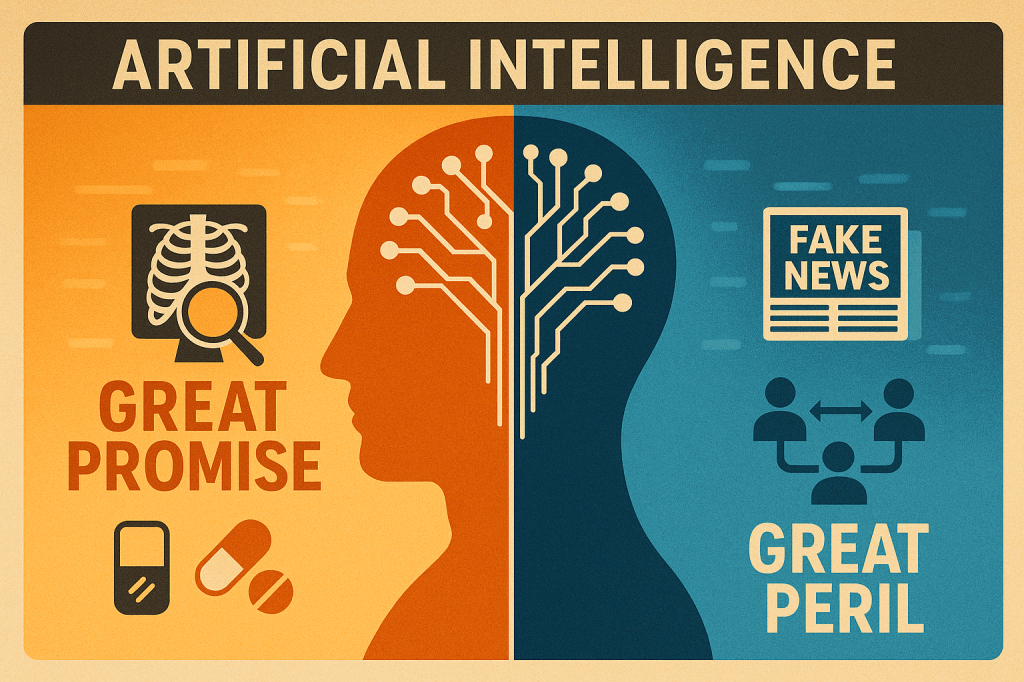
Artificial Intelligence (AI) is redefining what machines can do—from decoding complex medical images to crafting new life-saving drugs. Yet, behind this exhilarating progress lies a sobering reality: as much as AI can empower humanity, it also harbors the potential to destabilize key aspects of society. Balancing its transformative benefits with its inherent risks is one of the great challenges of our era.
The Great Benefits: Medicine, Innovation, and Human Potential
One of the most impactful and immediate domains where AI is thriving is healthcare. AI is now on par with, and in some cases surpassing, radiologists in interpreting medical images such as X-rays, MRIs, and CT scans. This has the potential to democratize expert diagnostics across under-resourced hospitals and rural clinics globally. By enabling early detection of diseases like cancer or neurological disorders, AI is enhancing life expectancy and reducing medical errors.
In drug development, AI is proving to be a revolutionary tool. It accelerates the discovery of potential drug molecules by predicting how they will interact with biological systems, cutting years and billions of dollars from the traditional research cycle. Already, AI-generated drug candidates have entered clinical trials, offering hope for faster treatments to emerging health threats.
Furthermore, AI is augmenting human creativity and decision-making across sectors—from climate modeling and supply chain optimization to personalized education and smart agriculture. This cross-sectoral utility promises a leap in productivity and efficiency, reshaping global development trajectories.
The Great Risks: Job Displacement, Bias, and Trust Erosion
However, as AI systems become more capable, they are also displacing traditional jobs, creating what some fear could be a “class of people who are unemployed and no longer valued.” Tasks once performed by humans—from driving and basic accounting to customer support—are increasingly being automated. This raises concerns about long-term employment, especially for workers in low- and medium-skill roles.
Another critical issue is algorithmic bias, especially in sensitive domains like employment, law enforcement, and financial services. AI systems trained on historical data can inadvertently perpetuate societal inequalities—such as racial profiling in policing or discriminatory hiring practices—because they reflect the biases embedded in the data itself. Without transparency and accountability, such biases can scale faster than they can be corrected.
Moreover, AI-driven misinformation poses a serious threat to democratic institutions. Deepfakes, AI-generated fake news, and manipulated media can mislead the public, influence elections, and foster polarization. The speed and scale at which these tools operate mean traditional fact-checking methods struggle to keep up, eroding trust in information ecosystems.
Navigating the Crossroads: A Call for Responsible AI
The juxtaposition of AI’s remarkable capabilities with its potential for societal harm makes it clear that governance and ethical oversight are not optional—they are essential. Governments, technologists, civil society, and international bodies must work together to:
Establish transparent AI development guidelines and ethical standards;
Create social safety nets and upskilling programs to support displaced workers;
Enforce algorithmic accountability, especially where AI impacts human rights;
Invest in public awareness and media literacy to counter misinformation.
AI is neither inherently good nor bad—it is a tool shaped by the values and structures of those who wield it. With thoughtful design, inclusive policies, and global cooperation, we can ensure that AI becomes a force for shared prosperity rather than social dislocation.
#ArtificialIntelligence #FutureOfWork #AIInHealthcare #AIAndSociety #TechEthics #ResponsibleAI #AlgorithmicBias #DigitalGovernance #JobDisplacement #Misinformation
 "Connecting communities, empowering nations: Unifying the Regional and Global Economy ."
Leave a comment