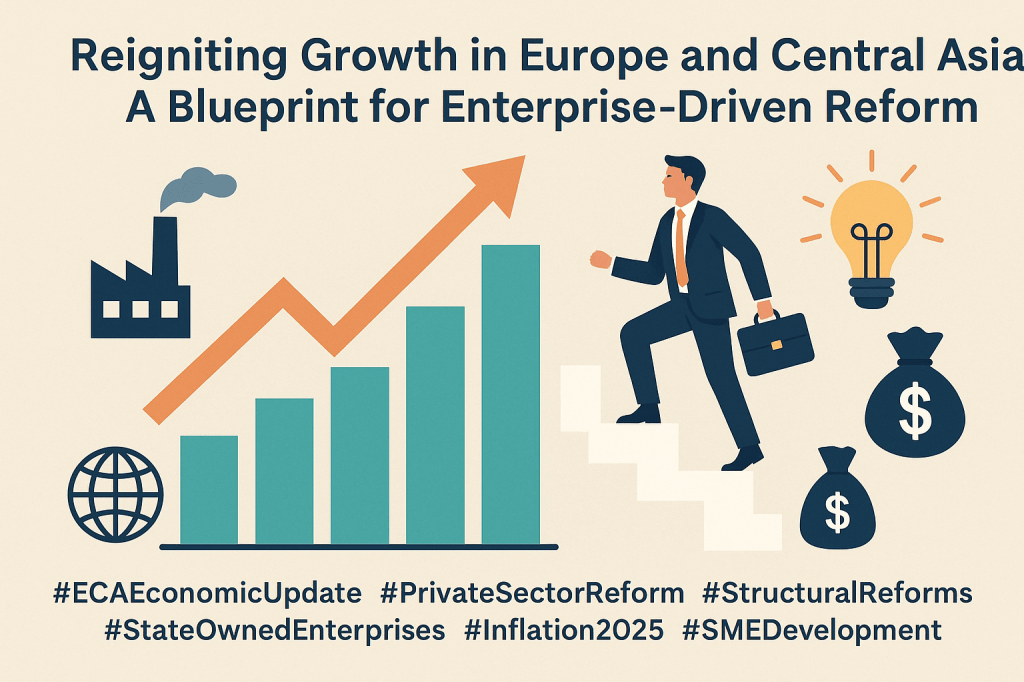
In 2025, the economies of Europe and Central Asia (ECA) are navigating turbulent waters. While growth in the region remained stable at 3.6% in 2024, excluding the Russian Federation, the broader outlook shows signs of strain, with projections slowing to 2.5% in 2025–26. Weak external demand, the fallout from geopolitical tensions, and policy uncertainty are contributing to this deceleration. The World Bank’s Spring 2025 update offers not just a sobering assessment of current trends but also a compelling call for enterprise-focused reforms to reinvigorate growth.
Growth with Limits: The Consumption-Led Recovery
Private consumption has been the backbone of recent growth across the ECA region. Rising wages, higher remittances, and increased consumer credit have supported household spending. Yet this growth model faces diminishing returns, especially as external demand remains fragile. Weak exports—hampered by sluggish demand in the European Union and constrained recovery in key economies like Ukraine—have curtailed the region’s broader economic momentum.
Inflation has added another layer of complexity. Median annual headline inflation rose to 5% in February 2025, up from 3.6% in mid-2024. This spike was driven by a surge in food prices and rising administered tariffs. Inflationary pressures have left central banks in a difficult position, torn between protecting real incomes and avoiding monetary tightening that could stifle growth.
The “Missing Middle” in ECA’s Private Sector
Beyond immediate macroeconomic risks, the ECA region faces deeper structural challenges. Foremost among these is what the World Bank terms the “missing large” problem: an excess of small, low-productivity firms and a dearth of high-growth enterprises capable of scaling globally. Policies that simply blanket support to SMEs have saturated the market with firms that lack innovation, competitive edge, or global ambition.
This stagnation is exacerbated by the dominance of state-owned enterprises (SOEs) in key sectors, particularly in larger ECA economies. These incumbents often crowd out new entrants, distort markets through preferential access to capital, and stifle technological advancement. The result is a lack of competition, limited innovation, and a private sector that struggles to scale and diversify.
Structural Reforms as a Path to Resilience
The World Bank argues that the path forward lies in bold, enterprise-led reforms. Governments must prioritize a business environment that promotes innovation, competition, and firm-level dynamism. This includes:
- Phasing out market-distorting subsidies that shield unproductive firms;
- Improving SOE efficiency and reducing their dominance in strategic sectors;
- Promoting technology adoption and R&D investment, particularly among mid-sized firms;
- Facilitating access to long-term finance to support scale and innovation.
The current period of economic disruption presents a rare window for action. Reform fatigue, often delayed by political risk, must now give way to decisive policy shifts. This is especially critical as global uncertainties—ranging from commodity price volatility to shifting trade alliances—compound the internal structural weaknesses of ECA economies.
Toward a High-Income Trajectory
To sustain long-term prosperity, ECA economies must transition from consumption- and state-led growth to a model rooted in enterprise dynamism. The goal should not just be recovery, but transformation: creating a thriving ecosystem of firms capable of competing globally, innovating persistently, and generating high-quality jobs.
With the right reforms, ECA nations can turn today’s uncertainty into tomorrow’s opportunity—charting a path toward economic resilience and inclusive growth.
 "Connecting communities, empowering nations: Unifying the Regional and Global Economy ."
Leave a comment