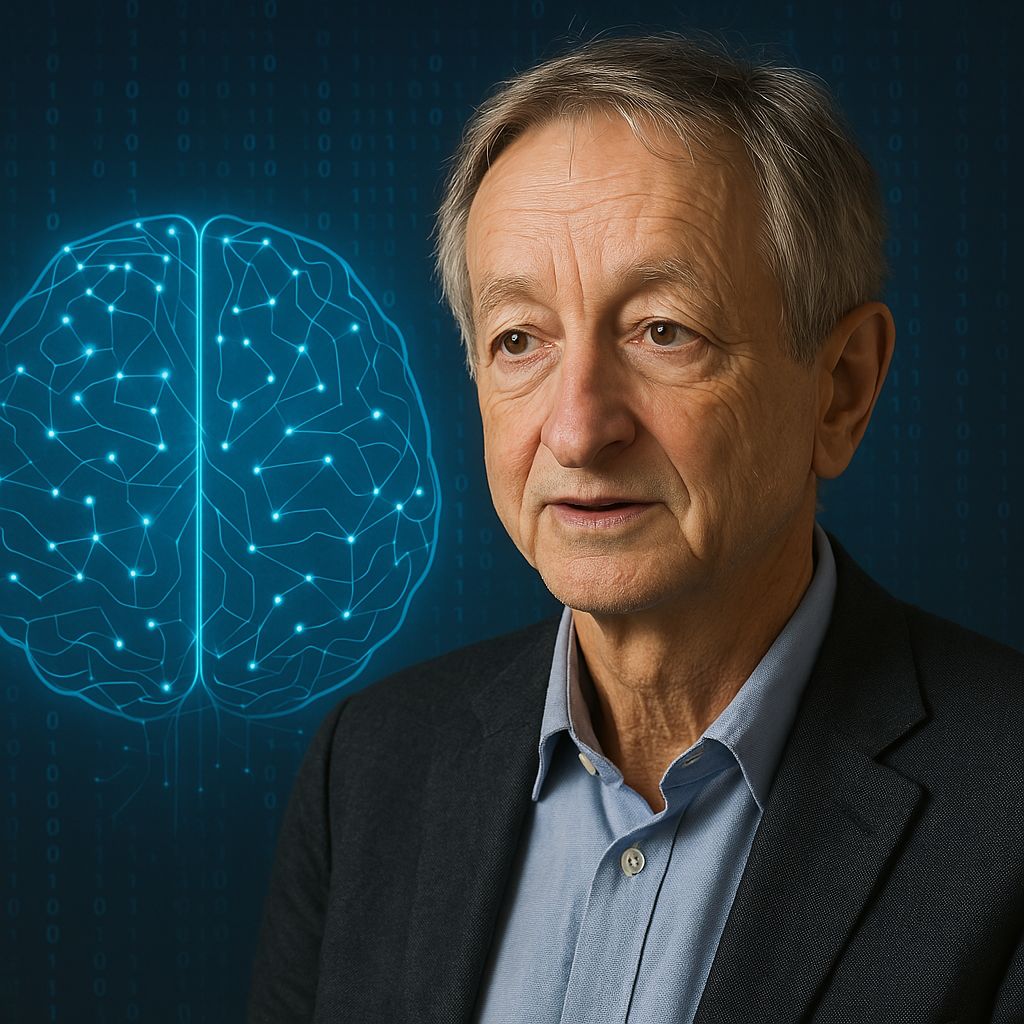
Geoffrey Hinton, often hailed as the “Godfather of AI,” is not just a pioneering scientist in artificial intelligence—he is a man with a story deeply shaped by legacy, personal struggle, and emotional insight. While the world knows him for his contributions to machine learning and neural networks, few appreciate the human journey that shaped his intellect and vision.
A Lineage of Brilliance
Hinton’s ancestry reads like a chapter from the history of ideas. He is the descendant of George Boole, the 19th-century mathematician whose Boolean logic laid the foundation of modern computing. Another ancestor, George Everest, lent his name to the world’s highest peak after leading the Great Trigonometrical Survey of India. With such towering figures in the family tree, the expectations on Hinton were immense.
But for young Geoffrey, these lofty legacies were less a source of inspiration and more a shadow cast by a domineering father. The emotional weight of living up to inherited greatness shaped much of his early life. Walking down the driveway to school, he often found himself clinging to the hope that one day, he might understand people—and perhaps even himself—better.
A Scholar of Minds, Machines, and Memory
Despite a troubled relationship with his father, Hinton eventually built a legacy in his own right—quietly, methodically, and brilliantly. Today, at 75, he is Professor Emeritus at the University of Toronto and has amassed more academic citations than his father ever did—a quiet triumph not of competition, but of self-actualization.
Some of Hinton’s work has helped shape generative AI tools like Google’s Bard, which stunned the world with its ability to craft compelling narratives from just a few prompts. One such instance involved generating a powerful short story from Ernest Hemingway’s famous six-word challenge: “For sale: baby shoes, never worn.” The AI built an emotional tale of a couple’s grief, miscarriage, and healing through the symbolic gesture of a gift—a deeply human story generated by a machine, but rooted in the nuances Hinton’s research helped unlock.
Hinton’s reaction? “I am rarely speechless,” he admitted. The ability of machines to evoke such emotion left even him confounded—a man who spent decades trying to make machines think, now watching them begin to feel, or at least mimic it with astonishing accuracy.
Reasoning and Responsibility
While the brilliance of generative AI is awe-inspiring, Hinton is also one of its most vocal critics and ethical thinkers. He recognizes the double-edged nature of this technological leap. Language models, trained on vast data sets, may seem “language-wise,” but they can also hallucinate, misinform, or reinforce bias. And as they become increasingly integrated into education, communication, and even therapy, the need for responsible AI becomes more urgent than ever.
Hinton’s journey teaches us that brilliance is not just in logic or language—but in empathy, humility, and understanding complexity. His own emotional life, shaped by personal challenges, appears to have given him a deeper grasp of what makes machines not just intelligent—but meaningful.
A Legacy Reimagined
As he steps back from active research, Geoffrey Hinton leaves behind not just papers and algorithms, but a philosophical roadmap. He invites us to think not just about what AI can do, but what it should do. And in doing so, he transforms his family’s legacy from a pressure-filled peak into a platform for broader, more compassionate intelligence.
In the end, Hinton’s story reminds us that the most powerful algorithms are still rooted in the most human of questions: Who are we? What do we want to become? And how do we carry the past into the future—wisely, responsibly, and with feeling?
 "Connecting communities, empowering nations: Unifying the Regional and Global Economy ."
Leave a comment