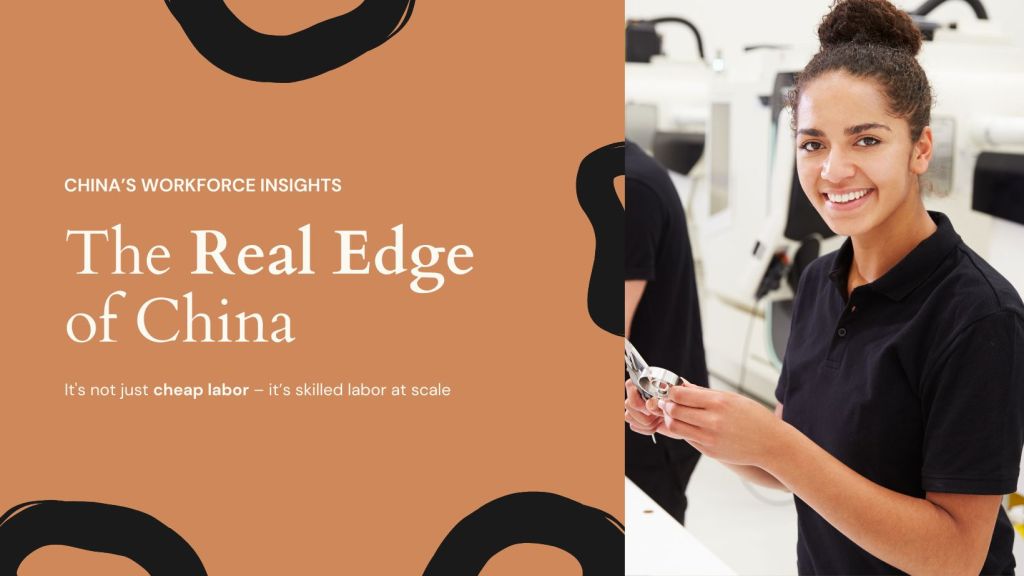
For decades, the global narrative around China’s economic rise has centered around the idea of cheap labor. Western businesses, policymakers, and economists have often attributed China’s dominance in manufacturing and export-led growth to its low-cost workforce. However, while competitive wages may have played a role initially, this perspective oversimplifies the real reason behind China’s industrial success.
The true engine of China’s economic power lies not in cheap labor but in its massive pool of skilled workers. In fact, China’s competitive advantage today rests more on productivity, expertise, and innovation than mere cost efficiency.
The Shift from Cost to Capability
In the early 2000s, low labor costs were undoubtedly an attractive factor for foreign companies setting up factories in China. But as wages gradually rose, instead of losing ground to other low-cost nations like Vietnam or Bangladesh, China strengthened its hold on global manufacturing. Why?
China wasn’t just producing cheap products – it was producing complex, high-quality goods at an unmatched scale. This shift underscores the importance of skills, infrastructure, and technological advancements over raw labor cost.
Skilled Workforce: The Hidden Powerhouse
1. Technical and Vocational Education
China has heavily invested in vocational education and technical training. The government launched numerous initiatives to develop a workforce that aligns with the needs of modern industries – from electronics and automotive manufacturing to robotics and green energy. By 2020, over 23 million students were enrolled in vocational programs.
This focus has created a workforce that isn’t just large but highly skilled in fields like precision engineering, assembly, and advanced manufacturing.
2. Manufacturing Ecosystem and Knowledge Transfer
China’s industrial zones have become learning hubs. The sheer scale of production means that Chinese workers gain hands-on experience at an extraordinary rate. Moreover, foreign direct investments (FDI) brought knowledge transfer and training programs, accelerating the development of local expertise.
The clustering of industries in regions like Shenzhen and Guangzhou has enabled cross-sector learning and facilitated vertical integration of supply chains. This environment not only enhances efficiency but also cultivates a workforce capable of managing complex production processes.
3. STEM Education and Innovation
China produces more science, technology, engineering, and mathematics (STEM) graduates than any other country. In 2021 alone, China produced nearly 4.7 million STEM graduates, compared to around 800,000 in the U.S. This focus on technical education feeds directly into the country’s growing industries, making its labor force highly adaptable and innovative.
Beyond Manufacturing: High-Skilled Sectors
China’s prowess is no longer confined to basic assembly-line production. The country has emerged as a leader in industries such as:
Semiconductors
Electric vehicles (EVs)
Telecommunications (e.g., Huawei, ZTE)
Renewable energy
Artificial Intelligence (AI)
These sectors require cutting-edge skills and advanced problem-solving abilities, proving that China’s competitive edge extends far beyond low-cost labor.
Why Companies Continue to Choose China
Despite rising wages, global companies continue to operate in China because:
1. Efficiency Gains: Skilled workers reduce errors, increase production speed, and improve quality – saving companies more in the long run than they might save by shifting to lower-wage but less efficient labor markets.
2. Infrastructure: China’s world-class infrastructure – including ports, roads, and logistics networks – ensures smooth supply chain operations.
3. Scale and Speed: Skilled workers can quickly scale up production, a vital asset in industries like electronics, where speed-to-market is crucial.
4. Innovation Ecosystem: Proximity to skilled engineers and designers helps companies iterate and innovate faster.
The Future: Upskilling and Automation
China is now moving toward Industry 4.0, focusing on automation, robotics, and smart factories. Even as automation reduces the reliance on manual labor, the need for skilled technicians, engineers, and software developers will only grow.
The Chinese government has set ambitious goals to develop 150 million high-skilled workers by 2025, ensuring that the country remains competitive in advanced manufacturing and technology.
Conclusion: The Real Competitive Advantage
The next time someone attributes China’s dominance to cheap labor, it’s worth correcting the record. The real story behind China’s success is one of massive investment in skills, education, and industrial capability.
China’s rise as the world’s factory was not just about low costs – it was about building an ecosystem of skilled talent capable of driving complex, large-scale production. And that’s a much harder advantage for any competitor to replicate.
 "Connecting communities, empowering nations: Unifying the Regional and Global Economy ."
Leave a comment