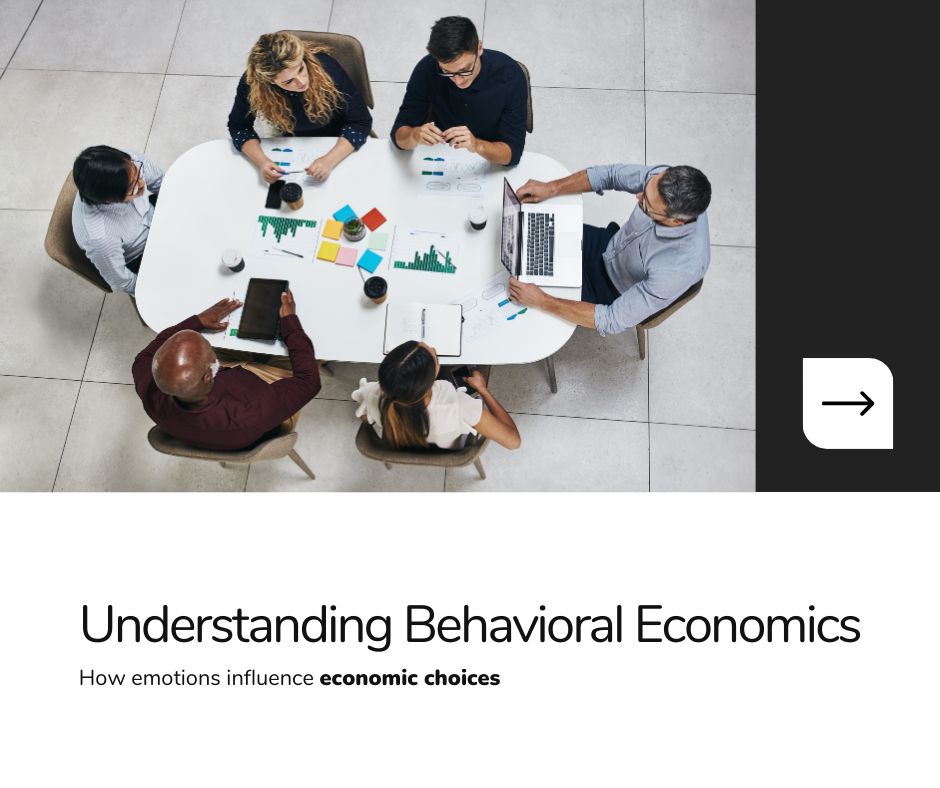
Economic decision-making has traditionally been viewed as a rational process where individuals weigh the pros and cons to make choices that maximize their utility. However, the growing field of behavioral economics has shown that decision-making is not always so logical. Psychological factors—ranging from cognitive biases and social influences to emotions—often play significant roles, leading people to act in ways that defy classical economic predictions. Behavioral economics is changing how economists and policymakers think about economic behavior, providing new insights into why people make the choices they do and how policies can be designed to better guide decision-making.
The Foundation of Behavioral Economics
Behavioral economics combines psychology and economics to explain how real people, with all their complexities, make economic decisions. Traditional economic models, based on the assumption of rationality, often fail to capture behaviors such as impulse buying, under-saving for retirement, or even procrastination on health screenings. Behavioral economics investigates these behaviors to reveal how biases like overconfidence, loss aversion, and social proof impact decision-making.
For example, loss aversion—the idea that people fear losses more than they value gains—explains why investors might avoid selling a stock at a loss, even when doing so might prevent further losses. Another concept, status quo bias, illustrates why individuals often stick to familiar choices, even if better options are available.
Behavioral Economics in Policy
In recent years, behavioral economics has been applied in policy to nudge people toward better choices without restricting their freedom. For instance, policymakers worldwide have used “nudges,” subtle interventions designed to influence behavior, to improve public outcomes.
A famous example of behavioral policy is the automatic enrollment in retirement savings plans. Instead of requiring individuals to opt-in to a savings program, employers set the default to automatic enrollment, with the option to opt-out. This approach leverages inertia—people’s tendency to stick with the status quo—and has significantly increased participation rates in retirement savings programs.
Similarly, in healthcare, simple adjustments like reordering organ donation registration forms so that people must opt-out instead of opting in have dramatically increased donor rates. These policies do not eliminate choice but make the preferable choice the easiest one to adopt.
How Psychological Factors Influence Economic Decisions
1. Framing Effect: The way information is presented can significantly alter people’s decisions. A study found that labeling a tax as a “carbon offset” led more people to accept it, compared to when it was labeled as a “tax” on emissions. This framing effect has implications for how policymakers design communications to shape public opinion on taxes and spending.
2. Anchoring Bias: People tend to rely heavily on the first piece of information they see, known as an anchor. For example, when shown an initial price for a product, consumers often compare all subsequent prices against that anchor, even if it isn’t representative. Retailers use this by showing a high initial price before offering discounts, which makes consumers perceive the final price as a bargain.
3. Herd Mentality: Behavioral economists have observed that individuals are often influenced by the actions and decisions of others. This is seen in stock market bubbles, where investors continue to buy overvalued stocks simply because others are doing so, rather than basing their decisions on fundamental valuations. Herd behavior also affects public policy outcomes; when people see widespread compliance with a new policy, they are more likely to follow it themselves.
Limitations
While behavioral economics offers valuable insights, it also faces criticism. One concern is that nudging could lead to manipulation, especially when policymakers or companies use these techniques to influence choices that benefit them more than individuals. Transparency and ethical considerations are essential when designing behavioral policies to ensure that they genuinely serve the public interest.
Another limitation is that behavioral interventions may not always produce uniform results. Nudges that work well in one cultural or socioeconomic context may not work in another. For example, a nudge promoting savings might be effective in high-income countries but have limited impact in low-income settings, where people may not have surplus income to save.
Finally, critics argue that behavioral economics, while helpful, cannot replace traditional economics. Psychological factors are just one layer of decision-making, and purely behavioral interventions may not address root causes, such as economic inequality, that deeply influence financial behaviors.
Behavioral Economics and Development
In the realm of economic development, behavioral insights are being applied to tackle poverty, improve education outcomes, and promote health in low- and middle-income countries. For instance, cash transfers conditioned on health check-ups or school attendance have been shown to improve health and education outcomes in developing countries by addressing barriers to behavior change.
One interesting development project used behavioral economics to increase vaccination rates. Researchers found that simply providing small rewards, like lentils, to families who brought their children for vaccinations significantly boosted participation. This small nudge helped overcome behavioral barriers like procrastination and mistrust.
Future of Behavioral Economics
Behavioral economics has brought a paradigm shift to economic policy and decision-making. As technology and data analytics continue to evolve, the ability to analyze individual behaviors and predict decision-making patterns will likely improve, leading to even more targeted interventions. However, maintaining ethical standards will be essential as these techniques grow more powerful and are applied on a broader scale.
By combining behavioral economics with traditional policy tools, policymakers have a unique opportunity to drive meaningful, positive change. While challenges and ethical considerations remain, the potential for behavioral economics to shape better outcomes for individuals and societies cannot be overlooked.
Behavioral economics has shown us that economic decision-making is more than a matter of rational choice—it’s influenced by human nature. Recognizing and integrating this reality into economic models allows us to build a world that better serves everyone’s needs.
 "Connecting communities, empowering nations: Unifying the Regional and Global Economy ."
Leave a comment