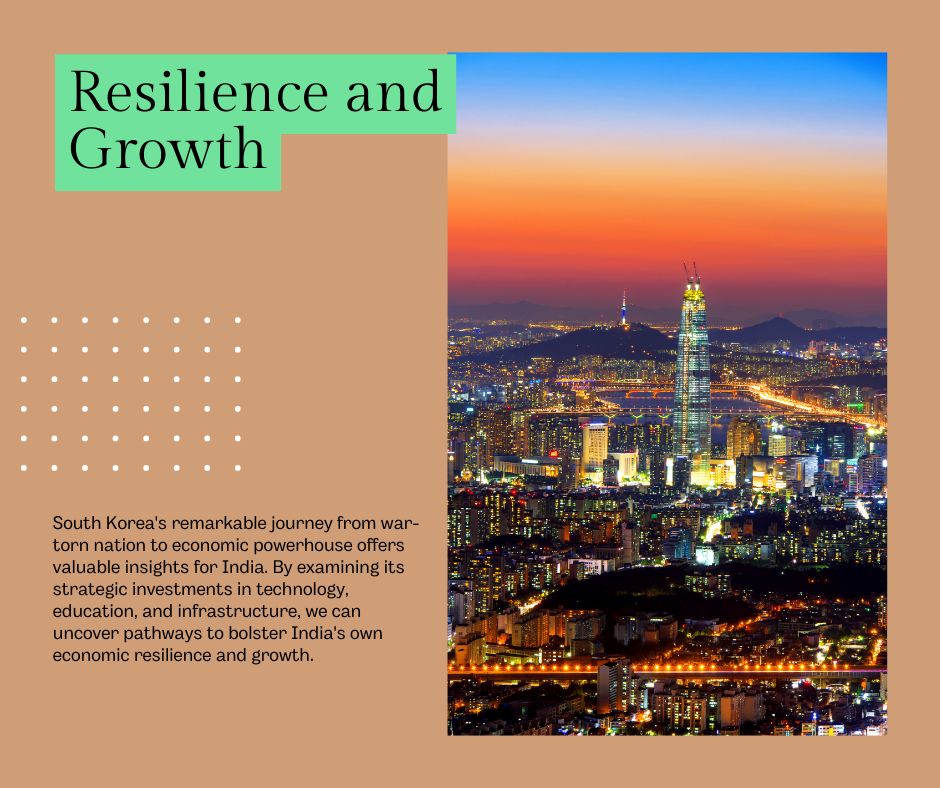
Resilience is a critical trait for any economy seeking sustainable growth, yet not all economies possess it equally. For India, fostering resilience is essential to navigating global uncertainties and achieving long-term economic success. By examining the key factors behind the economic resilience of South Korea’s manufacturing sector, India can learn valuable lessons on strengthening its own economic fabric, particularly in manufacturing and exports, to drive persistent growth.
South Korea’s Economic Resilience: Key Drivers
South Korea’s economy, often dubbed a ‘miracle,’ owes much of its resilience to its manufacturing sector. Over the decades, the country has systematically focused on innovation, export-oriented growth, and industrial diversification. Here are some of the major reasons behind South Korea’s manufacturing success:
1. Technological Innovation and R&D Investment: South Korea has consistently invested in technological advancements, making it a leader in sectors such as electronics, automobiles, and shipbuilding. According to data from the OECD, South Korea invests over 4.5% of its GDP in research and development (R&D), one of the highest rates in the world. This focus on innovation allows South Korean companies like Samsung, Hyundai, and LG to remain competitive on the global stage.
2. Government Support and Industrial Policy: The South Korean government has played a pivotal role in nurturing industries through targeted policies and financial support. Industrial policies encouraged the development of high-tech sectors, while trade agreements facilitated global market access. This alignment between the government and industry has ensured a rapid response to global economic shifts and has reinforced the sector’s stability.
3. Skilled Labor Force: A well-educated and skilled labor force has been central to South Korea’s manufacturing prowess. With high literacy rates and a strong emphasis on technical education, the country has cultivated a workforce capable of adapting to new technologies and processes. The availability of skilled labor has been instrumental in ensuring that industries remain efficient and productive.
4. Export-Led Growth: South Korea’s resilience is also tied to its export-driven economy. As of 2022, exports accounted for approximately 42% of the country’s GDP. The manufacturing sector is responsible for a significant portion of this, with key exports including semiconductors, automobiles, and machinery. South Korea’s ability to tap into global markets has provided a buffer against domestic economic downturns, helping it maintain consistent GDP growth.
5. Diversified Industrial Base: While South Korea excels in electronics and automobiles, its industrial base is well-diversified, which has helped mitigate risks associated with over-dependence on a single sector. The country’s competitiveness in various industries allows it to remain resilient in the face of changing global demands.
Lessons for India’s Economic Resilience
India, while experiencing robust growth in recent years, still faces challenges in building an equally resilient economy, especially in the manufacturing sector. The key to fostering resilience lies in addressing certain structural issues and drawing on lessons from South Korea’s experience:
1. Investing in R&D and Innovation: India’s current investment in R&D hovers around 0.7% of GDP, significantly lower than South Korea’s. For India to build a competitive edge, it must increase public and private investment in technological innovation, focusing on sectors such as electronics, clean energy, and pharmaceuticals. The government’s ‘Make in India’ initiative is a step in the right direction, but it needs stronger backing in terms of innovation and technology upgradation.
2. Skilling the Workforce: South Korea’s skilled workforce highlights the need for India to invest in quality education and vocational training programs. India’s demographic advantage, with one of the youngest populations in the world, can be converted into economic strength if the workforce is equipped with relevant skills. Initiatives like Skill India must be expanded to cover a broader range of industries.
3. Promoting Export-Oriented Growth: While India has made strides in increasing exports, the contribution of manufacturing to GDP still lags. In 2022, manufacturing accounted for just about 17% of India’s GDP, far behind South Korea’s. Strengthening the manufacturing sector through incentives for exporters, reducing trade barriers, and improving logistics infrastructure will be crucial for India to become a manufacturing powerhouse.
4. Government-Industry Alignment: The collaboration between government and industry in South Korea has been instrumental in building resilience. In India, policy inconsistency and bureaucratic delays have often hindered industrial growth. Streamlining processes and creating a more business-friendly environment are essential for fostering trust and collaboration between the government and the private sector.
5. Diversification of Manufacturing Base: Like South Korea, India needs to diversify its manufacturing base. Over-reliance on a few industries, such as textiles and pharmaceuticals, exposes the economy to sector-specific downturns. By expanding into emerging industries such as electric vehicles, advanced manufacturing, and renewable energy, India can build a more resilient and adaptable industrial sector.
South Korea’s Manufacturing Power
To underscore the role of manufacturing in South Korea’s economy, data shows that:
Manufacturing Value Added: As per the World Bank, manufacturing contributes around 27% to South Korea’s GDP, compared to around 17% for India.
Export Share: South Korea’s exports of goods and services represent 42% of its GDP, while India’s is approximately 19%. The concentration of high-tech goods in South Korea’s export portfolio further drives its competitive advantage.
Productivity Growth: In terms of labor productivity, South Korea outpaces many advanced economies, with the manufacturing sector contributing significantly to this trend.
The resilience of South Korea’s economy, particularly its manufacturing sector, provides a roadmap for India as it seeks to enhance its own economic stability and growth. By focusing on innovation, skilling, exports, and diversification, India can build a manufacturing sector capable of driving persistent economic growth in the face of global competition. With the right policies and investments, India can unlock its potential and become a resilient, competitive force on the global stage.
 "Connecting communities, empowering nations: Unifying the Regional and Global Economy ."
Leave a comment