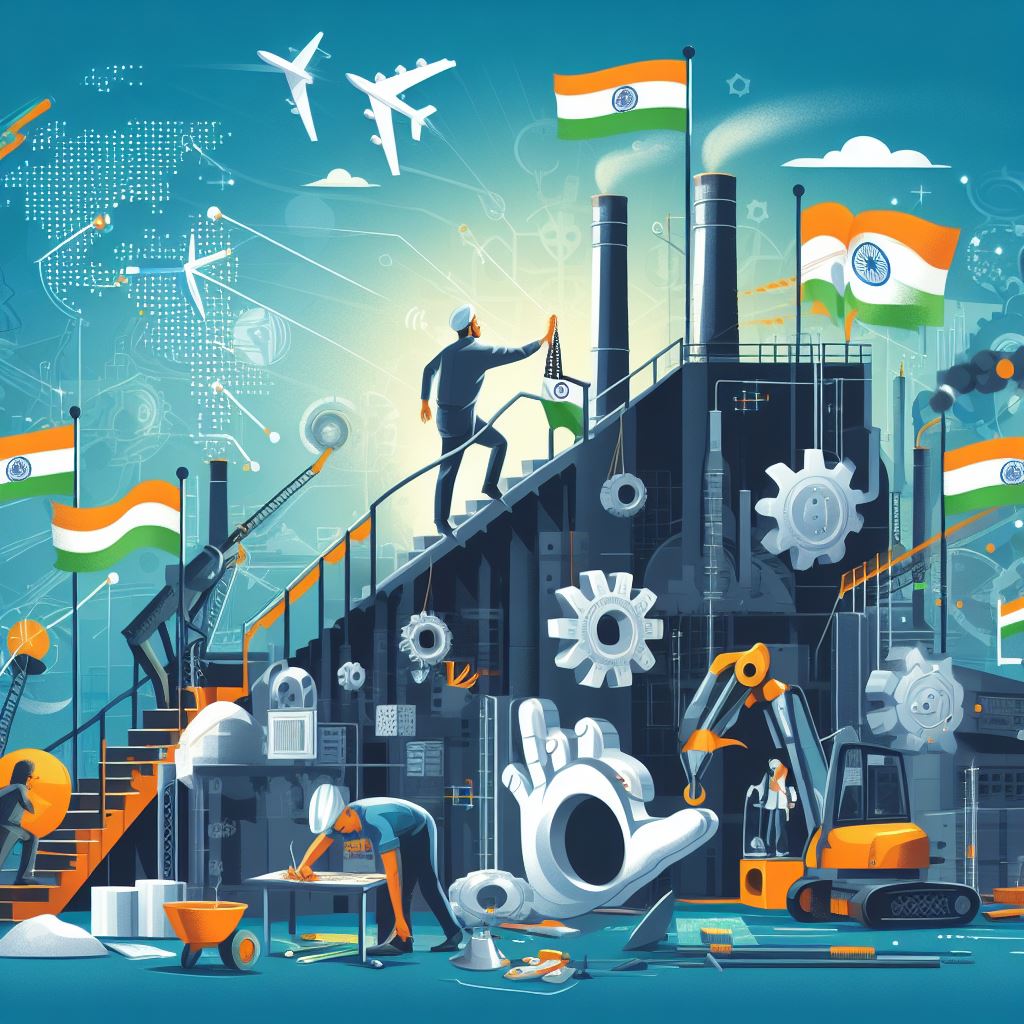
India’s industrial policy plays a crucial role in shaping the country’s manufacturing sector, ultimately contributing to its economic growth and development. It is a set of standards and measures implemented by the government to influence the ownership, structure, and performance of industries. The main objectives of India’s industrial policy are to ensure sustained productivity growth, generate gainful employment, optimize the use of human resources, achieve international competitiveness, and position India as a prominent player in the global arena.
Over the years, India’s industrial policy has evolved to address the changing needs and priorities of the country. Several milestones have marked the progression of India’s industrial policy:
1. Industrial Policy Resolution of 1948: This resolution outlined the role of the state in industrial development, establishing a mixed economic model for India. Industries were categorized into four groups based on the degree of state intervention and regulation.
2. Industrial Policy Resolution of 1956: This policy revision emphasized the expansion of the public sector, the development of a growing cooperative sector, and the prevention of private monopolies. It classified industries into three sectors based on ownership patterns: public sector, mixed sector, and private sector.
3. Industrial Policy Statement of 1977: Building on the 1956 policy, this statement focused on decentralization, the promotion of small-scale industries, and restrictions on multinational companies. Its main objective was employment generation and the reduction of wealth concentration.
4. Industrial Policy Statement of 1980: This statement recognized the need for promoting domestic market competition, modernization, selective liberalization, and technological upgradation. It acknowledged the role of the private sector in accelerating industrial growth.
5. Industrial Policy Statement of 1991: This policy marked a significant shift towards economic reforms. It aimed at deregulation, de-licensing, privatization, globalization, and market orientation. The public sector’s role was limited to strategic and core industries, while sectors were opened up for foreign investment and technology transfer.
6. New Industrial Policy for New India: The latest initiative by the Indian government aims to boost manufacturing in the country and position India as a global manufacturing hub. It includes measures such as ease-of-doing-business, production-linked incentives (PLIs), tariff protection, sectoral missions, and infrastructure development. The objective is to create jobs and enhance India’s competitiveness in the global market.
Despite India’s ambitious industrial policy framework, it faces various challenges in the context of global industrial development. These challenges include:
1. Navigating economic headwinds: The COVID-19 pandemic has disrupted global trade and demand, posing challenges to industrial growth. India needs to revive domestic demand and explore new export markets to sustain economic momentum.
2. Supply chain instability: The pandemic has exposed vulnerabilities in global supply chains, particularly in sectors like electronics, pharmaceuticals, and automobiles. India must diversify sources of inputs, develop domestic capabilities, and reduce dependence on foreign suppliers.
3. Inflationary pressures: Rising prices of raw materials, energy, and transportation increase cost pressures on industries. India needs to manage inflation expectations, improve productivity, and enhance efficiency to remain competitive.
4. Technological advancements: Rapid advancements in technologies like artificial intelligence, robotics, and biotechnology present both opportunities and threats to industries. India must invest in research and development, innovation, skill development, and digital infrastructure to leverage these technologies for industrial transformation.
5. Sustainable manufacturing: Growing awareness of environmental and social issues necessitates the adoption of green and inclusive practices. India needs to embrace cleaner and circular production methods, reduce its carbon footprint, improve resource efficiency, and ensure social responsibility in industrial activities.
To address these challenges, India’s industrial policy should focus on creating a favorable business environment, investing in infrastructure, promoting research and development, enhancing skill development programs, and fostering collaboration between academia and industry. Furthermore, effective implementation, monitoring, and evaluation of industrial policies are crucial for achieving desired outcomes.
In conclusion, India’s industrial policy is a key instrument in shaping the manufacturing sector, driving economic growth, and fostering the nation’s development. While it has witnessed significant reforms and adaptations over time, new challenges continue to emerge in the global industrial landscape. By addressing these challenges and focusing on sustainable and inclusive industrial growth, India can strengthen its position as a major player in the global economy.
References:
1. Das, M., & Das, B. (2022). New industrial policy for New India. The Hindu BusinessLine. Retrieved from https://www.thehindubusinessline.com/opinion/new-industrial-policy-for-new-india/article66433347.ece
2. Industrial Policy Resolution. (2022). Indian Industry Knowledge Centre. Retrieved from https://www.indianikc.com/kc/industrial-policy-resolution/#:~:text=Maintain%20sustained%20growth%20in%20productivity,%20enhance%20gainful%20employment,%20attain%20international%20competitiveness,%20and%20transform%20India%20into%20a%20major%20partner%20and%20player%20in%20the%20global%20arena
3. Top-7 Manufacturing Challenges for 2023. aPriori. Retrieved from https://www.apriori.com/blog/top-7-manufacturing-challenges-for-2023/
4. 5 Key Manufacturing Challenges (And What to Do About Them). Weidert. Retrieved from https://www.weidert.com/blog/key-manufacturing-challenges
5. What are the 10 biggest global challenges? World Economic Forum. Retrieved from https://www.weforum.org/agenda/2016/01/what-are-the-10-biggest-global-challenges/
6. Industrial Development Report 2022. UNIDO. Retrieved from https://www.unido.org/sites/default/files/files/2021-11/IDR%202022%20-%20EBOOK.pdf
7. 2023 Manufacturing Industry Outlook. Deloitte US. Retrieved from https://www2.deloitte.com/us/en/pages/energy-and-resources/articles/manufacturing-industry-outlook.html
 "Connecting communities, empowering nations: Unifying the Regional and Global Economy ."
Leave a comment