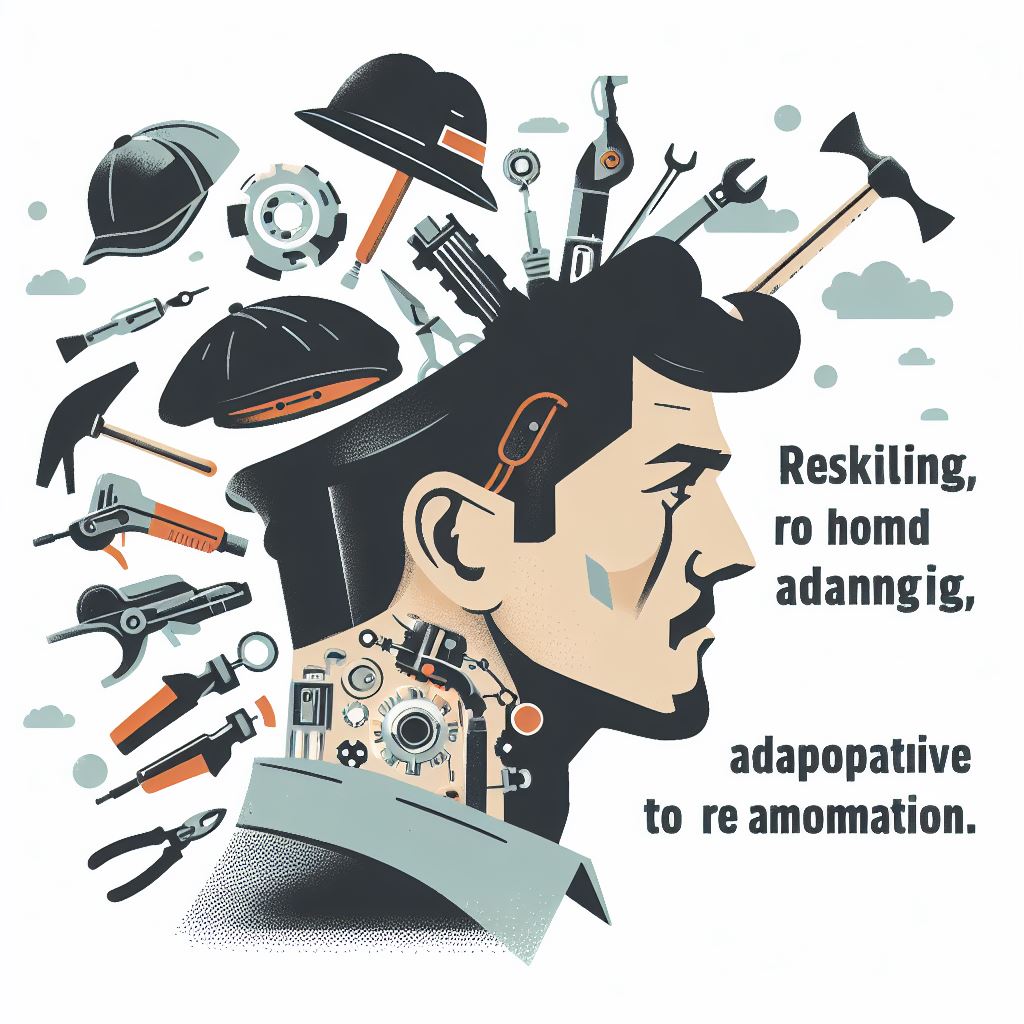
Automation is transforming the world of work, creating new opportunities and challenges for workers, employers, and society. According to a recent report by McKinsey Global Institute, as many as 375 million workers may need to switch occupational categories by 2030 due to the impact of automation and digitization¹. This means that millions of people will have to learn new skills and adapt to new roles in order to remain employable and productive.
Reskilling and upskilling are crucial for enabling workers to cope with these changes and to seize the benefits of automation. Reskilling refers to acquiring new skills that are different from one’s current occupation, while upskilling refers to enhancing one’s existing skills or learning new ones within the same occupation². Both types of skill development can help workers transition to new jobs, increase their value in the labor market, and improve their career prospects.
There are many benefits of reskilling and adapting to automation, both for individuals and for organizations. For individuals, reskilling and upskilling can:
Increase employability and income
– Workers who have relevant skills that are in high demand can access more job opportunities, earn higher wages, and enjoy greater job security³.
– Enhance personal growth and satisfaction. Workers who learn new skills can expand their horizons, discover new interests, and achieve their potential⁴. Learning can also boost one’s confidence, motivation, and happiness⁵.
– Contribute to social good. Workers who reskill and upskill can help address skill gaps and shortages in the economy, support innovation and productivity, and reduce inequality and poverty⁶.
For organizations, reskilling and upskilling can:
– Improve performance and competitiveness. Organizations that invest in their human capital can enhance their efficiency, quality, innovation, and customer satisfaction. They can also gain a competitive edge by having a skilled and agile workforce that can adapt to changing market needs.
– Reduce costs and risks. Organizations that reskill and upskill their workers can avoid the costs and challenges of hiring new talent, such as recruitment, training, turnover, and integration. They can also reduce the risks of losing talent, customers, or market share due to skill obsolescence or mismatch.
– Enhance reputation and loyalty. Organizations that reskill and upskill their workers can demonstrate their commitment to their employees’ well-being, development, and career progression. This can improve their reputation as an employer of choice, attract and retain talent, and increase employee engagement and loyalty.
However, reskilling and adapting to automation are not easy tasks. They require a collective effort from various stakeholders, such as workers, employers, educators, policymakers, and society at large. Some of the challenges and barriers that need to be overcome include:
– Lack of awareness and motivation. Many workers may not be aware of the impact of automation on their jobs or the need for reskilling. They may also lack the motivation or confidence to pursue learning opportunities due to various factors such as time constraints, financial costs, personal preferences, or fear of failure.
– Lack of access and opportunity. Many workers may not have access to quality and affordable learning opportunities that are relevant to their needs or aspirations. They may also face barriers such as limited availability, flexibility, or recognition of learning programs or providers.
– Lack of support and guidance. Many workers may not receive adequate support or guidance from their employers or other sources to help them identify their skill gaps, choose appropriate learning paths, or apply their new skills in practice. They may also encounter resistance or discrimination from their managers or peers due to stereotypes or biases about certain skills or occupations.
To address these challenges and barriers, various actions and interventions are needed at different levels. Some examples are:
– At the individual level: Workers need to take ownership of their own learning and career development by assessing their current skills, identifying their learning goals, seeking relevant learning opportunities, applying their new skills in practice, and updating their skills regularly.
– At the organizational level: Employers need to take responsibility for developing their human capital by creating a culture of learning within their organizations, providing access to quality and affordable learning opportunities for their workers, supporting them throughout their learning journeys, rewarding them for their achievements, and facilitating their transitions to new roles.
– At the societal level: Educators need to provide lifelong learning opportunities that are aligned with the changing labor market demands by offering flexible, diverse, inclusive, and innovative learning programs that cater to different learners’ needs, preferences, styles, and backgrounds. Policymakers need to provide an enabling environment for reskilling
and upskilling by establishing clear standards, regulations, incentives,
and partnerships that support the quality, accessibility, affordability, and recognition of learning opportunities for all workers. Society at large needs to foster a positive attitude towards reskilling and upskilling by raising awareness, promoting dialogue, and challenging stereotypes and biases about certain skills or occupations.
In conclusion, reskilling and adapting to automation are essential for the future of work. They can bring many benefits for workers, employers, and society, but they also pose many challenges and barriers that need to be overcome. By working together, we can shape a future where humans and machines collaborate to create a more productive, innovative, and equitable society.
Citations
(1) Retraining and reskilling workers in the age of automation. https://www.mckinsey.com/featured-insights/future-of-work/retraining-and-reskilling-workers-in-the-age-of-automation.
(2) Automation, reskilling, and the changing world of work – McKinsey & Company. https://www.mckinsey.com/featured-insights/themes/automation-reskilling-and-the-changing-world-of-work.
(3) Automation and Reskilling Are Critical for Employee and Business …. https://bing.com/search?q=The+importance+of+reskilling+and+adapting+to+automation.
(4) The Future of Work in the Age of AI: Job Disruption, Reskilling, and …. https://www.techopedia.com/the-future-of-work-in-the-age-of-ai.
(5) Automation and Reskilling Are Critical for Employee and Business …. https://hrdailyadvisor.blr.com/2020/06/15/automation-and-reskilling-are-critical-for-employee-and-business-success/.
(6) How Automation and Reskilling Can Boost Employees’ Careers. https://www.spiceworks.com/hr/talent-management/guest-article/how-automation-and-reskilling-can-boost-employees-careers-and-your-bottom-line/.
 "Connecting communities, empowering nations: Unifying the Regional and Global Economy ."
Leave a comment